Disclosure: This page contains affiliate links. As an Amazon Associate, Yard Foundry earns from qualifying purchases.
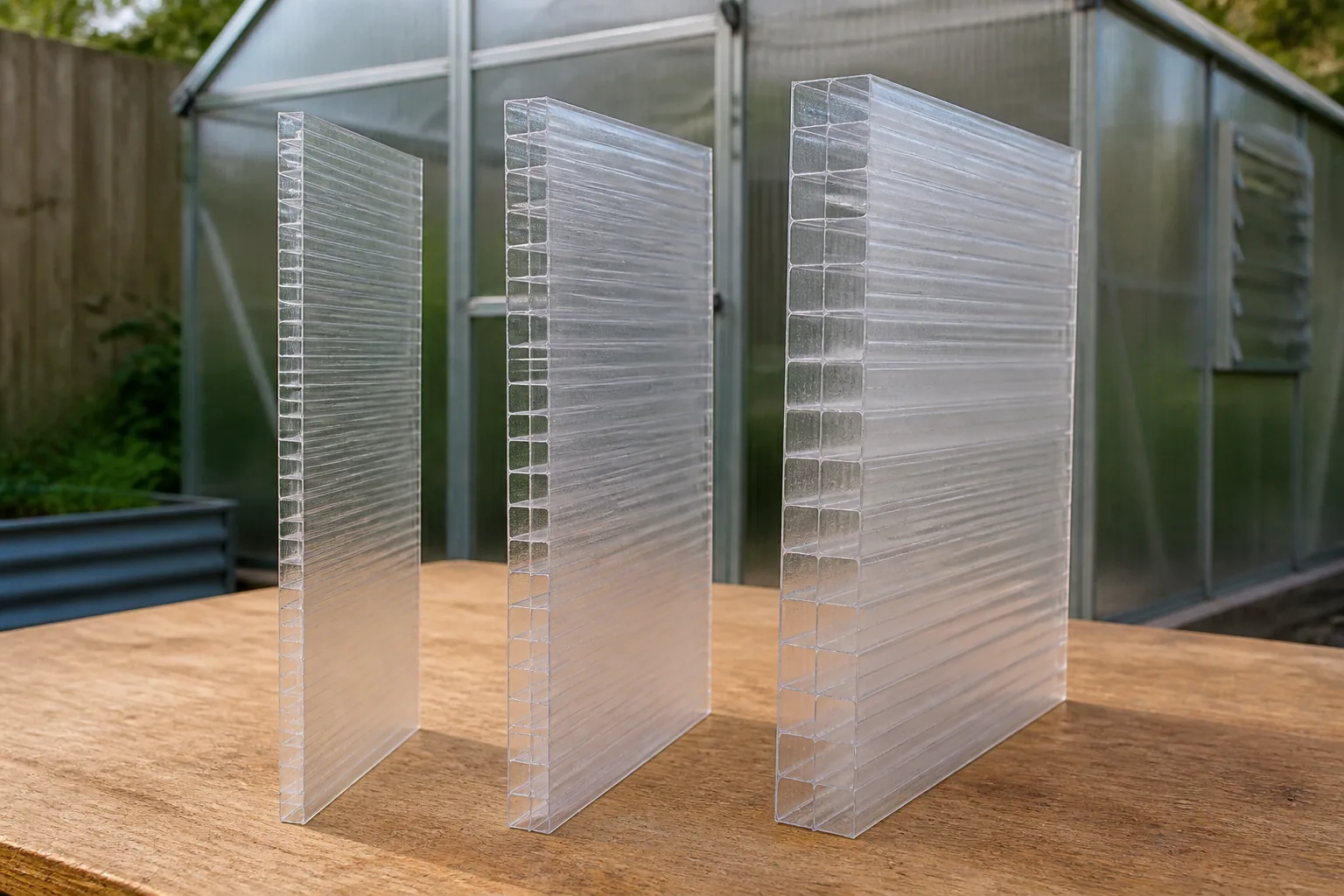
Greenhouse polycarbonate thickness should match the frame, support spacing, climate, heating plan, and the exact panel system. Six-millimeter twin-wall panels often suit compact seasonal houses with close supports. Eight-millimeter panels can add stiffness and insulation without a major frame change. Sixteen-millimeter multiwall panels are better candidates for cold or heated greenhouses, but only when the frame channels, bend radius, fasteners, and load documents accept them. Thicker is not automatically compatible.
This is a research based glazing guide. Yard Foundry has not laboratory tested these panels or approved a substitution for any greenhouse. Use the greenhouse manual, panel technical sheet, local load requirements, and manufacturer guidance for the final choice.
Why greenhouse polycarbonate thickness is only one variable
Multiwall polycarbonate traps air in channels between thin faces. A deeper panel may contain taller channels, more internal walls, or a more complex rib pattern. Those changes affect heat flow, stiffness, weight, light transmission, condensation behavior, and the profiles needed to hold the sheet.
Two panels sold at the same nominal thickness can still differ. Resin quality, ultraviolet protection, face thickness, rib spacing, internal geometry, surface treatment, manufacturing tolerance, and warranty all matter. Compare current technical sheets, not thickness labels alone.
The University of California, Davis greenhouse glazing overview describes how glazing materials differ in light transmission, durability, heat loss, and construction needs. Those broad principles help frame the choice, but the exact numbers must come from the current panel manufacturer.
If you are choosing a complete structure rather than replacement sheets, start with our polycarbonate greenhouse kit guide. A kit should be judged as a frame, glazing, hardware, base, and support system, not as a loose panel specification.
How 6 mm, 8 mm, and 16 mm panels usually differ
| Nominal thickness | Common role | Main question before buying |
|---|---|---|
| 6 mm | Compact seasonal greenhouse, cold frame, or replacement in a light kit | Does the support spacing meet the sheet maker’s wind and snow table? |
| 8 mm | General hobby greenhouse needing more stiffness or thermal resistance | Will existing channels, caps, fasteners, and bends fit the thicker sheet? |
| 16 mm | Heated or cold-climate greenhouse with a frame designed for multiwall glazing | Was the complete structure engineered and detailed for this panel? |
This is a comparison of typical roles, not a universal rating. A well-supported 6 mm panel can outperform a poorly installed thicker sheet. A 16 mm panel in a channel made for 8 mm material may never seat, seal, or expand correctly.
Ask for thermal transmittance or U-factor and light-transmission data from the same technical sheet. A lower U-factor indicates less heat transfer under the stated test conditions. Do not mix an insulation value from one product with the light-transmission value of another product that merely shares its thickness.
Match support spacing to wind and snow
Panel stiffness and support spacing work together. A sheet spanning farther between rafters or purlins deflects more under wind and snow. Manufacturers often publish tables that relate sheet type, spacing, panel orientation, and design load. The table for the exact product matters more than a retailer’s generic claim.
Washington State University’s greenhouse construction and management guidance emphasizes the connection between structure, covering, climate, and operation. The glazing does not create a snow rating on its own. Loads continue through profiles, rafters, posts, base, anchors, and foundation.
Confirm that the channels run in the required direction, commonly down the roof slope so condensation can drain. Check maximum sheet size, edge support, intermediate support, screw spacing, washer type, and limits on drilling through the panel. Do not add fasteners casually. A tight screw can crush a flute and prevent thermal movement.
The foundation also keeps the frame square enough for rigid sheets and doors to fit. Review the greenhouse foundation options before upgrading a kit that already binds or racks. A thicker panel will not correct a twisted base.
Check every profile before increasing thickness
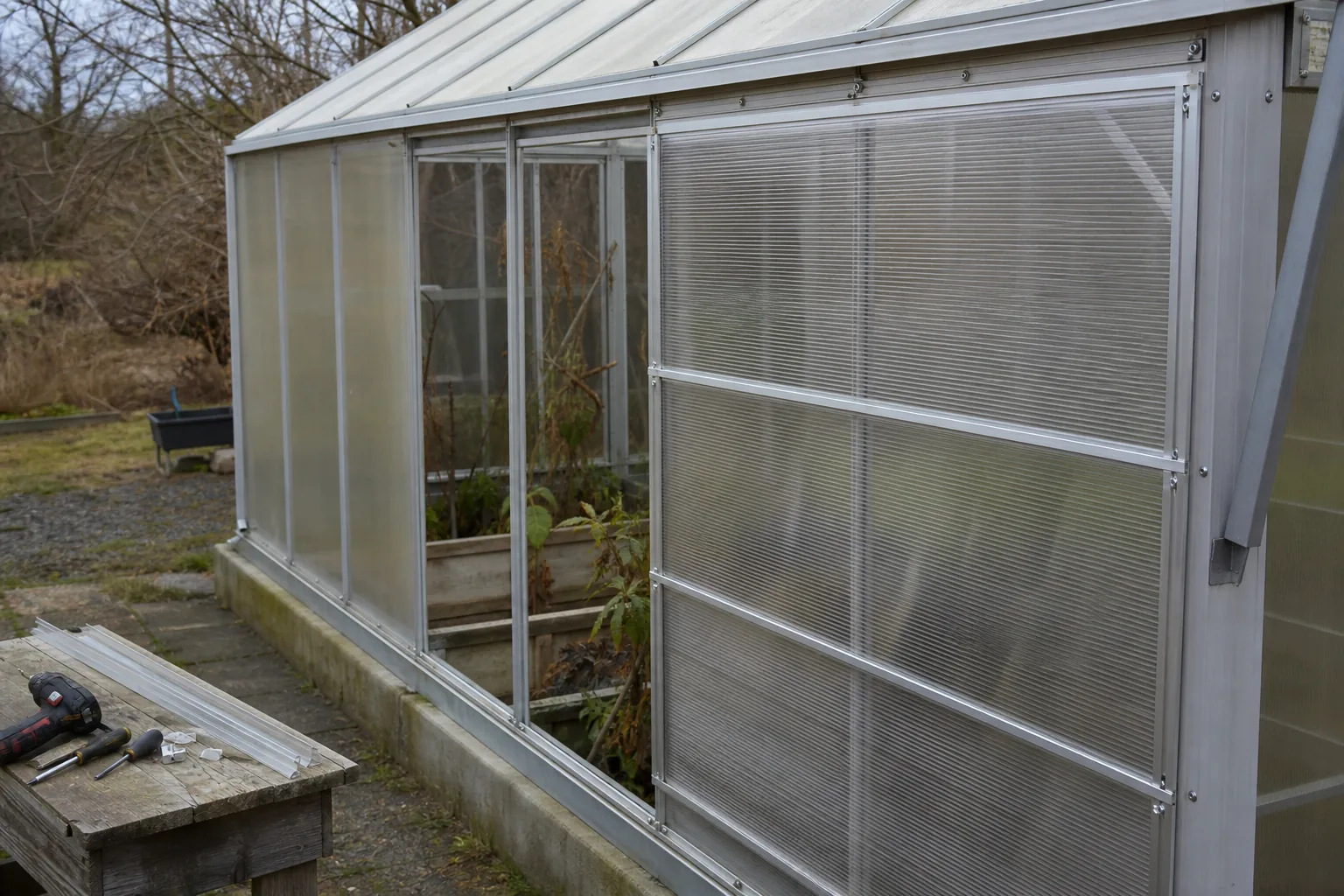
Glazing channels have a real capacity. An H profile joins sheets, a U profile closes or protects an edge, and caps or gaskets hold panels in the frame. Their names do not guarantee that they fit every sheet of the same nominal size.
Before ordering replacement panels, measure and document:
- Existing panel thickness and internal structure
- Clear width and depth of every glazing channel
- Required edge engagement in the frame
- Sheet length and width at installation temperature
- Roof curve and minimum cold-bending radius
- Fastener, washer, gasket, tape, and closure specifications
- Panel orientation, ultraviolet-protected face, and drainage direction
A thicker sheet may need wider profiles and a larger bending radius. Replacing the panels can therefore become a frame modification, not a simple reglazing job. Rutgers New Jersey Agricultural Experiment Station provides greenhouse reglazing guidance that puts material choice inside a broader inspection of the frame and installation.
For a lean-to structure, the wall flashing, roof connection, and limited ventilation openings add further constraints. Our lean-to greenhouse guide covers those whole-structure questions.
Allow polycarbonate to expand
Polycarbonate moves as temperature changes. The required clearance depends on sheet dimensions, temperature range, and the manufacturer’s coefficient and instructions. Long sheets need more total movement than short ones. Profiles, holes, and fasteners must allow that movement while still resisting weather and design loads.
Do not cut every sheet to the exact cold opening and clamp it hard at both ends. Expansion can make panels bow, creep out of channels, stress screws, or distort the frame. Do not leave arbitrary large gaps either. Follow the sheet maker’s allowance for the measured length and expected installation conditions.
Store sheets flat and protected as directed. Use tools and blades approved for polycarbonate, support the sheet during cutting, and remove swarf from channels. Keep the ultraviolet-protected side facing outward if the panel has a designated face. Removing printed protective film too early can make orientation harder to confirm, but all film must come off as the manufacturer instructs.
Balance insulation against usable light
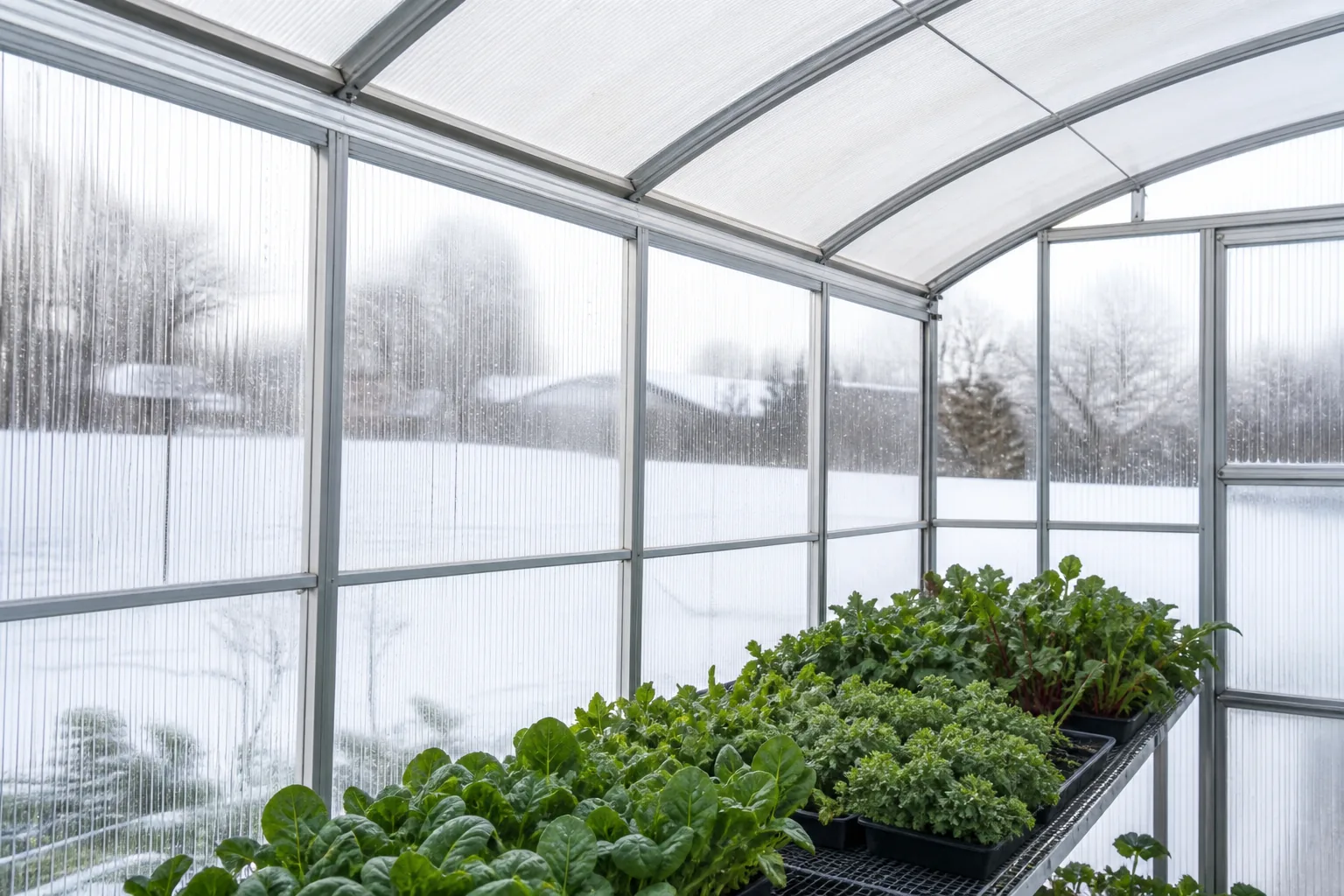
A thicker multiwall panel often reduces heat loss, which can matter in an actively heated winter greenhouse. It may also transmit less light than a thinner or simpler panel. The best choice depends on the crop, season, fuel cost, nighttime target, and local winter light.
The University of Georgia’s passive solar greenhouse guidance discusses glazing and thermal design as parts of a complete energy strategy. Passive solar design is not the same as choosing replacement panels for a conventional kit, but the central lesson applies: insulation, solar collection, storage, air sealing, and ventilation must work together.
Use the manufacturer’s optical data for new, clean material as a comparison point, then allow for framing, dirt, condensation, shade, and aging in real use. Clean glazing can be more valuable than a theoretical advantage that disappears under algae and dust.
If the greenhouse is heated, put the panel’s actual U-factor into the planning process behind our greenhouse heater guide. Do not choose 16 mm solely to buy a smaller heater. Air leakage at doors, vents, bases, and damaged closures can erase much of the expected benefit.
Control condensation inside the channels
Water vapor can condense inside or on the surface of multiwall sheets. Panel orientation, anti-condensate coatings, breathable or vented tape, solid closure tape, end profiles, roof pitch, and drainage details vary by system. Use the panel maker’s assembly instructions as one package.
Sealing both ends with an arbitrary household tape can trap moisture and debris. Leaving both ends open invites insects, algae, and dirt. Many systems use different treatments at upper and lower edges, but the correct detail depends on the product and orientation.
Surface dripping is also an environmental issue. Air temperature, leaf temperature, humidity, ventilation, and air movement determine when moisture forms. Our guide to greenhouse condensation covers that operating side of the problem.
A replacement-panel buying sequence
- Identify the greenhouse model, current glazing, and structural documents.
- Find the local wind and snow requirements for the site.
- Measure channels, supports, sheet spans, curves, and openings.
- Compare product-specific U-factor, light transmission, weight, rib pattern, and load tables.
- Verify profiles, fasteners, gaskets, tapes, edge closures, and expansion allowance.
- Confirm that the frame and foundation accept the proposed panel.
- Plan handling, cutting, orientation, storage, and safe installation.
- Obtain written manufacturer approval for any substitution outside the manual.
Compare greenhouse polycarbonate panel listings on Amazon (paid link). Use the listings to identify possible sheet sizes and structures, then verify the current technical sheet, warranty, load table, and installation manual at the manufacturer’s site.
Inspect the system, not just the new sheet
Before installation, check rafters, purlins, fasteners, seals, doors, vents, and the base for corrosion, movement, or damage. The University of Florida’s greenhouse design guidance treats covering and structure as an integrated system. Reglazing a weak frame can conceal the problem without solving it.
Order a small sample when the supplier offers one. Check its cut edge, rib arrangement, optical quality, protective-film instructions, and fit in a spare profile. A sample cannot establish structural capacity, long-term weathering, or whole-sheet tolerance, but it can expose an obvious mismatch before freight arrives. Confirm that the delivered sheets carry the same product designation as the technical sheet used for planning.
After installation, inspect each edge for proper engagement and room to move. Confirm that drainage channels remain open and that no screw has crushed the flutes. Watch the first hot day, cold night, heavy rain, and windy period from a safe position. Correct movement or leaks according to the manual rather than adding random sealant or fasteners.
The right thickness is the one documented for the frame and conditions. Six, eight, and sixteen millimeters are useful starting categories, but the final decision lives in the complete panel specification and the load path around it.