Disclosure: This page contains affiliate links. As an Amazon Associate, Yard Foundry earns from qualifying purchases.
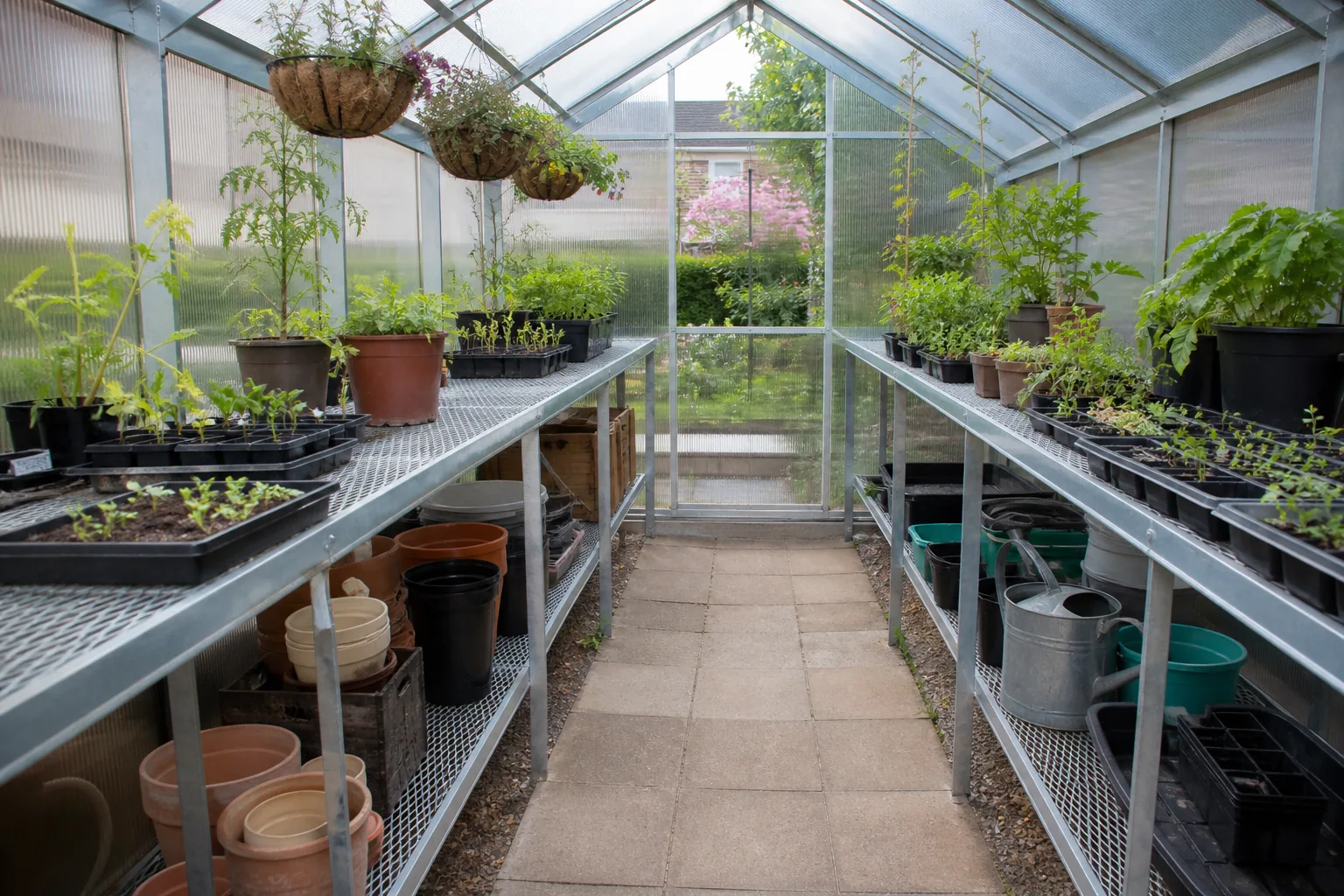
Greenhouse benches should fit the gardener’s reach, leave a clear working aisle, drain freely, and carry the weight of fully watered pots without swaying. Plan the greenhouse as a floor layout before choosing a bench. Mark doors, vents, heaters, hoses, and crop height, then choose stationary, peninsular, rolling, or tiered surfaces that improve access rather than merely filling the most square footage.
This is a research based planning guide. Yard Foundry has not load tested the benches or shelving discussed here. Follow the greenhouse and bench manufacturers’ limits, and obtain site-specific structural or accessibility guidance where needed.
Draw the working space before buying greenhouse benches
Start with the inside dimensions at bench height. Greenhouse sidewalls can slope inward, doors may swing into the growing area, and diagonal braces often occupy corners that look empty on a sales drawing. Mark the true footprint of each obstruction.
Next, trace how a normal task happens. Can you carry a full watering can from the door to the far bench without turning sideways? Can a bag of potting mix reach the work surface? Is there room to pull a tray out while another person passes? The best layout feels uneventful during routine work.
The University of Arkansas greenhouse benching module compares common layouts and the tradeoff between growing area and aisle space. Commercial production often measures bench efficiency closely, but a backyard greenhouse also needs comfortable access, tool storage, and a route for bulky plants.
If the shell has not been purchased, sketch the bench plan beside the options in our polycarbonate greenhouse kit guide. A wider greenhouse does not always add as much useful bench area as expected once a practical aisle and door clearance are included.
Set bench depth from reach
A bench against a wall is reached from one side. An island or peninsular bench may be reached from both sides. That makes the same physical depth feel very different. A deep wall bench encourages stretching over wet pots, while an overly narrow island wastes the advantage of two-sided access.
Test reach with a temporary surface before ordering. Put ordinary trays at the proposed back edge, then repeat the motion while holding a small pot. Consider the shortest regular user, not just the tallest person in the household. The goal is to reach the back without leaning on plants or loading the bench edge with body weight.
Height deserves the same trial. A propagation bench may be comfortable near counter height; large containers may need a lower surface so their foliage remains accessible. A dedicated potting area can be higher than a display shelf. Uniform height looks tidy, but different work can justify different levels.
The University of Alaska Fairbanks home greenhouse guidance discusses interior arrangement along with the broader greenhouse plan. Local climate changes how much space is given to heat, insulation, and seasonal storage, so copy dimensions only after checking them in the actual house.
Protect the aisle as real equipment space
An aisle is not leftover space. It carries the gardener, carts, hoses, plants, and emergency access. Keep the main route continuous from the door to the far end, without bench legs, shelf corners, loose cords, or watering cans projecting into it.
Measure the widest object that must pass. A garden cart, wheelchair, mower attachment, or mature shrub may need more room than a person. Door width and threshold can become the limiting points even when the aisle itself is generous.
Floor drainage matters too. Mesh benches release water directly below. If the floor pitches across the aisle or develops puddles at bench feet, routine watering creates slippery footing. Plan surface drainage together with the greenhouse condensation strategy, since wet floors and high humidity are related operating problems even when their water sources differ.
Compare layouts by access, not percentage alone
| Layout | Best use | Watch for |
|---|---|---|
| Wall benches | Simple small greenhouse with one central aisle | Excess depth and blocked low inlets |
| Peninsular benches | More growing area with two-sided reach | Dead-end aisles and tight turning space |
| Island bench | Work from both sides and around the ends | Reduced wall storage and multiple narrow aisles |
| Rolling benches | High space use with one movable aisle | Cost, floor level, pinch points, and daily access |
| Tiered shelves | Small plants or display near a bright wall | Shading, top-heavy loads, and uneven watering |
Rolling benches can recover floor area otherwise used by several aisles. They are more convincing in a long, level house with repeated crops than in a small mixed greenhouse where every plant needs frequent individual attention. A single open aisle also means the user must move benches whenever another row needs access.
UMass describes ways of increasing greenhouse production space, including movable and tiered systems. Those commercial ideas are valuable, but a home system should retain safe controls, stable travel stops, and access to utilities. Maximum floor coverage is not the same as maximum usefulness.
Choose a top that handles water and small pots
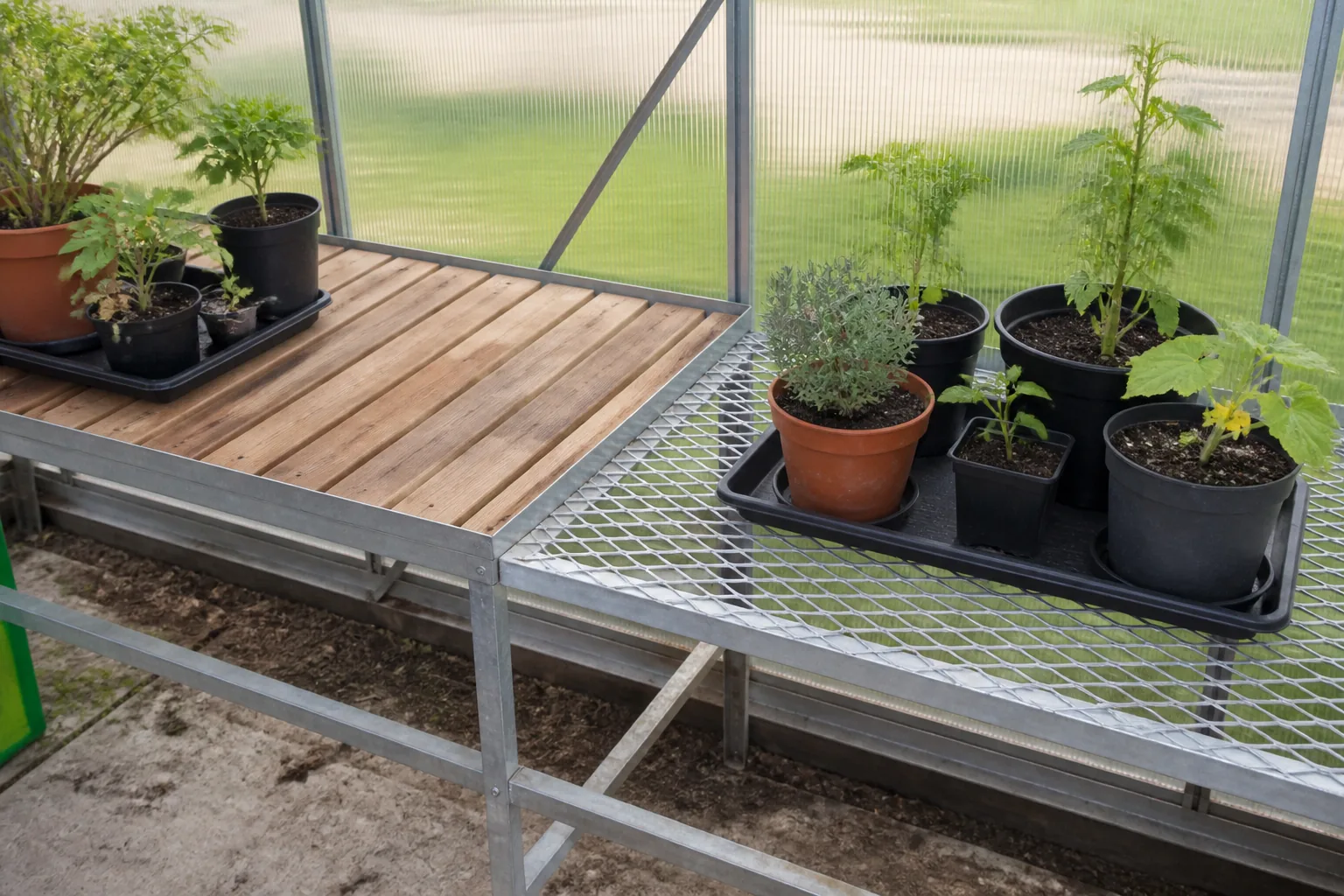
Open bench tops improve drainage and air movement around containers. Galvanized expanded metal is durable and allows spilled media to fall through, though sharp edges and corrosion at cut points need attention. Welded wire can work when the mesh and supports match the pot load. Plastic bench panels resist moisture and are easy to clean, but their support spacing and ultraviolet durability vary.
Wood slats feel warmer, are easy to modify, and can be built to fit an awkward house. Choose a decay-resistant species or appropriately treated material for the intended use, leave drainage gaps, and design replaceable top pieces. Broad boards trap water against pots and can cup over time.
Mesh opening is a practical detail. A surface that supports gallon pots may let plug trays or narrow feet tip. Keep rigid trays for very small containers, but avoid covering the entire bench with a solid sheet that defeats drainage and airflow.
Whatever the surface, it should release for cleaning or expose all corners to a brush. Soil, roots, algae, and fertilizer salts collect at joints. Smooth accessible frames are easier to sanitize than deep ledges and enclosed tubes with open ends.
Size the frame for wet, uneven loads
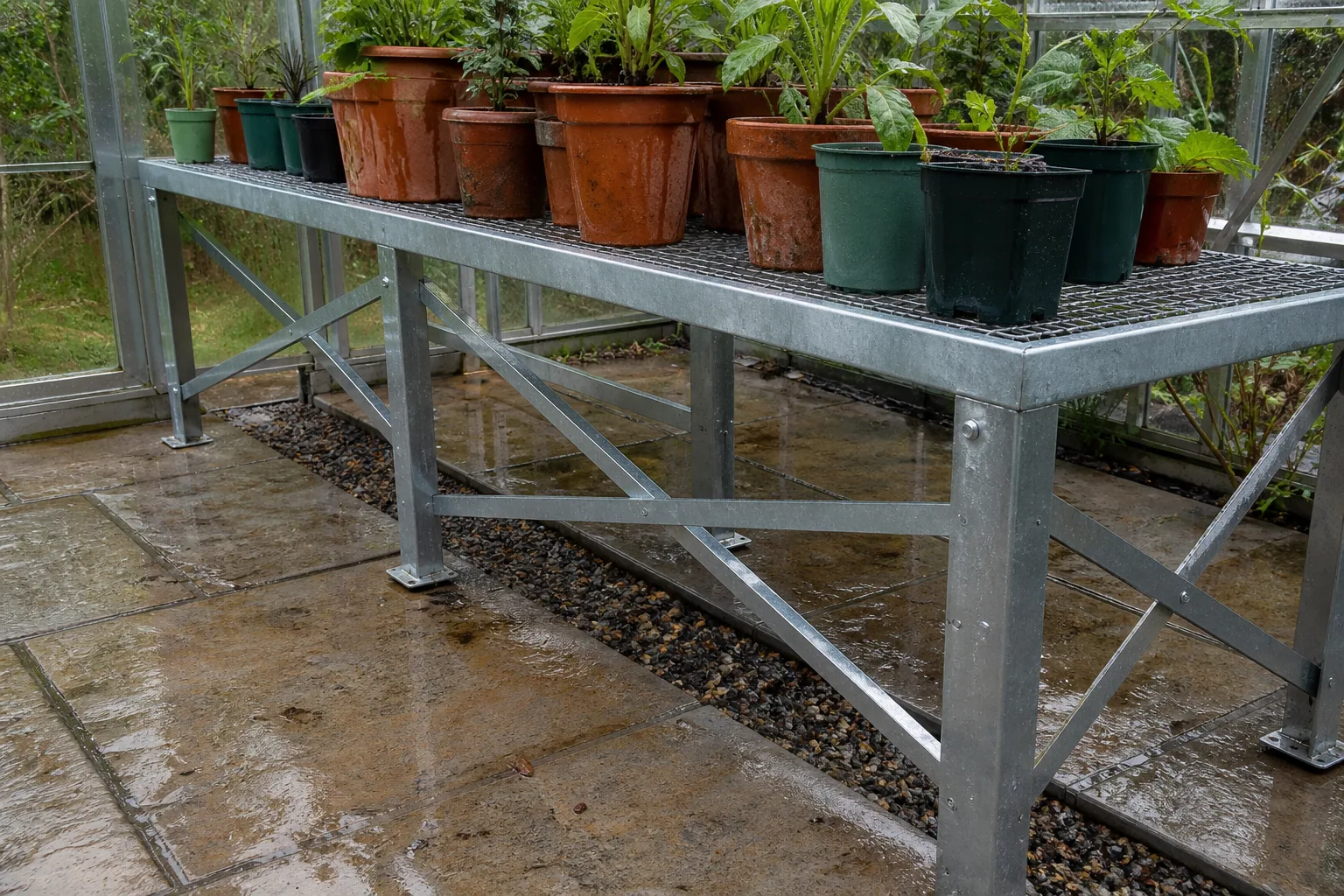
A dry empty pot is a poor basis for bench capacity. Count containers at their watered weight, then include trays, media bags, tools, and the temptation to set one heavy item at the edge. Loads are rarely distributed perfectly. One tray may be saturated while the next space is empty.
Ask the manufacturer for a stated load rating and the conditions behind it. Is the value total, per shelf, or per square foot? Is it evenly distributed? Does it require wall anchoring? Which span and leg arrangement were used? A long shelf can bow even when the total weight sounds modest.
Cross bracing controls sway. Adjustable feet help level a bench, but small feet can punch into soft gravel or settle into wet soil. Put them on a firm drained surface sized for the load. Secure tall shelving against tipping as its manual directs, especially where hanging baskets or large plants raise the center of gravity.
Do not attach benches or shelving to the greenhouse frame without written approval. Light frames carry wind, snow, glazing, and mounted equipment through specific members. Our greenhouse ventilation guide also explains why walls and openings need clear air paths, which shelving can accidentally block.
Plan water, heat, light, and air around the layout
A bench plan changes the environment. Solid shelves shade the floor and lower tiers. Tall crops can block an intake louver. A dense row of pots can interrupt horizontal airflow. Hanging baskets may shade seedlings and interfere with roof vents.
Keep heat-sensitive plants away from a heater’s discharge and preserve the clearances in its manual. Leave controls visible and reachable. If lights will hang above the benches, align fixture coverage with the final crop surface rather than the bench frame. Future pipes and drip lines need support that does not create trip loops across the aisle.
Sun angle shifts through the year. A shelf that works beautifully in May may cast a long winter shadow. Observe the greenhouse or model the seasonal sun before fixing tiered shelves permanently. Our greenhouse shade cloth guide can help separate structural shading from deliberate summer shading.
Buy in the right order
- Measure the interior at bench height and mark braces, doors, vents, and utilities.
- List the crops, pot sizes, carts, and work that the space must support.
- Test bench height and one-sided reach with a temporary surface.
- Protect the main aisle and turning area before adding growing space.
- Estimate wet container load and identify likely concentrated loads.
- Compare top material, support spacing, bracing, feet, and cleaning access.
- Check how the layout affects light, ventilation, heat, irrigation, and drainage.
- Read the assembly and anchoring manual before ordering.
Compare greenhouse benches and shelving on Amazon (paid link). Use the listings to identify formats and dimensions, then verify current load ratings, material specifications, support spacing, and anchoring instructions with the manufacturer.
Commission the layout with ordinary work
Assemble the first bench, level it, and load it gradually before filling the greenhouse. Check fasteners, sway, shelf deflection, foot settlement, and sharp edges. Follow the manufacturer’s inspection and tightening schedule rather than guessing at torque.
Then carry out a normal watering and potting session. Watch where the hose catches, where water lands, and which containers are awkward to reach. Confirm that vents open, fans breathe, doors swing, and controls remain accessible. Small adjustments are cheap while the rest of the benches are still boxed.
Washington State University’s greenhouse construction and management chapter frames the greenhouse as a system of structure, environment, and operation. Benches belong in that system. A little empty floor can be more valuable than one more tray when it keeps the greenhouse comfortable, clean, and easy to use.