Disclosure: This page contains affiliate links. As an Amazon Associate, Yard Foundry earns from qualifying purchases.
Choose a drip irrigation filter from the water source, the smallest emitter passage, the active-zone flow, and the amount of debris the filter must hold between cleanings. A screen filter is usually enough for clean municipal water. A disc filter gives more depth and debris-holding area for variable well, tank, or lightly organic water. A media filter is the starting point for heavy algae and organic material from ponds, canals, or open reservoirs. Sand may require a separator before the fine filter.
This is a component-selection guide, not a water-safety or potable-treatment guide. Yard Foundry has not physically tested the filters discussed here. Follow the emitter and filter manufacturers’ specifications, and comply with local backflow and plumbing rules.
Match the filter to the source first
| Water source | Typical contamination | Practical starting train |
|---|---|---|
| Municipal supply | Rust scale, pipe debris, occasional grit | Screen filter at the emitter maker’s required rating |
| Well | Mineral grit, sand, iron deposits | Sand separator when needed, then screen or disc filtration |
| Closed rainwater tank | Roof grit, sediment, small organic particles | Inlet screening and settling, then disc or screen filter at the irrigation head |
| Pond, canal, or open reservoir | Algae, plant fragments, silt, suspended organic material | Media or other source-water pretreatment, then a secondary screen or disc filter |
| Fertigation system | Source debris plus precipitates or undissolved material | Filtration and injection layout designed for the water and chemicals used |
This table is a starting map. A laboratory water analysis and a jar sample after the pump can reveal mixed problems. A well can carry both sand and dissolved iron. A rain tank can be clean after several calm days but send a sediment slug when the water level falls. Design for the worst repeatable condition, not the clearest sample of the year.
Start with the emitter’s filtration requirement
Drip emitters have narrow flow paths. The tubing or emitter technical sheet should state a required mesh or micron rating. Use that requirement even when the water looks clear.
Colorado State University Extension says a 150 to 200 mesh filter can serve relatively clean municipal water. It also notes that newer inline emitter tubing often relies on 200-mesh filtration for clog resistance. Those numbers are not universal. A large-orifice bubbler and a thin-wall dripline can require different protection.
Mesh counts and micron ratings run in opposite-looking directions. A higher mesh number normally means a finer opening. A lower micron number means a finer opening. Conversions are approximate because wire diameter and screen construction vary. Compare the exact micron rating in the manufacturer’s table rather than relying on a generic conversion chart.
Netafim’s drip irrigation handbook says most drip systems require 130-micron, or 120-mesh, filtration or finer, while also making water quality and the dripper specification the deciding inputs. The handbook cautions that standard irrigation filters do not remove salts or dissolved solids.
Screen filters: simple and effective for clean water
A screen filter passes water through a perforated or woven surface. Particles larger than the openings remain on that surface. The element is easy to understand, inexpensive, and compact. For a hose-bib garden fed by treated municipal water, a 150- or 200-mesh Y-filter may be all the filtration the emitter maker requests.
Screen filters have limited depth. Flexible organic particles can deform against the screen, and a heavy debris load can cover the surface quickly. Cleaning frequency rises as the effective area shrinks. A small filter that technically passes 10 GPM when clean may lose too much pressure after a modest load of sediment.
Pick a serviceable body. A Y- or T-style filter with an accessible flush port and removable element is easier to maintain than an inline housing buried among rigid fittings. Leave room to unscrew the cover without cutting pipe. Install unions or flexible connections where the layout needs them.
Disc filters: more depth for changing water
A disc filter compresses grooved rings into a cylindrical element. Water follows intersecting paths through the stack, which creates multiple capture points rather than one flat screening surface. This depth makes disc filtration useful where fine sediment and some organic debris vary through the season.
Disc elements can hold more debris than a similarly sized simple screen, but they still need cleaning. Manual models must be depressurized, opened, and rinsed according to the instructions. Automatic disc batteries require enough pressure and backflush flow to clean correctly. Buying an automatic filter without checking those requirements can leave the system with an expensive filter that never backwashes well.
Disc filtration is often a sensible middle ground for a closed rainwater tank, a well with light sediment after proper sand separation, or a small pond system that already has coarse intake protection. It is not a substitute for media filtration when the water carries heavy algae.
Media filters: heavy organic loads and surface water
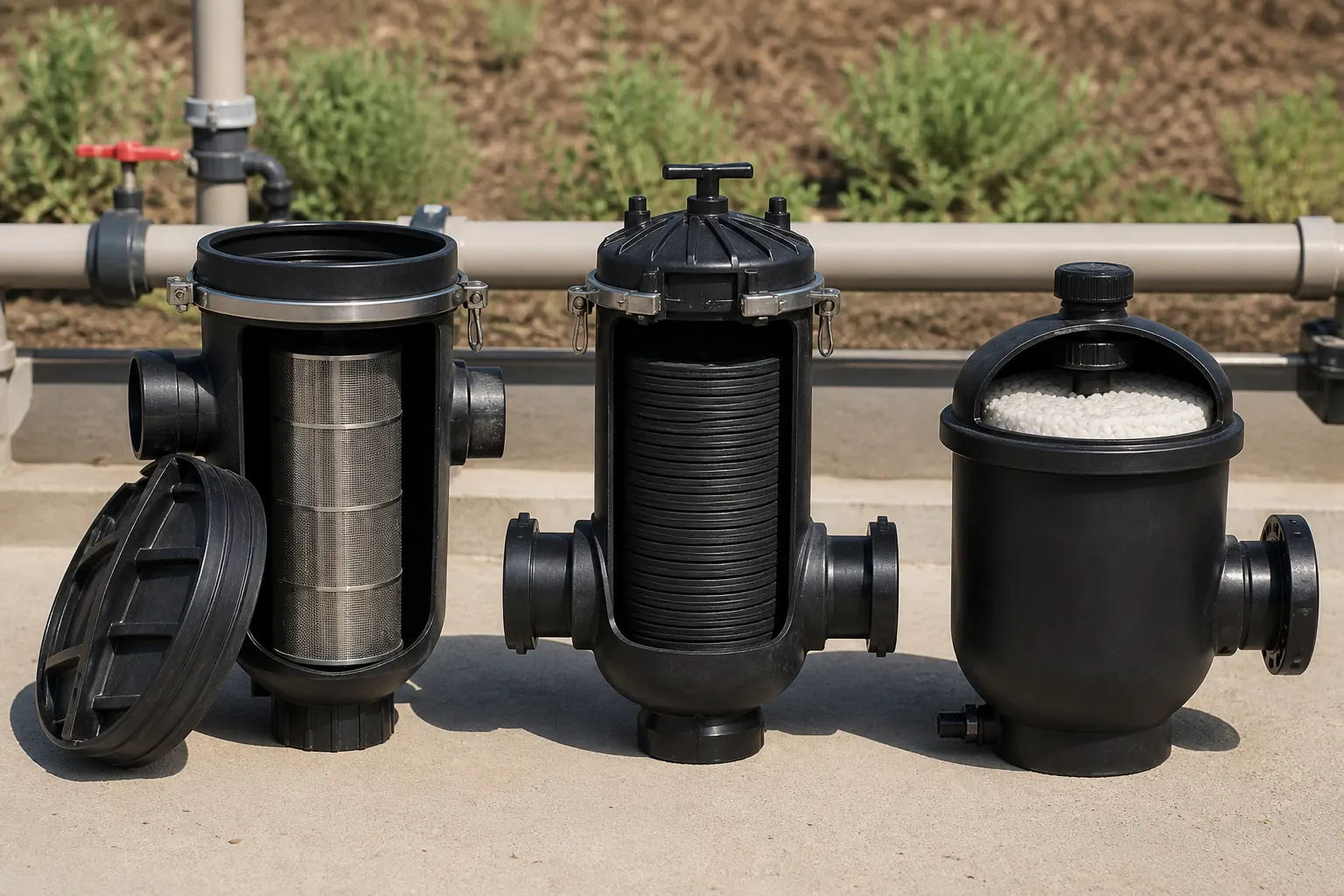
A media filter sends water through a bed of graded material, commonly sand or another specified medium. Its depth and large capture volume make it effective for suspended organic matter that can slip, deform, or mat across a screen. Surface-water irrigation systems often use paired tanks so one can backwash while the other continues filtering.
Media systems are larger, costlier, and more demanding. They need correct media, flow distribution, pressure, backwash rate, drain capacity, valves, and controls. Too little backwash flow fails to expand and clean the bed. Too much can carry media out. A residential pond does not automatically justify a commercial filter station, but heavy algae does call for more than a tiny hose filter.
After media filtration, many systems use a secondary screen or disc filter near the zones. The second stage catches particles released downstream or carried through during operational changes.
Sand separators solve a different problem
A hydrocyclone or centrifugal separator removes dense particles such as sand by spinning the water. It works best within a specified flow range and needs a collection chamber that is purged. It does not replace the fine screen or disc filter that protects emitters.
If a well produces sand, protect the pump and investigate the well condition rather than treating the separator as permission to ignore it. Abrasive particles wear pumps, valves, and emitters. The separator must be sized at the actual operating flow, not the pipe diameter alone.
Size the filter for zone flow and dirty head loss
Add the flow of every emitter or length of dripline operating in the zone. For 240 emitters rated at 0.5 GPH:
240 x 0.5 GPH = 120 GPH = 2 GPM
The filter must pass at least 2 GPM at the required filtration rating without excessive pressure loss. Do not pick the smallest body whose maximum happens to equal 2 GPM. Leave capacity for loading, flushing, future emitters, and the operating range the manufacturer recommends.
The Drip Irrigation Flow and Runtime Calculator totals a zone before filter selection. If a pump supplies the system, include clean and dirty filter loss in the Garden Pump Total Dynamic Head Calculator. Filter pressure drop changes with flow and debris; use the manufacturer’s curve or table.
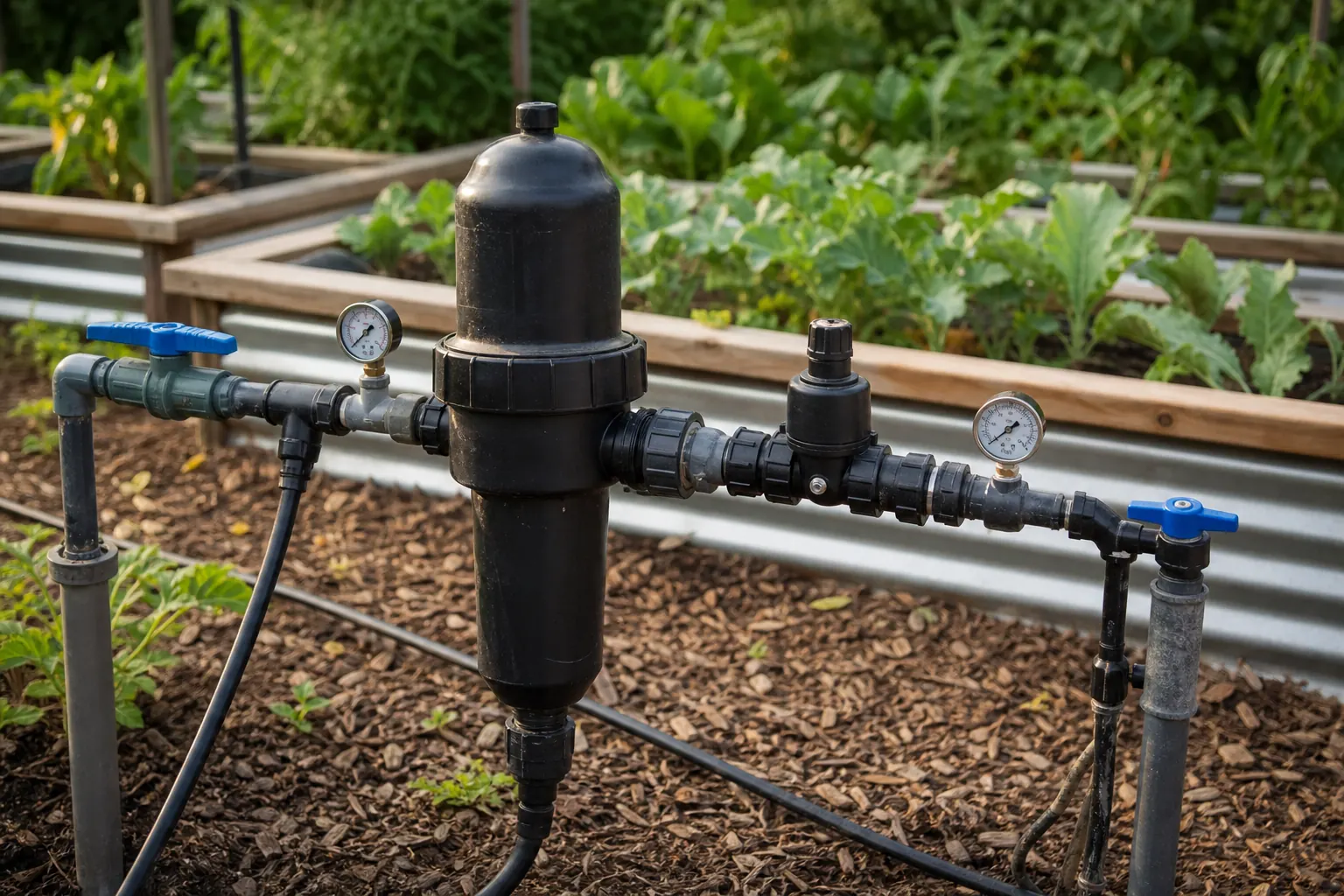
Two pressure gauges, one upstream and one downstream, make loading visible. The difference between them is the filter’s pressure loss. Clean or backwash at the differential stated by the manufacturer. Waiting until plants wilt means the pressure problem has already reached the emitters.
Place filtration in the correct head assembly
A small hose-bib system commonly follows the sequence specified for its components: shutoff or timer, required backflow protection, filter, pressure regulator, then distribution tubing. Colorado State describes a head assembly with backflow prevention, filter, and pressure regulation. Local requirements and product designs can change the exact order.
Keep filtration where it sees the full zone flow and remains accessible. A filter hidden under mulch will not be inspected often. Protect exposed plastic housings from mower impact, freezing, and prolonged sunlight if the material is not rated for it.
Separate drip from high-pressure spray zones. The raised-bed drip irrigation layout guide explains zoning and tubing layout. A filter cannot correct a zone that mixes incompatible operating pressures or exceeds the tubing’s flow limit.
Maintenance is part of filter sizing
A filter is not a fit-and-forget part. EPA WaterSense advises inspecting irrigation systems monthly and cleaning microirrigation filters as needed. A new system may need checks after every early run because construction debris and pipe shavings are still moving.
Use a repeatable routine:
- Record clean upstream and downstream pressure at normal zone flow.
- Inspect the differential on a regular schedule.
- Shut down and relieve pressure before opening a manual housing.
- Rinse the element with clean water as the manual directs.
- Inspect O-rings, screens, discs, clamps, and flush valves.
- Flush mains and laterals so trapped debris leaves the system.
- Investigate recurring slime, scale, or iron instead of scrubbing harder each week.
Do not improvise acid, bleach, or other chemical cleaning. Concentration, contact time, rinsing, disposal, and material compatibility matter. Use only a method approved for the filter, irrigation components, water source, and crop.
Filtration cannot fix every clog
Standard screens, discs, and media filters remove suspended particles. They do not desalinate water. They do not guarantee microbiological safety. Dissolved iron, manganese, calcium, and biological growth can precipitate later inside tubing. Root intrusion and insect entry create other blockage paths.
If emitters still clog after appropriate filtration, identify the deposit. A water test, emitter inspection, and irrigation professional can separate mineral scale from algae, bacterial slime, and sediment. The smart irrigation controller guide can improve scheduling, but a controller cannot compensate for poor hydraulic uniformity or plugged emitters. The irrigation pump sizing guide covers pressure and flow when the filter is only one part of a pumped system.
A practical filter selection checklist
- Identify the water source and repeatable contaminant types.
- Use the emitter maker’s required mesh or micron rating.
- Calculate the maximum active-zone flow.
- Check pressure loss at that flow, both clean and at the service threshold.
- Add sand separation or media filtration when the source requires it.
- Provide gauges, flush points, isolation, and room to remove the element.
- Confirm backwash pressure and drain flow for automatic filters.
- Plan routine inspection and lateral flushing.
Compare drip irrigation filters on Amazon (paid link). Before ordering, verify the filtration grade, flow range, port size, pressure rating, clean-loss data, service method, replacement element, and whether the body is approved for the installation location.