Disclosure: This page contains affiliate links. As an Amazon Associate, Yard Foundry earns from qualifying purchases.
If you are deciding when to aerate a lawn, time the job for active growth and mild recovery weather. Aerate cool-season lawns in late summer or early fall. Aerate warm-season lawns after full spring green-up through early summer, while the grass is growing strongly. The soil should be moist enough for hollow tines to pull cores, but not wet enough to smear or rut. Do not core-aerate dormant, drought-stressed, waterlogged, frozen, or newly seeded turf.
This guide gives regional timing principles, not a date guaranteed for every ZIP code. Grass species, soil temperature, recent weather, irrigation access, and local pesticide rules can shift the workable window.
Start with the grass, not the calendar
The right month depends on when your dominant turf can repair the holes. Cool-season grasses grow hardest in cool weather. Common examples include Kentucky bluegrass, perennial ryegrass, fine fescues, and tall fescue. Warm-season grasses such as bermudagrass, zoysiagrass, centipedegrass, and St. Augustinegrass build most of their growth in late spring and summer.
| Lawn type | Best general window | Acceptable backup window | Avoid |
|---|---|---|---|
| Cool-season | Late summer through early fall | Spring after active growth resumes, if moisture and recovery time are available | Hot summer stress and winter dormancy |
| Warm-season | Late spring through early summer after green-up | Later summer while growth is still vigorous and water is available | Winter dormancy and late work close to first frost |
| Mixed lawn | Use the dominant desirable grass | Treat separate areas in their own growth windows when practical | One date chosen only for convenience |
University of Maryland Extension recommends fall for cool-season lawns and June through July for warm-season lawns in its region. It also gives the most portable rule: never aerate a dormant lawn, and work while desirable grasses are growing vigorously.
When to aerate a cool-season lawn
Late August through early October is a useful northern starting range, then localize it. The ideal day arrives after summer heat has eased, soil still holds warmth, and several weeks of growth remain before hard freezes. This window also aligns with renovation and overseeding for many cool-season lawns.
University of Minnesota Extension places its preferred aeration period between late August and early October, with the exact timing depending on how far north the property lies. That does not mean an Arizona high-elevation lawn and a Minnesota lawn share the same weekend. Watch growth, weather, and the first-frost pattern where you live.
Spring aeration can work when compaction is severe or the fall window was missed. Wait until the lawn has resumed growth. Minnesota’s guidance suggests waiting until the lawn has been mowed twice. Spring brings a tradeoff: open soil can favor germinating annual weeds. If a preemergent herbicide is part of the lawn program, read its label and coordinate timing with aeration and seeding. Some products are incompatible with new seed, and local rules differ.
Skip summer aeration when cool-season turf is conserving water or turning brown. Puncturing a stressed canopy adds recovery demand precisely when root function is limited. A forecast of cooler weather is not enough if the soil profile is dry and irrigation is unavailable.
When to aerate a warm-season lawn
Wait until the lawn is fully green and mowing regularly. Then aerate during the stretch of vigorous growth that follows. In many southern areas, that means May through July. A warm spring can advance the window; a cold spring can delay it.
Oklahoma State University Extension describes late spring or early summer as the effective period for core cultivation of warm-season grasses, compared with early to mid-fall for cool-season grasses. The reason is recovery, not convenience. Bermudagrass and zoysiagrass can spread into holes quickly when their stolons and rhizomes are active.
Do not aerate a warm-season lawn simply because the first green blades appeared. Patchy green-up can leave much of the plant below full activity. Give the turf time to enter steady growth. At the other end of summer, stop early enough for the surface to close before the local dormancy period and frost risk.
Heat alone is not proof that conditions are good. If the lawn is wilted, under watering restrictions, or recovering from disease, postpone the job. Aeration can help long-term root-zone conditions, but it does not rescue turf from immediate drought stress.
Aerate for a reason
A calendar reminder should trigger an inspection, not an automatic rental. Core aeration is most useful where traffic or construction has compacted soil, water enters slowly, roots stay shallow, or a soil test and physical inspection point to restricted pore space. It can also help bring soil to the surface where a heavy thatch layer is developing.
Try a screwdriver test after irrigation or rain. If a long screwdriver is difficult to push into several representative areas while comparable garden soil is easy, compaction may be part of the problem. Check more than the driest corner. Buried gravel, tree roots, or extremely dry clay can imitate general compaction.
Aeration and dethatching are not interchangeable. An aerator removes or displaces soil to relieve compaction. A dethatcher cuts into accumulated organic material near the surface. The aerator versus dethatcher guide helps identify which layer is actually limiting the lawn.
Choose core aeration for lasting soil relief
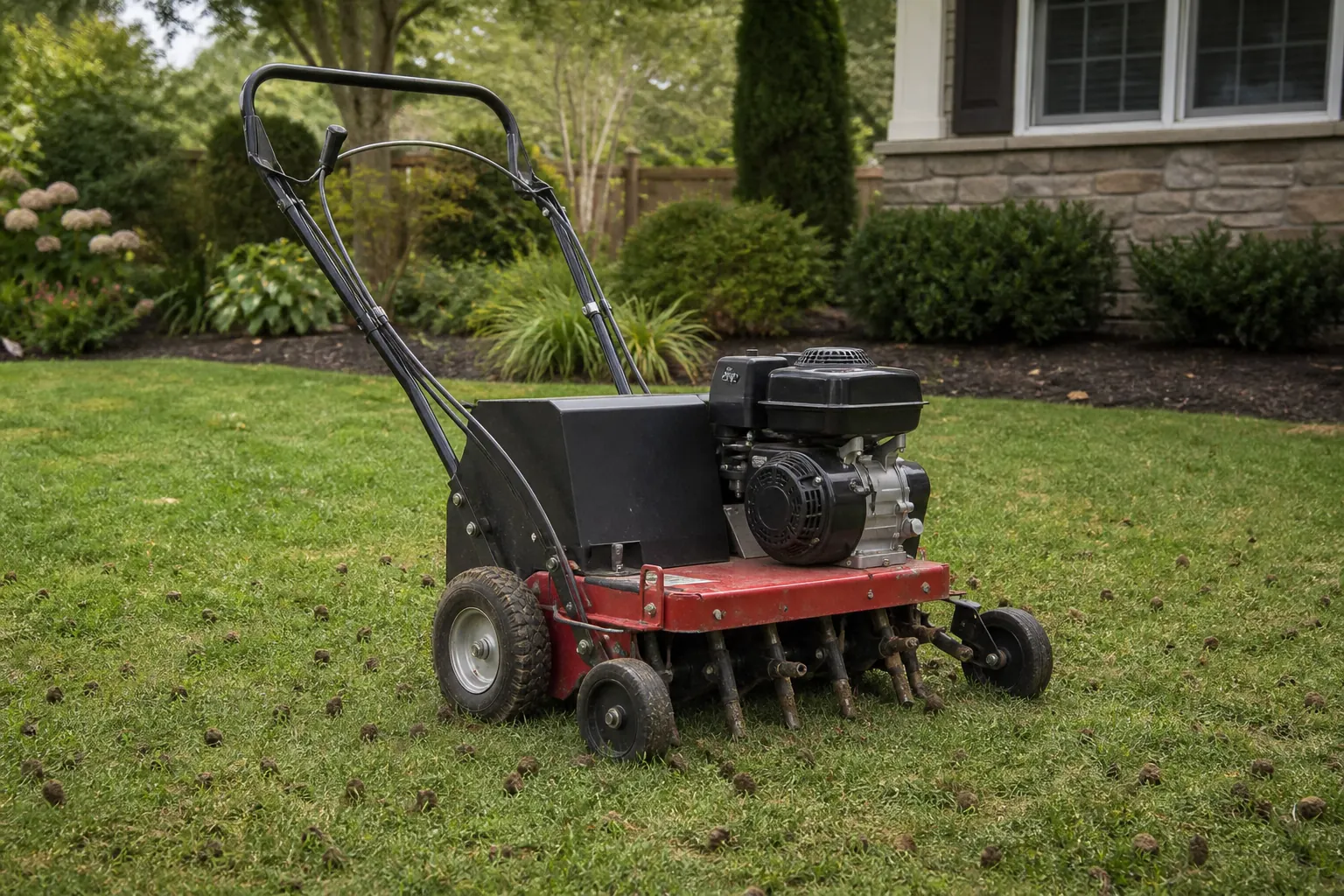
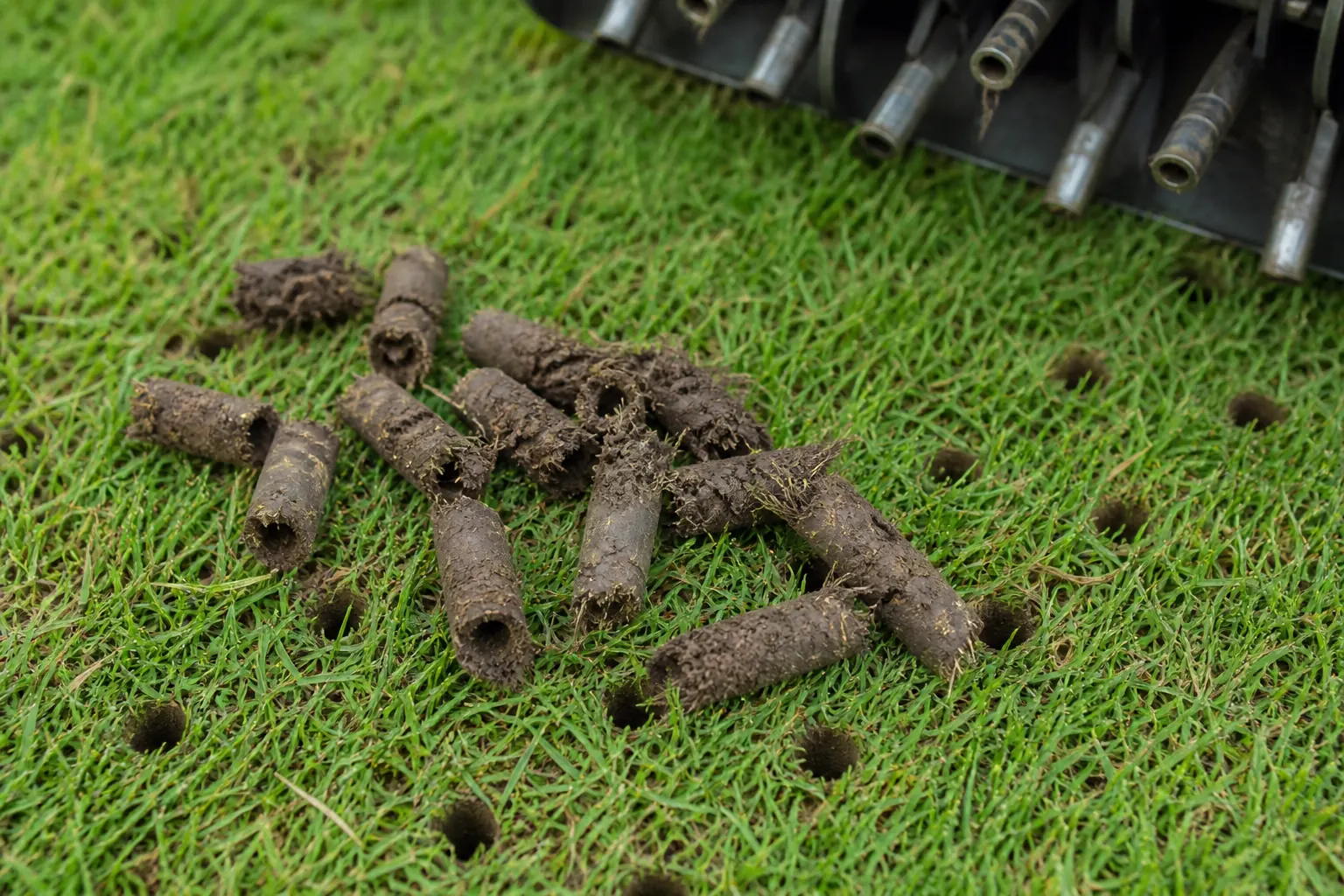
For compaction, hollow-tine core aeration is the standard approach. The machine removes plugs and creates space without compressing soil sideways. Solid spikes make holes by displacing soil. They can provide temporary access at the surface, but repeated use in heavy soil may compact the walls around each hole.
The plug versus spike aerator comparison explains that mechanical difference in detail. If you are shopping for a tractor attachment, the tow-behind aerator buying guide covers tray weight, tine pattern, hitch fit, turning, and storage.
One light pass with shallow plugs is rarely enough on a hard traffic lane. University of Minnesota Extension advises several passes in different directions for compacted soil. The same source says hollow tines or spoons that bring soil cores to the surface are needed for effective long-term work.
Check soil moisture two days before the job
Dry clay can stop tines at the surface. Saturated soil can rut, smear, and close the very pores you want to open. Aim for evenly moist soil that holds together as a core but does not ooze water underfoot.
If rain has been absent, irrigate deeply enough to moisten the target depth one or two days ahead. The exact amount varies with soil and weather. Test several areas by pushing in a screwdriver or digging a small inspection hole. Postpone if footsteps leave shiny mud or water rises around the sole.
Mark shallow irrigation lines, invisible pet fence wire, valve boxes, sprinkler heads, drain cleanouts, landscape lighting cable, and tree roots that could be damaged. The rental machine does not know where they are. Call the appropriate utility-location service before any work that could approach buried public utilities, and follow local requirements.
Coordinate seeding, fertilizer, and weed control
Core aeration immediately before overseeding can improve seed-to-soil contact, especially when the same seasonal window suits the grass seed. It does not bury seed evenly by itself. Spread at the labeled rate, ensure contact, and keep the seedbed moist according to the cultivar and local extension guidance.
Do not add fertilizer by habit. Use a soil test and local nutrient rules. Aeration creates access but does not diagnose nitrogen, phosphorus, potassium, lime, or organic-matter needs. Excess fertilizer cannot repair compaction and may increase water demand.
Herbicides require more care. Preemergent products are designed to interrupt seedling establishment, which may include the grass you want to plant. Postemergent treatments can carry mowing, irrigation, or reseeding intervals. The label is the controlling instruction. When the plan includes aeration, overseeding, and weed control, build the sequence before opening any bag.
What to do with the cores
Leave normal soil plugs on the lawn. Once they dry, mowing and weather break them apart and return soil to the surface. Maryland Extension notes that cores typically decompose within a couple of weeks. Large clods from very wet soil are a sign that timing was poor, not a reason to remove all the soil.
Resume mowing when the surface is firm enough to avoid ruts and the grass has reached its normal mowing threshold. Keep traffic light while holes are open and seedlings are establishing. Water for the needs of the existing grass and any new seed, not simply because aeration occurred.
How often should a lawn be aerated?
High-traffic clay soil may justify annual work. A lightly used lawn on well-structured soil may go several years without it. Maryland Extension suggests every one to two years for heavy traffic and every two to four years for typical home lawns. Treat that as an inspection interval, not a command.
Repeated compaction points to a design problem. Redirect foot traffic, add a path, protect saturated soil from vehicles, correct drainage, and keep heavy equipment off the root zone. Aerating the same muddy shortcut twice a year will not remove the cause.
A simple go-or-wait checklist
- The dominant grass is actively growing.
- Several weeks of recovery weather remain.
- The lawn is not dormant, wilted, diseased, frozen, or waterlogged.
- Soil is moist at tine depth but does not smear.
- Sprinklers, wires, drains, and other shallow obstacles are marked.
- Core aeration addresses a real compaction or renovation need.
- Seeding and pesticide intervals have been checked in advance.
For a one-time job, compare rental, delivery, and ownership costs with the core aerator rent-versus-buy calculator. Compare lawn core aerators on Amazon (paid link), but choose a machine only after confirming the lawn type, timing window, access width, tine design, and safe operating instructions.