Disclosure: This page contains affiliate links. As an Amazon Associate, Yard Foundry earns from qualifying purchases.
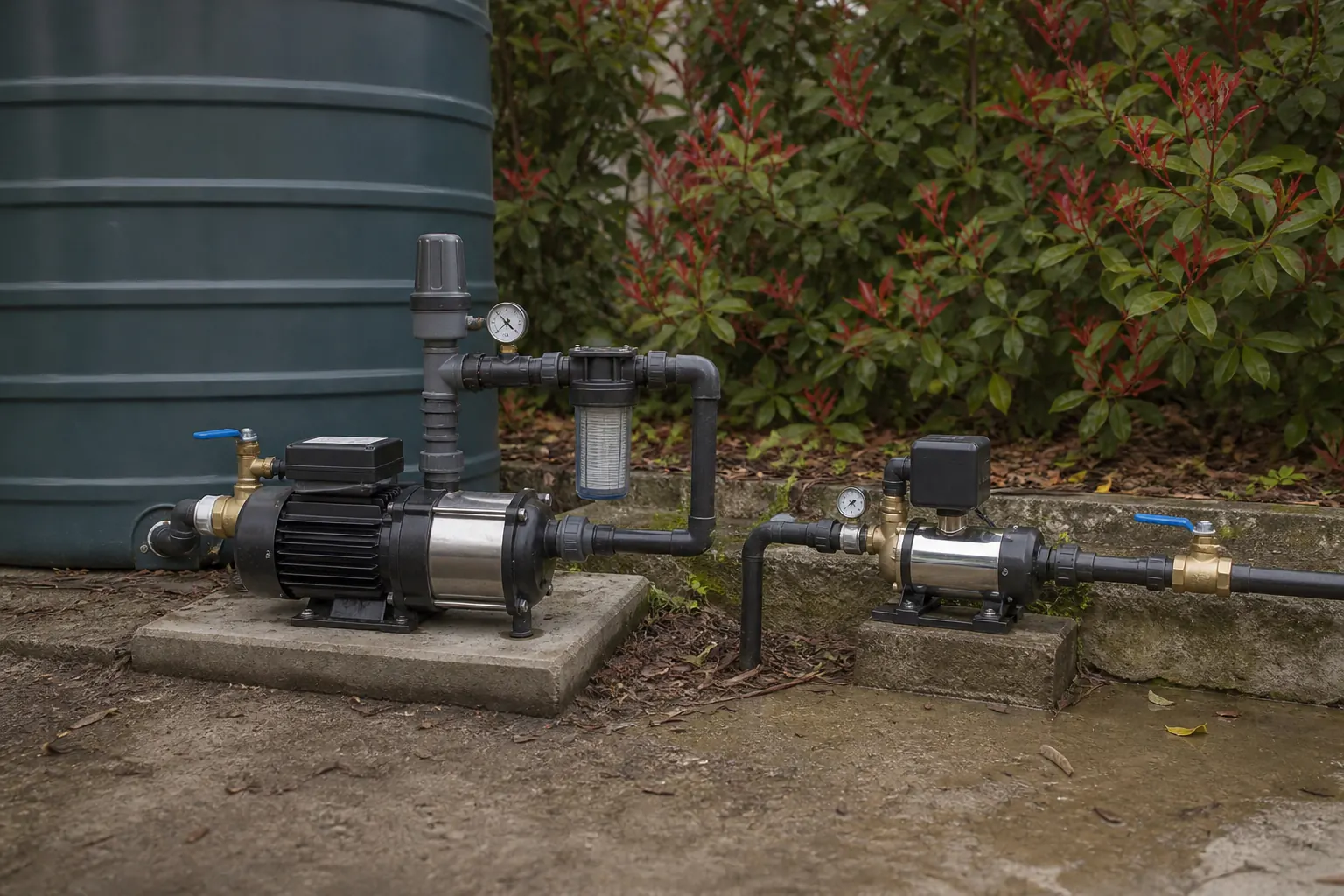
In an irrigation pump vs booster pump decision, use a source pump when water must be taken from a nonpressurized tank, pond, cistern, or well and delivered to the irrigation system. Use a booster pump when water already reaches the pump inlet under adequate pressure or flooded-suction conditions but needs more pressure downstream. Product names overlap, so the final choice must come from inlet requirements and the pump curve at your zone’s flow, not the word “booster” on the box.
This is a research-based selection guide, not a hands-on pump test. Pumping from wells, connecting to public water, and adding cross-connections can involve permits, utility approval, backflow protection, electrical work, and equipment protection. Use qualified help where required.
The practical difference is at the inlet
| Water source and condition | Likely pump class | Main design question |
|---|---|---|
| Municipal line with low dynamic pressure | Booster package, if utility and plumbing rules allow it | How much pressure must be added at peak zone flow? |
| Atmospheric rain tank or cistern | Surface transfer/irrigation pump or submersible source pump | Can the pump handle the inlet arrangement and total dynamic head? |
| Pond or shallow surface source | Appropriate centrifugal, self-priming, or submersible irrigation pump | Are suction, screening, submergence, and water quality acceptable? |
| Deep well | Properly selected well or submersible pump | Can it meet design flow at pumping level and total head? |
| Existing irrigation main that reaches remote zones at low pressure | Inline booster, often with controls | What is the lowest inlet pressure while the zone operates? |
A packaged booster may contain an ordinary centrifugal pump, pressure tank, sensor, variable-speed drive, and check valve. Another seller may market a self-priming pump as a booster even though it can draw from a tank. Treat the name as a category hint. The installation manual decides whether negative suction pressure, flooded suction, potable-water connection, outdoor exposure, and the intended water quality are allowed.
Choose a source pump when water is not already pressurized
A tank open to the atmosphere has little pressure at a ground-level outlet. A pond has none available to a pump sitting above the surface. A well adds depth and drawdown. In each case, the pump must both acquire the water and supply the energy needed downstream.
NC State Extension notes that gravity from a cistern may fill a bucket or water nearby plants, while most rainwater systems need a pump for useful flow and consistent pressure. It recommends choosing from required flow and total head. The same publication warns that a pump placed above a cistern can have priming problems and suggests considering a submersible pump or consulting a plumber for the specific arrangement.
Surface centrifugal pumps need an airtight, water-filled suction path unless a specific self-priming design and procedure say otherwise. Suction lift, water temperature, altitude, pipe loss, and net positive suction head limit what the pump can do. A large motor cannot compensate for an air leak or an inlet that starves the impeller.
Submersible pumps avoid a long suction lift because the pump sits in the water. They still need correct submergence, intake clearance, filtration or screening, dry-run protection, electrical protection, and service access.
Choose a booster when usable inlet pressure already exists
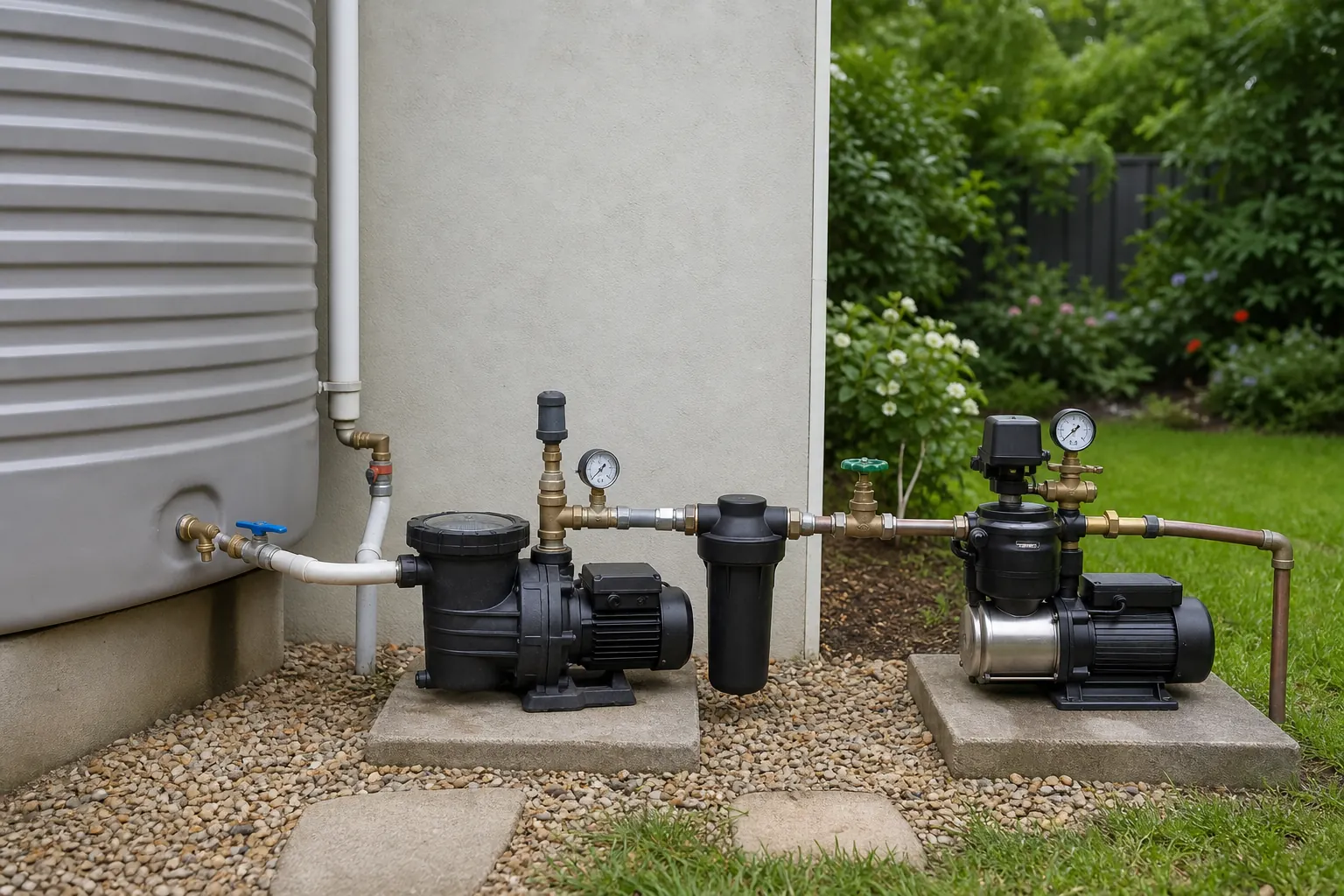
A booster adds head to an existing supply. The inlet could be a public-water line, a pressurized private system, or a pipeline served by another pump. The key number is the lowest dynamic inlet pressure while the irrigation zone and any simultaneous household demand are running. Static pressure at 2 a.m. is not enough.
Grundfos defines inlet pressure as the pressure available where the suction pipe meets the booster. That pressure may be positive or negative, but the booster model must be approved for the condition. Many compact residential booster packages expect a positive supply and are not intended to pull through a dry suction line.
Public-water boosting deserves special caution. Some utilities prohibit direct suction because it can lower pressure in the main or create contamination risk. Backflow prevention, maximum house pressure, pressure-reducing valves, and permits may apply. Ask the water provider and local plumbing authority before buying equipment.
Both choices still need a flow-and-head design point
Regardless of the label, the pump has to deliver the active zone’s gallons per minute at the required head. A listing’s maximum flow and maximum pressure occur at different operating points. Use a curve.
North Dakota State University Extension explains that irrigation pump selection depends on the total dynamic head available at a specific flow. NDSU also notes that centrifugal pumps are used for surface sources and as boosters in irrigation pipelines. Hardware may overlap; the system role and inlet conditions make the distinction.
The irrigation pump sizing guide covers the full design-point method. Use the Garden Pump Total Dynamic Head Calculator to organize pressure, elevation, pipe friction, filter loss, and other components before reading curves.
How to size a source pump from a tank
Suppose a drip and micro-spray zone needs 8 GPM at 35 psi. The highest outlet is 8 feet above the lowest operating water level. Pipe, fittings, filter, check valve, and regulator consume an estimated 12 feet of head at 8 GPM.
Convert pressure to head:
35 psi x 2.31 = 80.9 feet
Add elevation and friction:
80.9 + 8 + 12 = 100.9 feet of total dynamic head
The source-pump design point is 8 GPM at about 101 feet of head. Find that point on the pump curve. Confirm the permitted water-level range, intake arrangement, controls, and motor load. The answer is not simply “an 8 GPM pump,” because its flow at 101 feet may be far lower than its advertised maximum.
How to calculate the pressure a booster must add
Assume a sprinkler zone needs 40 psi at the nozzles and 12 GPM. The zone is 10 feet above the booster, which adds about 4.3 psi of elevation requirement. Downstream pipe, valves, and filter lose 6 psi at 12 GPM. Required booster outlet pressure is approximately:
40 + 4.3 + 6 = 50.3 psi
The measured dynamic inlet pressure falls to 25 psi at that same demand. The booster must add:
50.3 – 25 = 25.3 psi
Convert the added pressure to head if the curve uses feet:
25.3 psi x 2.31 = 58.4 feet of added head at 12 GPM
Now check the booster curve at 12 GPM and about 58 feet of added head. Also test the high-inlet case. If inlet pressure rises to 45 psi when demand is low, the combined outlet could exceed the rating of tubing, valves, or irrigation components unless controls limit it.
Measure flow before choosing either pump
Add only devices that operate together. Sequential zones do not all count toward pump GPM, but simultaneous household or hose use may matter. The Drip Irrigation Flow and Runtime Calculator totals emitter demand. The Garden Water Demand Calculator estimates volume over a day or week. Instantaneous GPM selects the pump; daily gallons size storage and source capacity.
A 2 GPM drip zone and a 14 GPM sprinkler zone can create a control problem for one fixed-speed pump. The large zone sets peak flow, while the small zone may cause rapid cycling or operation below the pump’s minimum recommended flow. Consider zone redesign, a pressure tank, variable-speed control, or a pump specifically able to cover the range.
Controls matter as much as the pump body
A manual transfer pump can be switched on for one task. An automatic irrigation system needs a coordinated start and stop method. Common parts include:
- Pressure switch or pressure sensor
- Flow sensor or demand controller
- Variable-speed drive for constant-pressure operation
- Pressure tank to supply small draws and reduce starts
- Check valve where the pump design requires one
- Low-level float or dry-run protection for tanks and wells
- High-pressure shutdown and motor overload protection
- Backflow prevention required by the water source and local code
NC State describes a pressure tank as stored pressurized water that reduces cycling for small demands. It is not the same as a large atmospheric irrigation tank. A pressure tank’s usable drawdown is only part of its shell volume and changes with pressure settings.
Do not stack pumps without a system check
Adding a booster after an existing well pump or transfer pump can work, but it also changes both pumps’ operating points. The first pump must supply the booster inlet without cavitation or starvation. Check valves, pressure switches, and variable-speed controls can fight each other. The combined shutoff pressure may exceed pipe ratings.
Draw the whole path from water level to the most demanding outlet. Record pressure at key points while the zone runs. A pump professional can then check both curves and the control sequence. Buying another pump because a gauge looks low is a poor substitute for finding a clogged filter, undersized pipe, failing pressure tank, or worn source pump.
Water quality and filtration affect the choice
Ponds and tanks can carry sediment and organic debris. Wells may carry sand or mineral deposits. Include intake screening and filter loss at the design flow. A clogged filter increases required head and reduces inlet conditions. Filter selection belongs upstream of the final curve check.
Solar pumping adds another layer because available power changes through the day. The solar irrigation pump kit guide explains how a storage tank can decouple slow daytime pumping from a shorter irrigation cycle. Do not call every small solar transfer pump a booster simply because it raises pressure.
Final irrigation pump vs booster pump checklist
- Identify whether the inlet is nonpressurized, flooded, under suction lift, or positively pressurized.
- Measure the lowest dynamic inlet pressure at peak simultaneous demand.
- Calculate active-zone GPM.
- Calculate total head for a source pump or added head for a booster.
- Check the exact curve at that flow and head.
- Verify suction, priming, submergence, NPSH, and water-quality limits.
- Check both low-inlet and high-inlet outlet pressure.
- Design controls for the largest and smallest zones.
- Confirm utility approval, backflow protection, electrical supply, and pressure ratings.
Compare irrigation and booster pumps on Amazon (paid link). Reject any candidate that lacks a readable pump curve, inlet-condition limits, pressure rating, control description, dry-run guidance, and service support for the intended source.