Disclosure: This page contains affiliate links. As an Amazon Associate, Yard Foundry earns from qualifying purchases.
Reliable irrigation water tank sizing starts with a water balance, not a round tank size. Calculate the landscape’s demand during the period you want to cover, subtract only the refill you can depend on during that same period, add a working reserve, then divide by the fraction of the tank that is actually usable. A buffer tank for a slow well may need to bridge one irrigation cycle. A rainwater cistern expected to cover dry weather may need days or weeks of storage. Those are different design problems.
This is a planning guide for nonpotable landscape irrigation. Local rules govern rainwater harvesting, cross-connections, backflow prevention, setbacks, overflow, foundations, and potable uses. Large tanks, buried tanks, and any connection to household plumbing deserve qualified design.
The core sizing formula
For a tank that receives a predictable refill while irrigation operates, use:
Required usable storage = (irrigation demand during the design period – reliable refill during the design period) + working reserve
Then convert usable storage to the nameplate tank capacity:
Nominal tank capacity = required usable storage / usable fraction
The usable fraction accounts for water below the pump intake, freeboard below the overflow, sediment allowance, float-switch settings, and any volume you deliberately keep as a dry-run reserve. If 90 percent of a tank can be used, divide by 0.90. Do not quietly assume every gallon on the label reaches the irrigation line.
For full dry-day autonomy with no dependable refill:
Required usable storage = daily irrigation demand x target dry days + working reserve
Use the Garden Water Demand Calculator to estimate daily or weekly landscape volume. It answers the demand side. The Garden Water Tank Size Calculator turns that demand, autonomy target, refill, reserve, and usable fraction into a starting capacity.
Decide what the tank must accomplish
A tank can solve several problems, and each one sets a different design period.
| Tank job | Design period | Critical input |
|---|---|---|
| Bridge a slow source during one irrigation zone | Longest or highest-demand cycle | Zone GPM minus simultaneous source GPM |
| Limit how often a well or transfer pump starts | Desired refill and rest cycle | Source flow, controls, and minimum safe run time |
| Supply several dry days | Chosen autonomy in days | Peak-season daily gallons |
| Store harvested rain between storms | Monthly or daily water balance | Catchment yield, rainfall pattern, and demand timing |
| Provide emergency reserve | Defined outage scenario | Essential zones only, not normal full-yard demand |
Write one sentence before calculating: “This tank must…” If the sentence says it must bridge a 75-minute drip cycle, do not size it from annual rainfall. If it must cover a five-day source outage, a single-cycle deficit is not enough.
Step 1: measure irrigation demand
Use actual zone data when the system already exists. Add emitter flow, read sprinkler nozzle charts at operating pressure, or measure source volume over a known time. Do not multiply the pump’s maximum GPM by hours and call that plant demand. The pump may be capable of more water than the zone applies.
For drip, total the emitters that run together. One hundred 1 GPH emitters use 100 gallons in a one-hour cycle. If two identical zones run sequentially, the tank supplies 200 gallons over two hours, not 200 gallons at once. The Drip Irrigation Flow and Runtime Calculator helps keep flow and duration in the same units.
For area-based planning, one inch of water over one square foot equals about 0.623 gallon. Adjust for effective rainfall and irrigation efficiency rather than assuming every applied gallon enters the root zone. EPA’s WaterSense Water Budget Tool uses local climate, landscape area, plant water needs, and irrigation design to compare estimated landscape water use. EPA notes that the tool is for design-level water budgeting, not real-time scheduling.
Size from a demanding but credible period. An annual average can hide a hot, dry week. An extreme emergency number can make the tank unaffordable. State the chosen scenario so the owner knows what the capacity can and cannot cover.
Step 2: calculate the refill you can count on
Reliable refill might come from a low-yield well, a timed municipal fill, a spring, or another tank. Measure its sustained rate under the conditions that matter. A well that produces 5 GPM for ten minutes but falls sharply during a two-hour test does not provide a dependable 5 GPM irrigation refill.
Rain is not a reliable refill for a dry-day calculation. It belongs in a separate probability or monthly water-balance model. When the design goal is to survive four rainless days, set rainfall refill to zero for those four days.
Check whether refill continues while the irrigation pump runs. Some systems can fill and draw at the same time. Others isolate the source, pause filling, or have controls that restrict simultaneous operation. Use the real control sequence.
Worked example: bridge a slow source
A sprinkler zone needs 10 GPM for 60 minutes. The source can deliver a sustained 3 GPM into the tank during the cycle. The net draw from storage is:
(10 GPM – 3 GPM) x 60 minutes = 420 gallons
Add an 80-gallon working reserve for intake submergence, controls, and ordinary variation. Required usable storage becomes 500 gallons. If only 90 percent of the nominal tank volume is usable:
500 gallons / 0.90 = 556 gallons nominal
The next standard size above the result may be 600 or 650 gallons, depending on the supplier. The 420 gallons removed during the cycle will take 140 minutes to replace at 3 GPM if nothing else draws water. That refill time limits how soon the same high-demand zone can run again.
This example does not size the delivery pump. The pump still must supply 10 GPM at the required total dynamic head. The irrigation pump sizing guide owns that calculation.
Worked example: cover several dry days
Suppose a garden needs 360 gallons per day during the selected peak period. The owner wants four full days without refill and keeps 120 gallons as a reserve above the low-level cutoff.
360 gallons/day x 4 days + 120 gallons = 1,560 gallons usable
At an 88 percent usable fraction:
1,560 / 0.88 = 1,773 gallons nominal
A nominal 1,800-gallon tank barely meets the arithmetic. A 2,000-gallon tank provides more practical margin, but only if the foundation, space, overflow, budget, and refill supply can support it. Storage alone does not create water. If the source cannot replenish what irrigation removes over the season, a larger empty tank only delays the shortage.
Rainwater storage needs a supply-and-demand balance
For a rainwater system, compare capture and use month by month, or day by day when reliability matters. Oklahoma State University Extension gives this monthly collection equation:
Harvested gallons = 0.6 x monthly rainfall in inches x roof footprint in square feet x collection efficiency
OSU uses a 0.90 efficiency assumption when better information is absent and stresses that cistern sizing depends on both rainfall timing and demand. Roof footprint means the horizontal area covered, not the sum of sloped roof surfaces. Gutter overflow, first flush, splash, leaks, and evaporation reduce collection.
Run a balance in chronological order:
- Start with the water in storage.
- Add capture for the period, limited by remaining tank space.
- Subtract irrigation demand.
- Apply the low-level reserve.
- Record overflow and any shortage.
A yearly total can look generous while the tank empties in July. The timing of storms matters. If municipal or well backup is available, define exactly when it opens and whether an air gap or other backflow protection is required.
Usable volume is smaller than tank volume
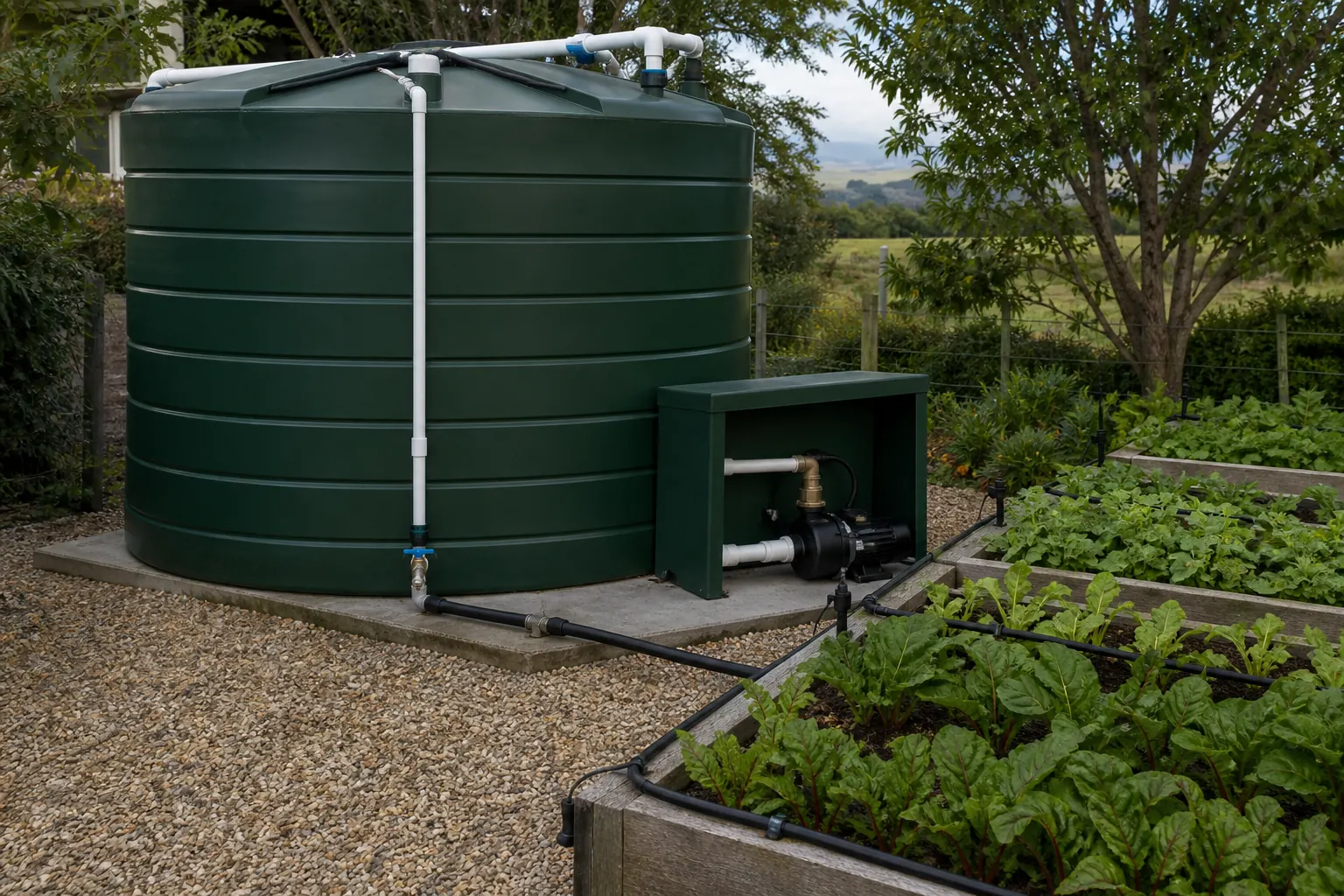
The pump intake cannot normally draw the tank to a bone-dry bottom. Sediment collects below the outlet. A submersible pump needs adequate submergence and dry-run protection. An aboveground tank needs freeboard and an overflow path. Float switches have spacing between start and stop levels.
Ask the tank and pump suppliers for:
- Nominal capacity and actual volume at the overflow elevation
- Outlet height and unusable volume below it
- Minimum water depth over a submersible intake
- Float-switch on and off elevations
- Required freeboard, venting, and overflow capacity
- Allowance for settled material and cleaning access
Do not use an arbitrary 90 percent for final construction when exact dimensions are available. Calculate the operating volume between the upper control level and the low-level cutoff.
Tank weight, base, and location are design inputs
Water weighs about 8.34 pounds per gallon. A full 1,000-gallon tank carries roughly 8,340 pounds of water before adding the tank, fittings, pump, and enclosure. OSU Extension calls for a flat foundation that can support full weight and warns that an empty buried tank can become buoyant when groundwater rises.
Keep aboveground storage opaque or shielded from sunlight to limit algae and UV damage. Screen vents and overflow openings against insects while preserving airflow. Route overflow away from foundations, slopes, neighboring property, and septic components. Provide safe access for inspection and cleaning without creating an open-water hazard.
Cold climates add freeze protection. Hot climates raise water-temperature and material-compatibility questions. Local codes may restrict tank placement or rainwater uses. Check before delivery, because a large tank is expensive to move.
The tank does not replace pump and pressure design
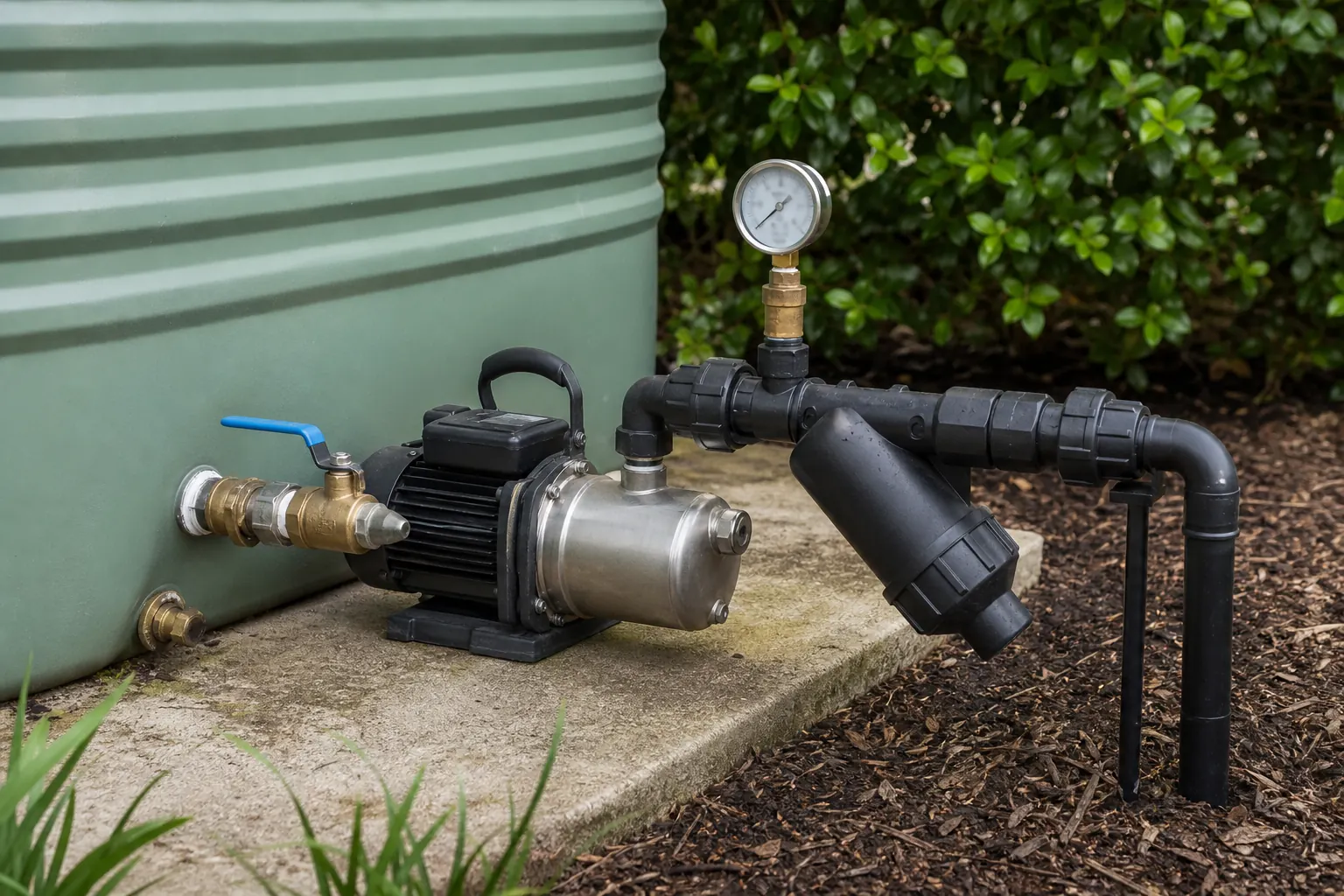
A tall water column creates some gravity pressure, but a typical ground-level tank will not run ordinary sprinklers well without a pump. The delivery system still needs the active zone’s GPM, required outlet pressure, elevation lift, and friction loss. If solar power is involved, the solar irrigation pump kit guide covers the separate match among pump, array, controller, and storage strategy.
Protect the pump from dry running. Include filtration suitable for the water source and emitters. A pressure tank may reduce rapid pump cycling, but it is not the same as a bulk irrigation storage tank. Its usable drawdown can be much smaller than its shell volume.
Final irrigation water tank sizing checklist
- State the tank’s exact job and design period.
- Calculate peak-season demand from real zone flow and runtime.
- Subtract only refill that is sustained and available during that period.
- Add a defined reserve instead of a vague safety factor.
- Convert usable gallons to nominal capacity from actual control elevations.
- Check refill time before scheduling the next zone.
- For rainwater, run a chronological supply-and-demand balance.
- Verify foundation load, overflow, venting, screening, freeze exposure, and code.
- Size the pump and filtration separately.
Compare irrigation water storage tanks on Amazon (paid link). Treat the calculator result as a minimum planning volume, then verify usable capacity, fittings, material rating, dimensions, freight access, foundation requirements, and local rules before ordering.