Disclosure: This page contains affiliate links. As an Amazon Associate, Yard Foundry earns from qualifying purchases.
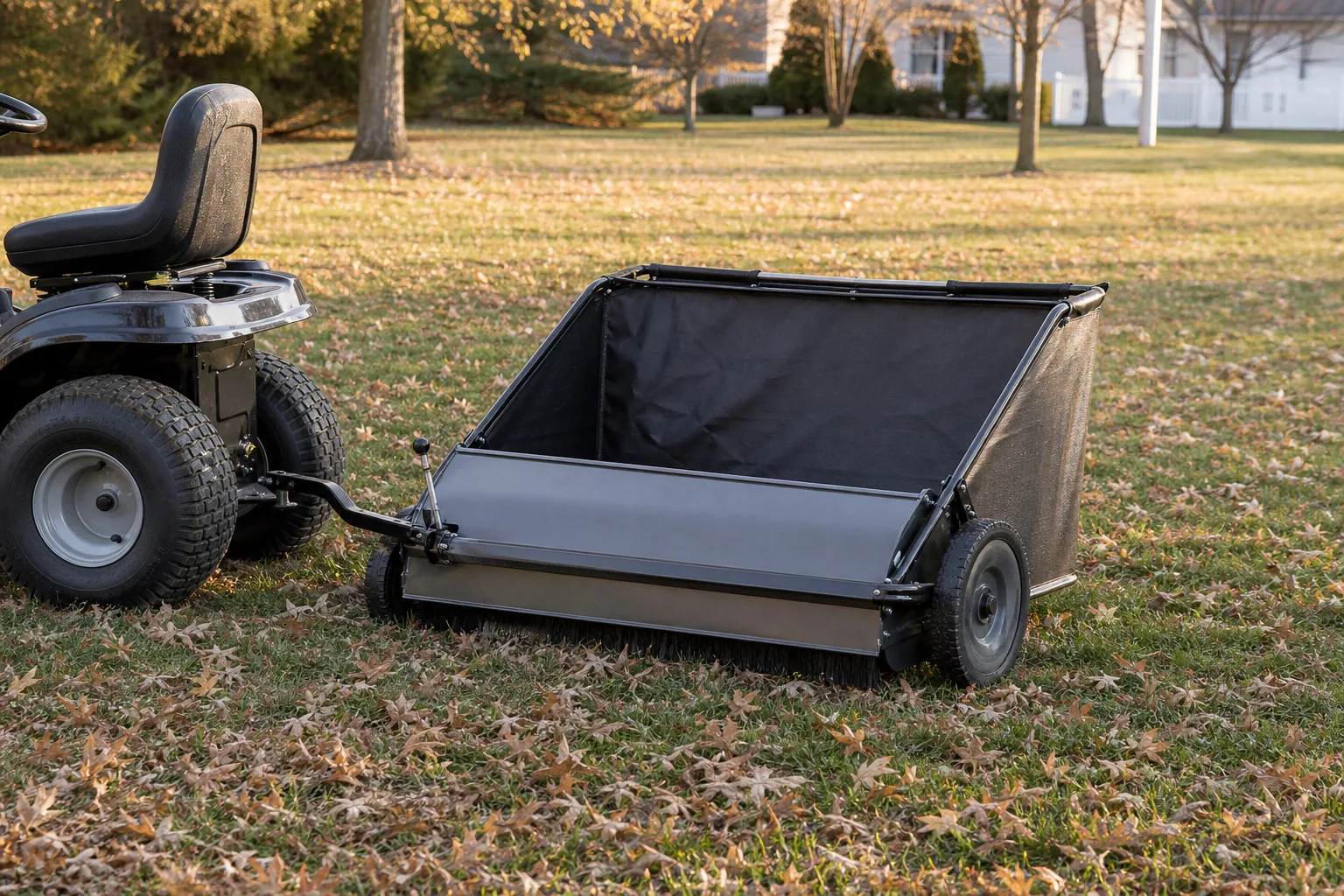
A tow behind lawn sweeper is worth considering when a riding mower already covers the property and dry leaves, grass clippings, pine cones, or light lawn debris require repeated cleanup. Choose by tow-vehicle compatibility, working width, brush adjustment, loaded hamper weight, dumping access, and storage footprint. Hopper volume matters, but a large fabric bag that becomes too heavy to dump is not useful capacity.
This is a research-based buying guide, not a hands-on product test. Yard Foundry has not operated the sweepers discussed here. Speed limits, load limits, hitch setup, brush depth, and permitted debris must be confirmed in the manual for the exact model.
Choose a tow behind lawn sweeper for the actual cleanup job
A lawn sweeper uses its ground wheels to drive rotating brushes. The brushes lift loose material from the surface and throw it into a trailing hamper. It does not have the suction of a vacuum, and it does not cut or loosen material that is embedded in turf.
That distinction saves a lot of disappointment. A sweeper is well suited to dry, loose leaves on a reasonably even lawn. It may also collect clippings, small seed pods, and light twigs. It is not a substitute for dethatching. Brinly’s STS sweeper manual specifically warns that the machine cannot pull embedded thatch, needles, or leaves from the grass. If compacted thatch is the problem, compare the tools in the aerator versus dethatcher guide.
Wet debris is another poor match. Water makes leaves and clippings heavier, more adhesive, and harder to dump. Mud can pack around brushes and wheels. Ohio Steel’s sweeper instructions tell operators not to sweep wet or muddy material and to remove large debris first. Plan to work after the surface dries rather than using an oversized hamper to overpower bad conditions.
Match the hitch and tow vehicle before comparing capacity
Start with the tractor or riding mower manual. Confirm that it permits a pin-hitch tow-behind implement and check any attachment or tongue-weight limits. A universal-looking drawbar does not make every combination safe. The tow vehicle still has to steer, brake, and remain stable with a full hamper behind it.
The sweeper body should run close to level when attached. A tongue angled sharply up or down changes the relationship between the brushes, housing, and lawn. Some models use spacer bushings or multiple hitch holes to match different hitch heights. Include those parts in the assembly check rather than improvising a stack of loose hardware.
Measure the hitch-pin diameter, vertical hitch height, clearance around the rear of the mower, and the route of the dump rope. The rope belongs where the operator can reach it without wrapping it around a body part or allowing it near wheels and rotating parts. Agri-Fab’s 52-inch sweeper manual gives that warning directly.
Working width is a route-planning decision
A wider sweeper covers more lawn per pass. It also needs a wider gate, more turning room, and more storage wall. The useful width is the largest machine that can travel from storage to the work area without being disassembled. Measure narrow gates, shed doors, paths between beds, trees, parked vehicles, and the inside corner where the unit will turn.
Wider is not automatically faster on a divided property. A 52-inch unit that cannot pass a 48-inch gate creates extra handling every time it is used. On an open lawn, width can reduce passes. Around trees and beds, a narrower sweeper may follow the mower more neatly and leave fewer missed arcs.
Check the full assembled width, not only the advertised sweep path. Wheels, hamper tubes, adjustment levers, and fasteners may extend beyond the brushes. Also check transport position if the model folds.
Brush contact controls pickup and resistance
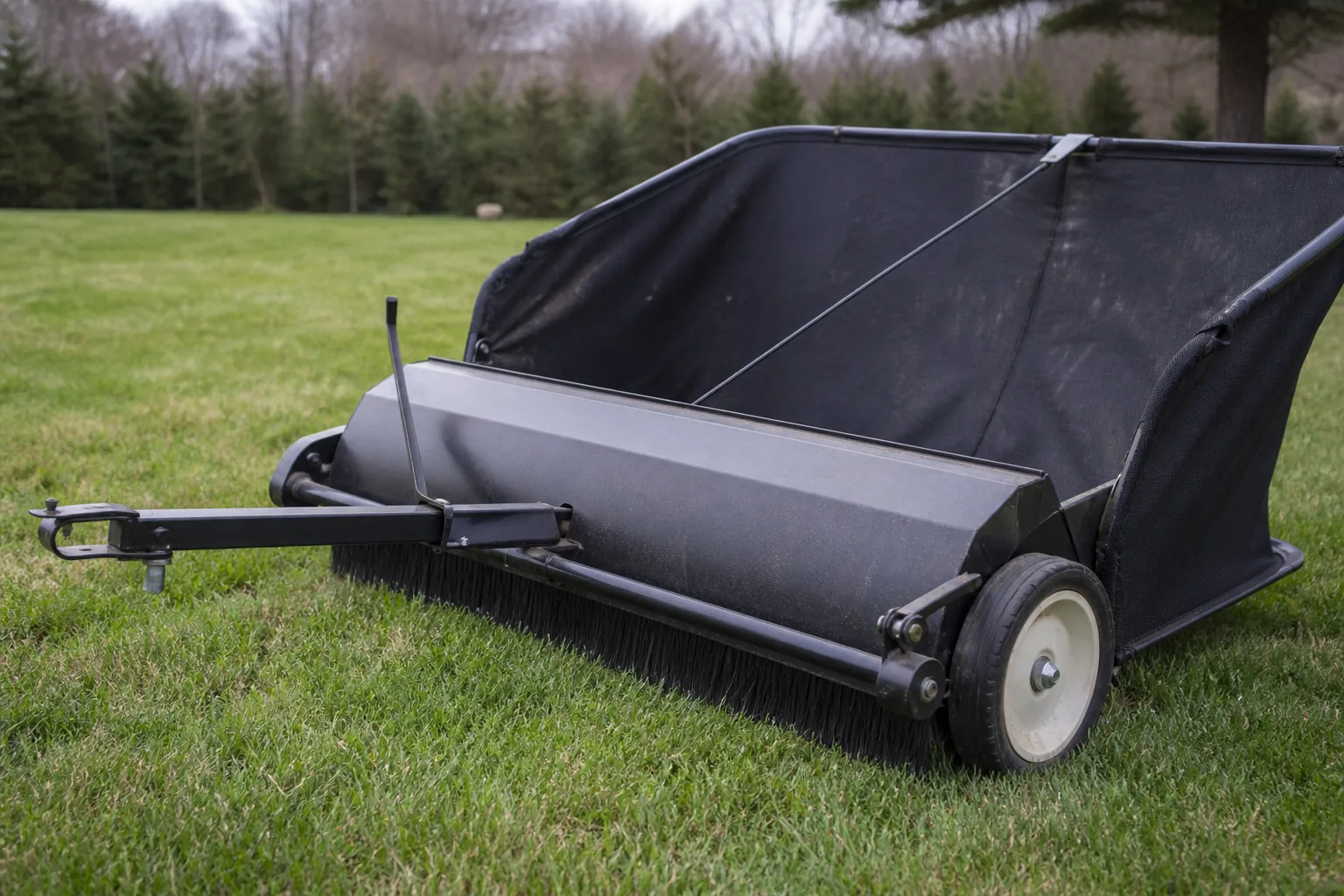
The brushes should touch the material without digging deeply into the turf. Too high, and debris stays behind. Too low, and the tractor pulls harder while the brushes scrub grass and wear faster. Several manufacturer manuals converge on a starting point near one-half inch into the grass, followed by small adjustments for the surface and mowing height.
Agri-Fab recommends starting near one-half inch and mowing to an even height before sweeping. Ohio Steel advises using the highest setting that still collects the material because extra depth increases resistance. Brinly suggests setting brush height near the mower’s cut height, then lowering one notch at a time if needed. These are starting procedures, not one universal dimension for every brush design.
Look for an adjustment that is easy to repeat and difficult to knock out of place. A visible index, positive detents, or a secure hand knob makes seasonal changes less frustrating. Check whether both sides remain level as height changes. Replacement brushes, brush retainers, wheel gears, and bearings should be available before purchase.
Understand the ground-drive system
The wheels do more than carry the frame. On most residential sweepers they power the brushes through gears. Wheel traction, tire diameter, brush gearing, and direction of travel all affect collection. A wheel that skids on damp grass cannot drive the brush consistently.
Inspect the manual’s parts diagram. Look for replaceable wheel gears or pinions, accessible brush shafts, and a clear lubrication schedule. Some designs drive from one wheel; others use both. The category is not standardized enough to assume that a larger tire or higher brush-to-wheel ratio is better without seeing how the model behaves at its permitted speed.
Never back up as a normal sweeping technique unless the manual expressly permits it. Brush and gear systems are designed around forward travel, and a sharp reverse turn can fold the hamper or bind the hitch.
Hamper volume is not the same as usable load
Manufacturers often advertise hamper volume in cubic feet. That tells you roughly how much fluffy debris can fit, not how much the frame, fabric, rope, or operator should handle. Moist leaves weigh far more than dry ones. Pine cones and twigs create awkward loads. A bag packed above its designed fill line can spill forward into the brush housing.
| Hamper detail | Why it matters | What to inspect |
|---|---|---|
| Rated volume | Estimates stop frequency for light debris | Manufacturer method and fill line |
| Rated load | Protects frame, fabric, and tow vehicle | Manual limit for the exact model |
| Dump geometry | Determines whether the load empties cleanly | Full-swing opening, rope route, ground clearance |
| Windscreen | Helps retain light dry leaves | Adjustment, visibility, replacement fabric |
| Fabric and seams | Take repeated abrasion and folding | Replaceable bag, reinforced corners, drainage |
One current Brinly product is advertised with a 42-inch sweep path and a 24-cubic-foot hamper, while the related manual provides its own 120-pound load limit. Those figures illustrate why volume and weight must be read together. They do not establish a category-wide target.
Dumping access can decide the whole purchase
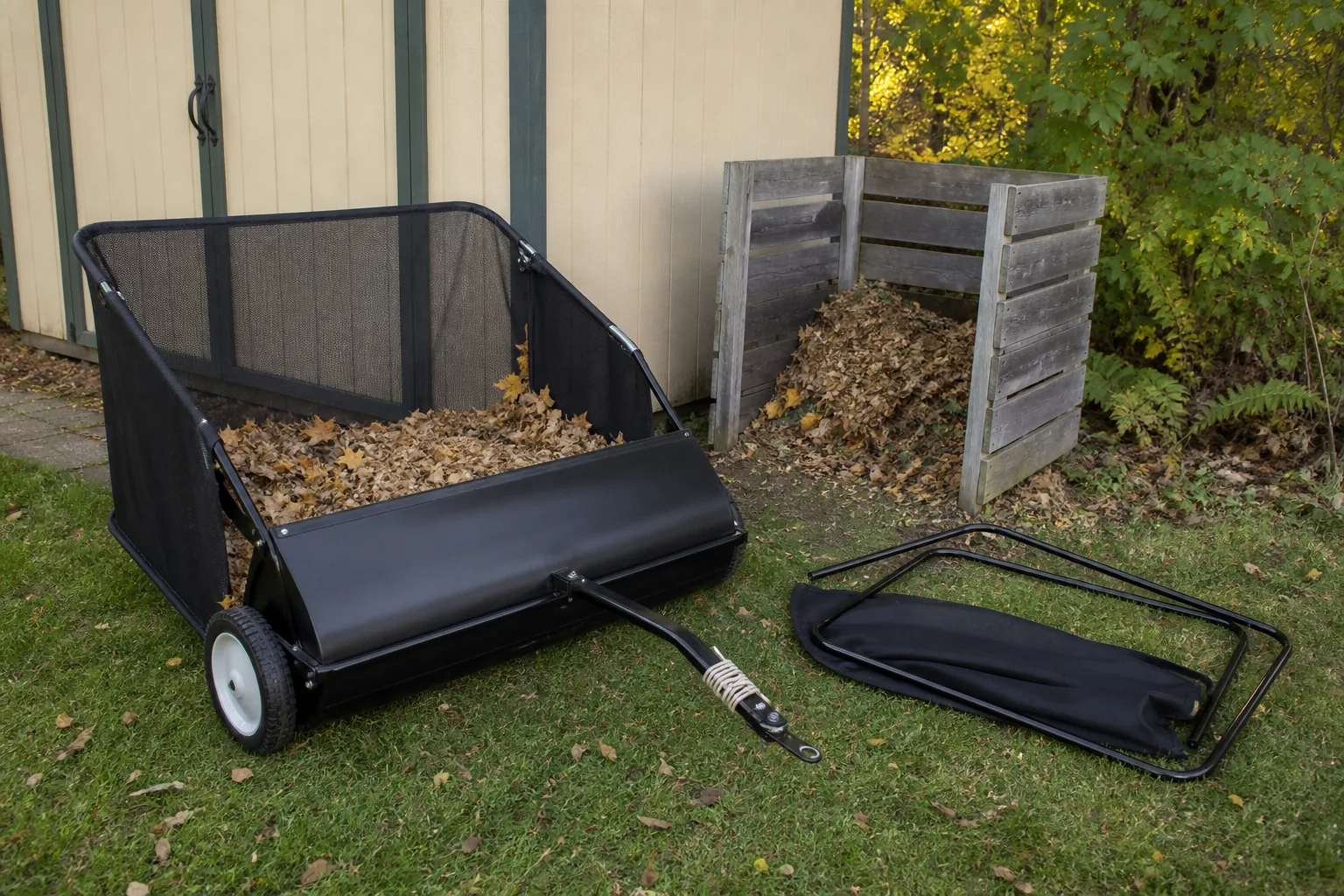
Picture the final ten feet of each load. Can the tractor approach the compost pile or curb in a straight line? Is there enough room for the hamper to swing? Will the frame strike a raised edge? A remote dump rope is useful only when its path stays clear and the operator can empty the load while seated without leaning dangerously.
Dry leaves should release with a controlled pull. Wet clippings tend to cling to fabric and may require manual cleaning after shutdown. Keep hands away from the brush area, stop the tractor, set the brake, remove the key as the manuals direct, and wait for moving parts before clearing any jam.
If the property generates material for compost, plan the receiving area before sizing the sweeper. The machine may save collection time but still create a bottleneck if every load must be hand-carried around a fence.
Speed should be boring
Sweeping faster does not guarantee better pickup. Brushes can throw material past the hamper, wheels can bounce, and turning forces rise. Manufacturer limits vary. The cited Agri-Fab manual suggests beginning around 3 mph and says not to exceed 6 mph. Brinly’s cited manual says best performance is typically 3 mph or less and gives a 5 mph maximum for that model. Ohio Steel advises starting at the slowest speed.
Use the exact manual’s lower limit. Make the first pass straight and slow. Increase only if collection stays clean and the ground remains smooth. Reduce speed before slopes, turns, bumps, roots, and full-load transport. If the tractor feels pushed during braking, the combination is too fast, too heavy, or unsuitable for the terrain.
Storage is a feature, not an afterthought
A large hamper consumes floor space long after leaf season. Check whether it folds without tools, whether the frame stores upright, and which parts must be removed. Record folded dimensions from the manual. Confirm that upright storage is specifically permitted and stable, especially around children.
Empty and clean the hamper after use. Agri-Fab warns that stored grass and leaves can present a spontaneous-combustion hazard. Let fabric and the brush housing dry before folding. Remove wrapped string and vegetation from the shafts, inspect wheel gears, and store the unit in a dry place.
A clear shed route matters here. If the building is already crowded, the shed sizing guide offers a better planning method than hoping a 5-foot implement will stand behind the door.
How a sweeper fits the rest of lawn care
A sweeper cleans the surface. It does not relieve compaction, create seed holes, or remove rooted thatch. For compacted lawns, the tow-behind lawn aerator buying guide covers a different attachment class. The plug versus spike aerator comparison explains why those tools should not be chosen by appearance alone.
Timing also matters. Heavy cleanup traffic on saturated soil can create ruts. The lawn aeration timing guide helps separate ordinary surface cleanup from the period when soil recovery work is appropriate.
A practical shortlist
- Confirm the tow vehicle permits the attachment and loaded weight.
- Measure every gate, door, turn, and storage position.
- Favor repeatable brush-height adjustment and available replacement brushes.
- Read the rated hamper load as well as cubic-foot capacity.
- Check the dump rope route, swing, and approach to the disposal point.
- Verify model-specific speed, slope, wet-debris, and reverse-travel rules.
- Price replacement fabric, wheel gears, bearings, and hitch hardware.
- Choose a folding or upright design only when the manual supports that storage method.
Compare tow-behind lawn sweepers on Amazon (paid link). Open the candidate manual before ordering and verify assembled width, hitch-height adjustment, brush service, actual load limit, speed, and folded dimensions.
The right sweeper is not necessarily the widest or the one with the largest hamper. It is the model that fits the tractor, reaches every part of the property, lifts the recurring dry debris at modest brush contact, dumps where the material belongs, and still fits through the shed door when the season ends.