Disclosure: This page contains affiliate links. As an Amazon Associate, Yard Foundry earns from qualifying purchases.
This guide compares tow-behind aerator types and operating constraints. Yard Foundry did not measure compaction relief from every model.
Compacted soil can leave a lawn thin even when fertilizer and watering look reasonable. A tow-behind aerator covers a larger property faster than a walk-behind rental, but it needs enough towing traction and the right soil moisture to do useful work.
The first choice is plug versus spike. They are not interchangeable.
See tow-behind plug aerators on Amazon
For lasting relief of soil compaction, hollow tines that remove plugs are not interchangeable with solid spikes. The University of Minnesota Extension recommends core aerification and explains that the machine should make several passes in different directions. See its lawn aeration guidance.
Plug aerators remove soil cores
Hollow tines cut and lift small plugs from the lawn. The openings give compacted soil room to expand and improve movement of air and water. Cores left on the surface break down with mowing and rain.
Plug aeration is the usual choice for real compaction. It works best when soil is moist enough for the tines to enter but not muddy. Bone-dry clay produces shallow results, while saturated ground can smear and rut.
Spike aerators make holes without removing soil
Solid spikes puncture the surface. They are simple and less likely to clog, but they push soil aside rather than removing a core. On heavily compacted soil, that can compress the sides of each hole.
Spike units can still help with light surface work or preparing for overseeding on suitable soil. They are not a direct substitute for a hollow-tine machine when compaction is the main problem.
Working width and turning room
A wide aerator reduces passes on open turf. It also needs a wider gate, more storage, and careful turns. Raised tines should clear paths and driveways during transport.
Measure the narrowest access point on the property. An extra foot of working width isn’t useful if the machine can’t reach the back lawn.
Weight trays and penetration
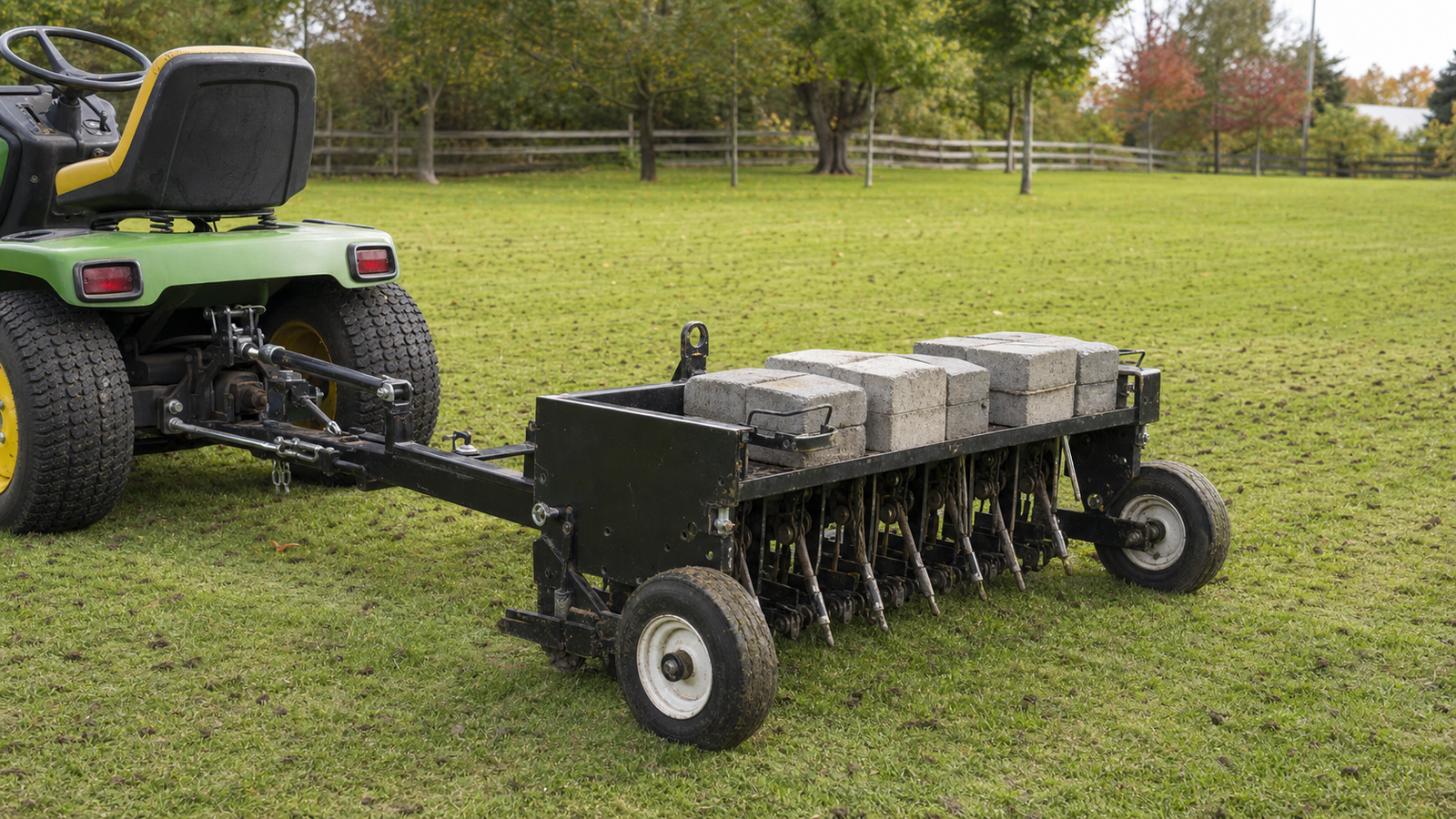
Many tow-behind aerators use a top tray for concrete blocks or other ballast. More weight can improve penetration, but the frame, hitch, tires, and towing vehicle all have limits. Follow the manual’s maximum load.
Secure every weight. Loose blocks can shift on a slope or fall into the tine assembly. Purpose-made ballast or strapped flat blocks are safer than a stack balanced on edge.
Can your mower or tractor pull it?
Check the towing vehicle’s manual for attachment and slope limits. Ballast weight, aerator weight, operator weight, and terrain all affect traction and braking. A light lawn tractor may spin its tires before a heavily weighted aerator reaches full depth.
Four-wheel-drive garden tractors and utility vehicles have more traction, but they can still damage wet turf. Use gentle turns and avoid steep cross-slope travel.
Tine construction and service
Hollow spoons hit stones and hard soil. Replaceable individual tines are easier to live with than a welded assembly that becomes useless after damage. Check bearing or bushing grease points, wheel hardware, and lift mechanisms.
Open spoons can clog with dense soil. Designs that allow access from both ends are easier to clean once safely raised and blocked.
Transport controls
A lever or actuator raises the tines for crossing pavement. The control should be reachable and should lock securely. Some wide units offer a seat-mounted control; others require dismounting.
Never work beneath a raised aerator supported only by its lift mechanism. Use solid stands and follow service instructions.
When to aerate
Aerate while grass is actively growing so it can recover. Cool-season lawns are commonly aerated during cooler growth periods, while warm-season grass is handled during its active warm season. Avoid aerating heat-stressed or dormant turf.
Mark sprinkler heads, shallow irrigation, invisible fence wires, and landscape lighting before starting. Deep tines can turn an ordinary lawn job into a repair project.
Ownership versus rental
Buying makes sense for a large property that needs regular aeration and already has a capable towing machine. Renting a commercial core aerator may be better for a small lawn or severe one-time compaction. Storage is part of the math because tow-behind implements consume floor space.
How to compare tow-behind lawn aerators
- Choose hollow tines for meaningful compaction relief.
- Match total loaded weight to the towing vehicle.
- Confirm gate width and transport clearance.
- Look for replaceable tines and available parts.
- Use a secure ballast tray and reliable lift lock.
- Plan dry storage and safe off-season positioning.