Disclosure: This page contains affiliate links. As an Amazon Associate, Yard Foundry earns from qualifying purchases.
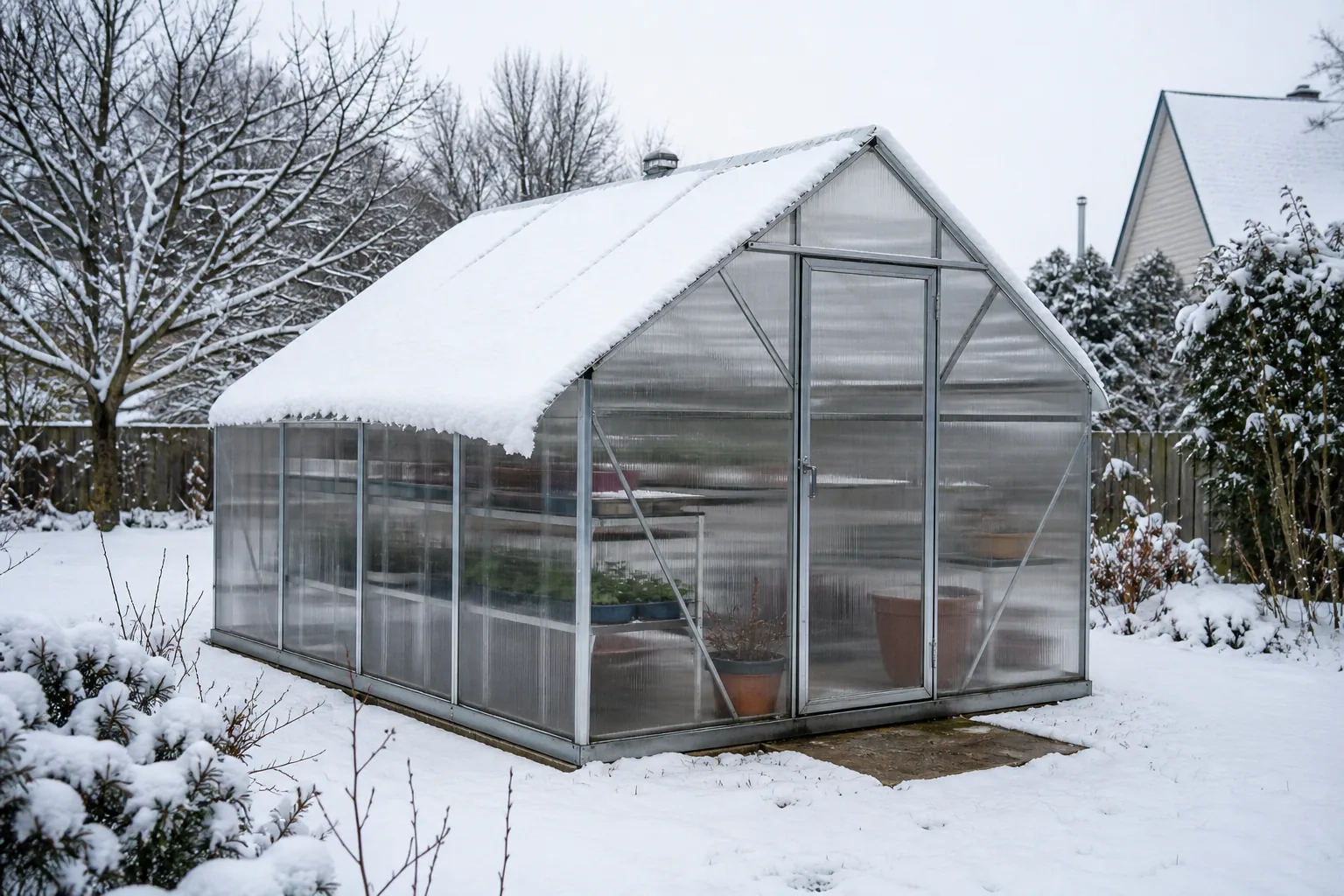
A greenhouse snow load rating only helps when it names the load, the structure, and the conditions behind the number. Before buying, look for a site-specific roof snow load in pounds per square foot, stamped or traceable engineering documents, and an installation manual that ties the rating to the exact frame, glazing, foundation, and anchor layout. A vague phrase such as “snow resistant” is not a structural rating.
This is a research based planning guide. Yard Foundry has not load tested the greenhouse kits discussed here. Local building officials, the kit manufacturer, and a qualified engineer should settle any site-specific structural question.
What a greenhouse snow load rating should tell you
Snow load is a design force, not a promise that a roof can hold a certain depth of snow. Snow density changes sharply with moisture, ice, wind, and thawing. Two storms that leave the same depth on the lawn can put very different weight on a roof.
The Greenhouse Engineering manual hosted by Cornell University explains that greenhouse design must account for dead load, live load, snow, and wind. It also notes that snow calculations depend on ground accumulation, roof slope, whether houses are freestanding or connected, and whether the structure is heated. That is why a bare “20 psf” in a product listing needs follow-up questions.
| Term in the documents | What it means for the buyer | Question to ask |
|---|---|---|
| Ground snow load | A mapped starting value for snow expected on the ground at the site | Which location and code edition does this value come from? |
| Roof snow load | The load used to design the roof after adjustments for shape, exposure, heat, and other factors | Is this the required roof load for my address? |
| Balanced snow load | Snow distributed in the assumed uniform pattern | Does the analysis also cover an uneven load? |
| Unbalanced or drift load | Snow concentrated on one roof area by wind, sliding, or a nearby taller wall | Were drift and sliding snow considered for this placement? |
| Collateral or dead load | Permanent weight carried by the frame, such as heaters, fans, pipes, or hanging systems | How much equipment may be suspended from the structure? |
Do not convert ground snow load directly into a pass or fail decision for a kit. Building rules turn that ground value into a roof design load using several adjustments. A seller should be able to provide the engineering basis or refer you to someone who can. If the only answer is a marketing sentence, treat the rating as unverified.
Read the small print around the number
A rating may apply only to one frame spacing, one glazing package, or one anchor method. Adding wider bay spacing, changing panel thickness, omitting diagonal braces, or setting the base on loose blocks can put the installed greenhouse outside the tested or engineered configuration.
Ask for the full installation manual before paying a deposit. Match its model number and dimensions to the quotation. Then find these details:
- Frame tube or extrusion size, wall thickness, alloy or steel grade, and corrosion protection
- Rafter, bow, or hoop spacing for the rated configuration
- Required purlins, ridge members, cross ties, trusses, and diagonal bracing
- Approved glazing type, panel thickness, fastener pattern, and closure profiles
- Foundation dimensions, anchor type, anchor spacing, and minimum embedment
- Any limit on hanging heaters, lights, baskets, irrigation pipe, or thermal curtains
- Conditions that require snow removal or continuous heat
The University of Florida’s greenhouse design guidance treats permanently supported fans, heaters, and piping as dead load. Those items do not disappear when snow arrives. If you plan to hang equipment, get an allowable collateral-load value rather than assuming the roof has spare capacity.
Balanced snow is not the hardest case
Snow rarely settles as a tidy, even blanket. Wind can strip one roof face and pile snow against another. Snow can also slide from a house, barn, or taller greenhouse and land on the lower structure. Gutter-connected houses collect snow where roof slopes meet. These patterns concentrate weight on fewer frame members.
The engineering documents should address the placement you intend to use. A kit designed as an isolated freestanding structure may need another review when installed beside a tall wall. The same concern applies to a lean-to greenhouse attached to a home, where sliding snow and the wall connection deserve direct attention.
Spacing matters too. The engineering practice summarized in the Cornell manual recommends room between greenhouses in snowy areas so shed snow does not crush sidewalls. A backyard buyer may not have ten feet to spare. That does not make the problem go away; it makes a site-specific answer more important.
Roof shape helps, but it is not a rating
A steep Gothic arch or pitched roof tends to release snow more readily than a shallow curved roof. University of Maine Extension describes using a Gothic arch for that reason. Still, snow shedding depends on temperature, surface condition, wind, fasteners, and the shape of the accumulated layer. A steep profile cannot replace structural calculations.
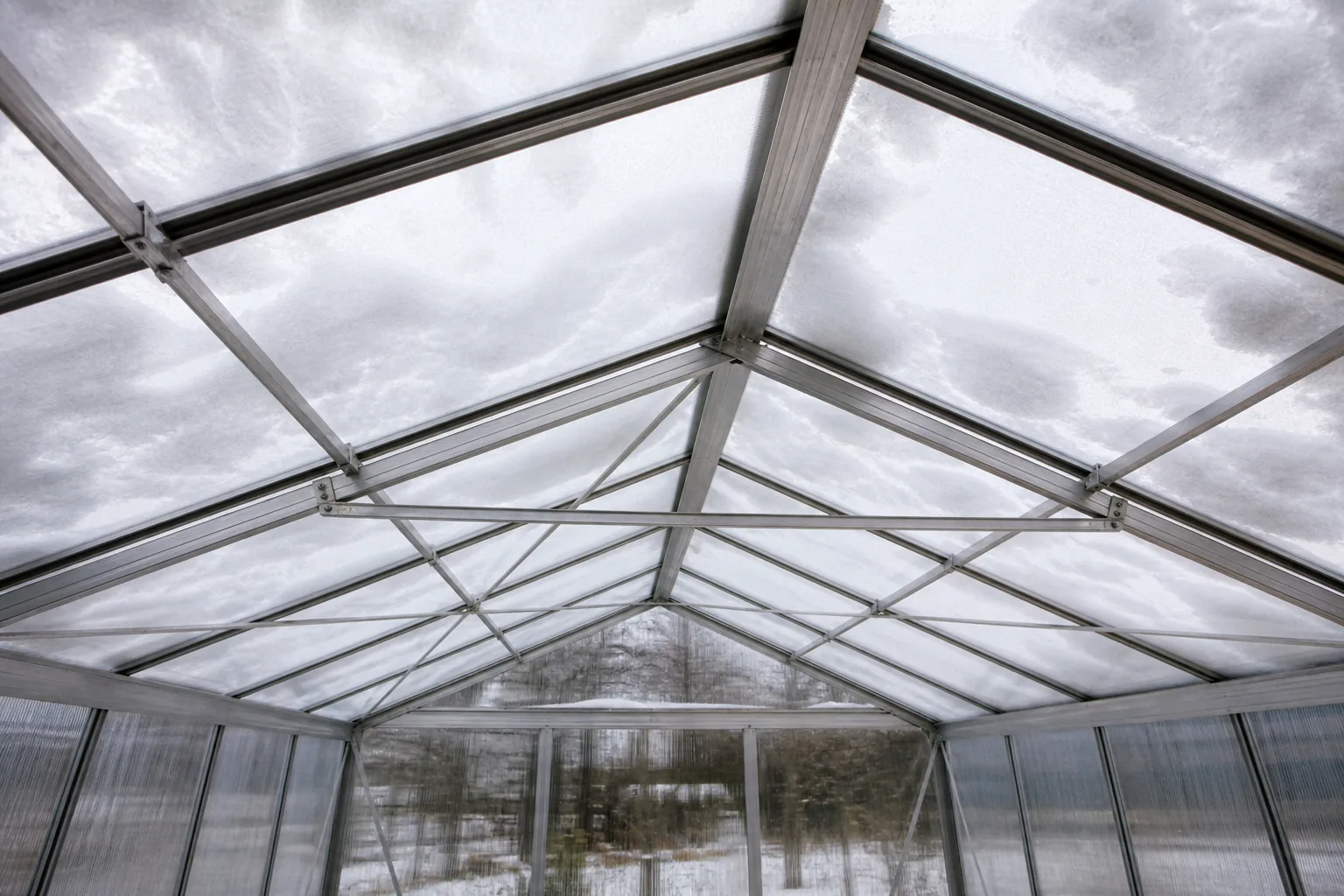
Glazing changes the load path and the way heat reaches the roof. Twin-wall polycarbonate, glass, and inflated polyethylene do not behave alike. If a manufacturer publishes a load for one covering, do not assume a different covering earns the same number. Start with the polycarbonate greenhouse kit guide if you are still comparing frames and panel systems.
Look closely at doors and end walls. A strong series of roof bows still needs braced end assemblies and connections that keep the frame square. Loose doors can admit wind pressure during a storm, while an out-of-square base makes panels and fasteners carry forces they were not meant to take.
The foundation is part of the snow-load system
Gravity pushes roof load through rafters, posts, base rails, anchors, and finally into soil or concrete. Every connection in that chain needs to stay seated and aligned. An uneven base can twist a light frame before the first winter. Frost movement can change door fit and place stress on rigid glazing.
Compare the manufacturer’s required foundation with the options in our greenhouse foundation guide. Then confirm frost depth, drainage, permit rules, and the soil bearing conditions with the local authority. A timber perimeter may suit one small kit, while another engineered package requires piers or a concrete curb.
Anchors matter during snow season even though they are often discussed as wind hardware. They keep the frame located on its foundation while loads shift. Use the exact connector type, diameter, edge distance, and spacing in the plans. Substituting whatever fastener is nearby can break the documented load path.
Compare kits with a document checklist
A fair comparison puts both kits against the same address and intended use. Price comes later.
- Find the local ground snow load and applicable code through the building department.
- Ask whether the greenhouse needs a permit even if it is sold as a hobby structure.
- Request the exact model’s structural drawings, load table, and installation manual.
- Confirm whether the published value is ground load, roof load, or a simplified capacity statement.
- Check the assumed roof shape, frame spacing, glazing, heat condition, and exposure.
- List every planned hanging item and ask whether it fits the collateral-load allowance.
- Send the site plan and documents to the building official or engineer when local review calls for it.
Be wary of a seller who cannot separate wind and snow ratings, will not send drawings until after purchase, or uses the same capacity claim for every size in a product family. A longer greenhouse may repeat identical bays, but end-wall behavior, bracing, and foundation requirements can still change.
Compare snow-rated greenhouse kit listings on Amazon (paid link). Use the listings to identify possible models, then verify every structural claim in the manufacturer’s current documents.
Plan for a storm before the greenhouse is full
Even a properly rated structure needs a winter operating plan. Inspect bracing, glazing clips, base connections, doors, and heater service before snow season. Keep the area beside the greenhouse clear enough to accept shed snow. Do not stack lumber, bins, or frozen piles where sliding snow needs to land.
Heating can help some greenhouse roofs shed snow, but the structure and glazing must be designed for that operating method. The University of Kentucky severe-weather guide recommends planning for structural loads, anchorage, and emergency preparation before a storm. The document’s regional figures are not universal specifications, so use them as an example of the process rather than a national minimum.
If the design relies on heat, a power failure changes the assumption. Size the heater with the Greenhouse Heater Size Calculator, review our greenhouse heater guide, and decide what you will do if the primary system stops. Do not climb onto a slick greenhouse roof or strike rigid panels with a shovel. NC State Extension’s snow advisory puts personal safety ahead of saving the structure, which is the right order.
Frequently asked questions
Is 20 psf a good greenhouse snow load?
It may be adequate at one address and inadequate at another. You also need to know whether 20 psf is a roof design load, what load pattern it covers, which frame configuration earned it, and whether local code requires more.
Can a heater replace a higher snow rating?
No. Heat may be one assumption in a professional greenhouse design, but a portable heater does not upgrade an unrated frame. A design that depends on heating also needs reliable fuel or power, safe equipment, air movement, and a failure plan.
Does thicker polycarbonate increase the frame’s snow capacity?
Not by itself. Panel stiffness, support spacing, fastening, frame capacity, and connection details work together. Use only the panel options listed for the engineered configuration unless the manufacturer or engineer approves the change.
Before ordering, put the seller’s load documents beside the local requirements and circle every assumption that applies to your site. If the two sets of information do not meet cleanly, pause the purchase. A greenhouse can be replaced; a guess about structural capacity should not be the reason it needs replacement.