Disclosure: This page contains affiliate links. As an Amazon Associate, Yard Foundry earns from qualifying purchases.
A useful compost tumbler buying guide starts with the amount of material you can collect for one batch. A small barrel is easy to turn but loses heat quickly and fills faster than its advertised capacity suggests. A larger tumbler handles more leaves and kitchen scraps, yet it becomes heavy when wet. For most gardens, the right choice has enough usable room to mix a batch freely, a frame that stays rigid under load, and an opening wide enough to empty without a shovel fight.
This is a research based buying guide, not a hands-on product test. Yard Foundry has not operated or timed the composters discussed here. Product capacity, permitted materials, assembly details, and warranty terms need to be checked for the exact model.
Compost tumbler buying guide: start with batch size
The gallon number on a listing describes the shell, not the amount you should pack inside. Compost needs open pore space so air can move between particles. The contents also need room to fall and remix when the barrel turns. A drum packed to the lid may rotate, but the mass can slide as one wet lump instead of tumbling.
Estimate a normal week of food scraps, dry leaves, spent plants, and small chopped stems. Then decide whether you want to collect a full batch and let it finish, or keep adding material every few days. A continuous stream of new scraps keeps resetting the age of a single chamber. That is why batch habits matter more than a headline capacity.
| Household pattern | Better starting format | Main tradeoff |
|---|---|---|
| Light kitchen scraps with stored dry leaves | Compact single chamber | Simple and easy to turn, but the batch may be too small to retain heat in cold weather |
| Steady scraps from several people | Dual chamber or two separate units | One side can cure while the other receives fresh material |
| Large seasonal garden cleanup | Large tumbler plus a holding pile or bin | The tumbler alone may not accept an autumn surge |
| Mostly leaves and woody yard debris | Open bin or three-bin system | A tumbler may be an expensive bottleneck for bulky material |
Before buying, mark out the assembled footprint and the space needed to rotate the drum. Leave room for a bucket or garden cart beneath the door. If the composter has to live behind a narrow gate, compare its fully assembled width rather than its shipping box.
Single chamber or dual chamber
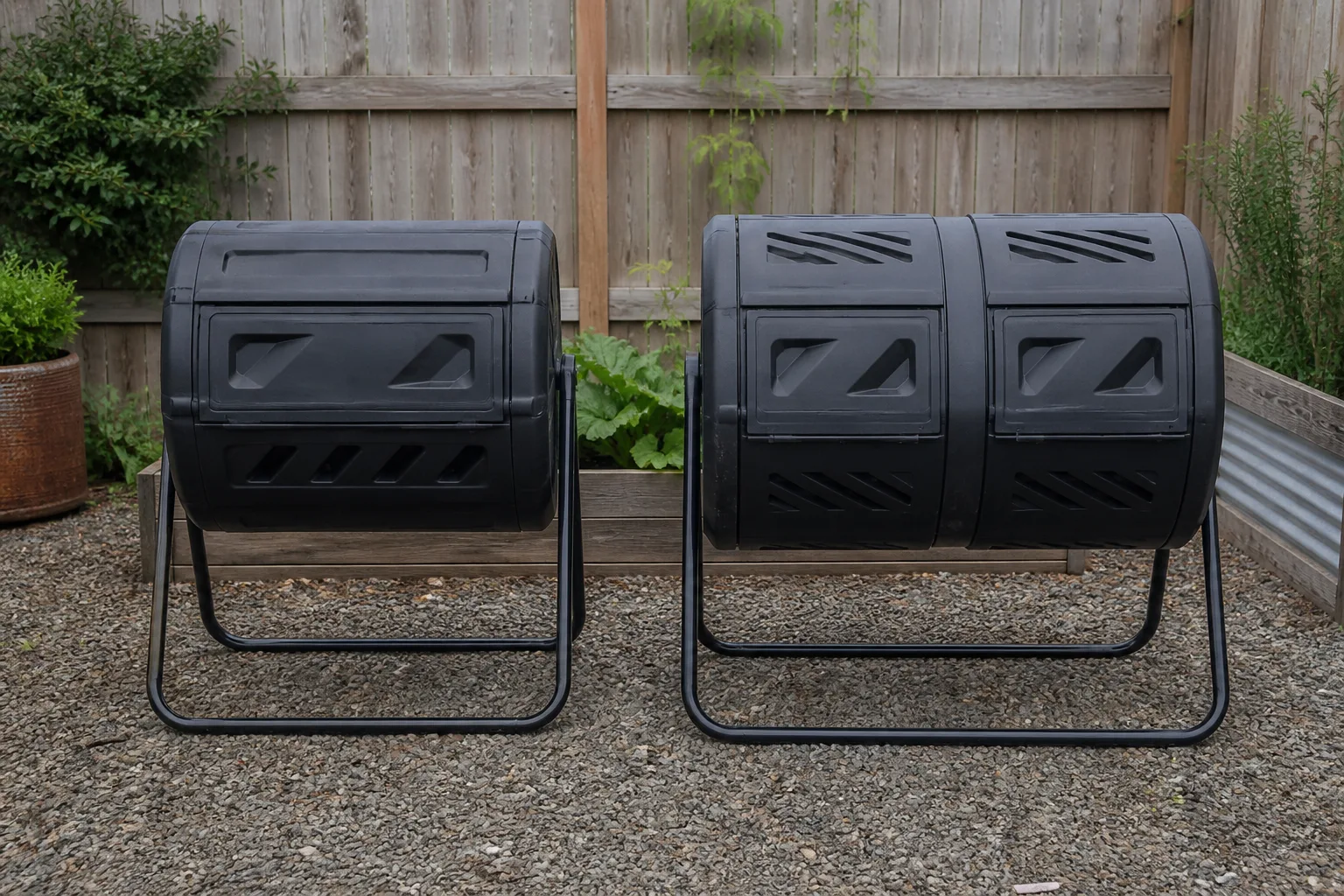
A single chamber gives one uninterrupted volume. That helps when the household can collect enough browns and greens to build a complete batch at once. It is also easier to inspect and clean because there is no divider. The drawback is timing. Once the barrel is full, fresh scraps need another destination until the first batch has decomposed and cured.
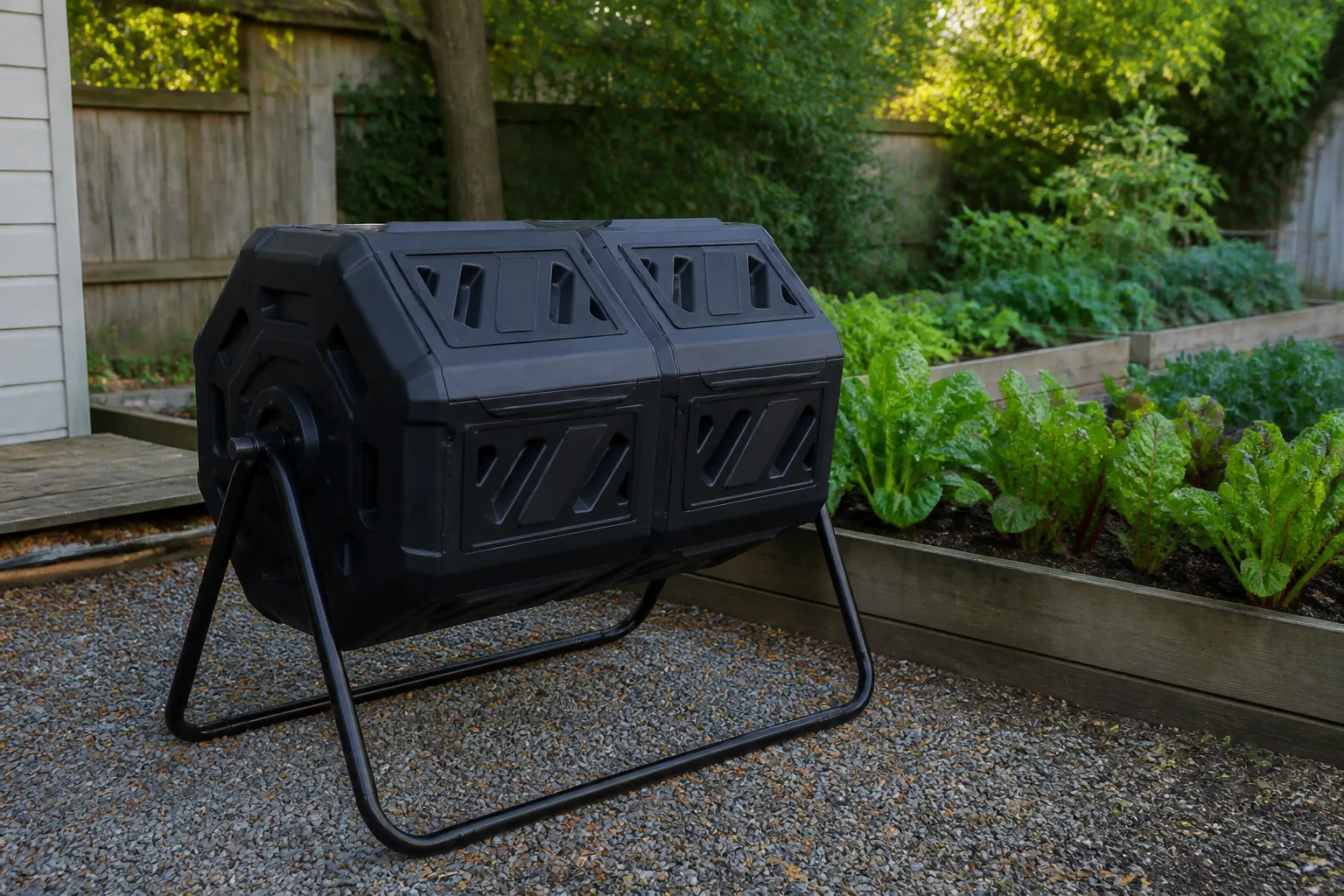
A dual chamber lets one side work while the other side fills. The routine is tidy, especially for kitchens that produce scraps every day. The divider, however, cuts each chamber into a much smaller thermal mass. A product advertised as 80 gallons may behave like two 40 gallon composters. In a cold winter, neither side may stay warm enough for rapid decomposition.
Oregon State University Extension advises that larger tumblers generally perform better and notes that small two-chamber designs can struggle to insulate themselves in winter. That does not make every large model a good purchase. It means chamber size deserves its own line in your comparison sheet.
What the tumbler can and cannot speed up
Turning helps redistribute moisture and opens air paths. It does not fix a poor ingredient mix. Composting organisms still need carbon-rich browns, nitrogen-rich greens, water, and oxygen. The EPA home composting guide recommends adding two to three times the volume of browns to greens as a practical starting point, then adjusting for moisture and odor.
Tumblers are convenient for food scraps because the enclosed shell discourages casual access by larger animals. No residential design should be called completely pest proof. Latches can loosen, ventilation holes can admit insects, and spilled scraps beneath the stand attract attention. Meat, dairy, fats, pet waste, treated wood, and other excluded materials do not become suitable just because the lid closes.
Chopping tough stems and scraps exposes more surface area. If woody pruning makes up most of the pile, an electric wood chipper or a different bin system may be a better first purchase. The electric and gas chipper comparison explains how processing volume changes that equipment choice.
Usable opening and emptying height
A wide door is pleasant while loading and even more useful when compost is damp and reluctant to fall out. Look at the opening in relation to your scoop or bucket. A narrow sliding panel can work for dry material but catch fibrous stems along its track. Hinged doors need a latch that remains aligned when the plastic flexes.
Check the clearance below the opening when the door points downward. Can a five-gallon bucket fit underneath? Can a low garden cart roll between the legs? If the barrel sits too low, finished material may have to drop onto a tarp. If it sits high, lifting a heavy bucket of scraps to the opening becomes the daily nuisance.
Vertical drums that flip end over end can be awkward once loaded because the weight travels farther from the axis. A horizontal barrel with a central axle usually asks for less leverage, though handle design and bearing friction still matter. Read owner assembly diagrams to see what supports the loaded drum. Thin plastic sleeves around a steel axle will wear differently from replaceable bearings or bushings.
Frame, axle, panels, and hardware
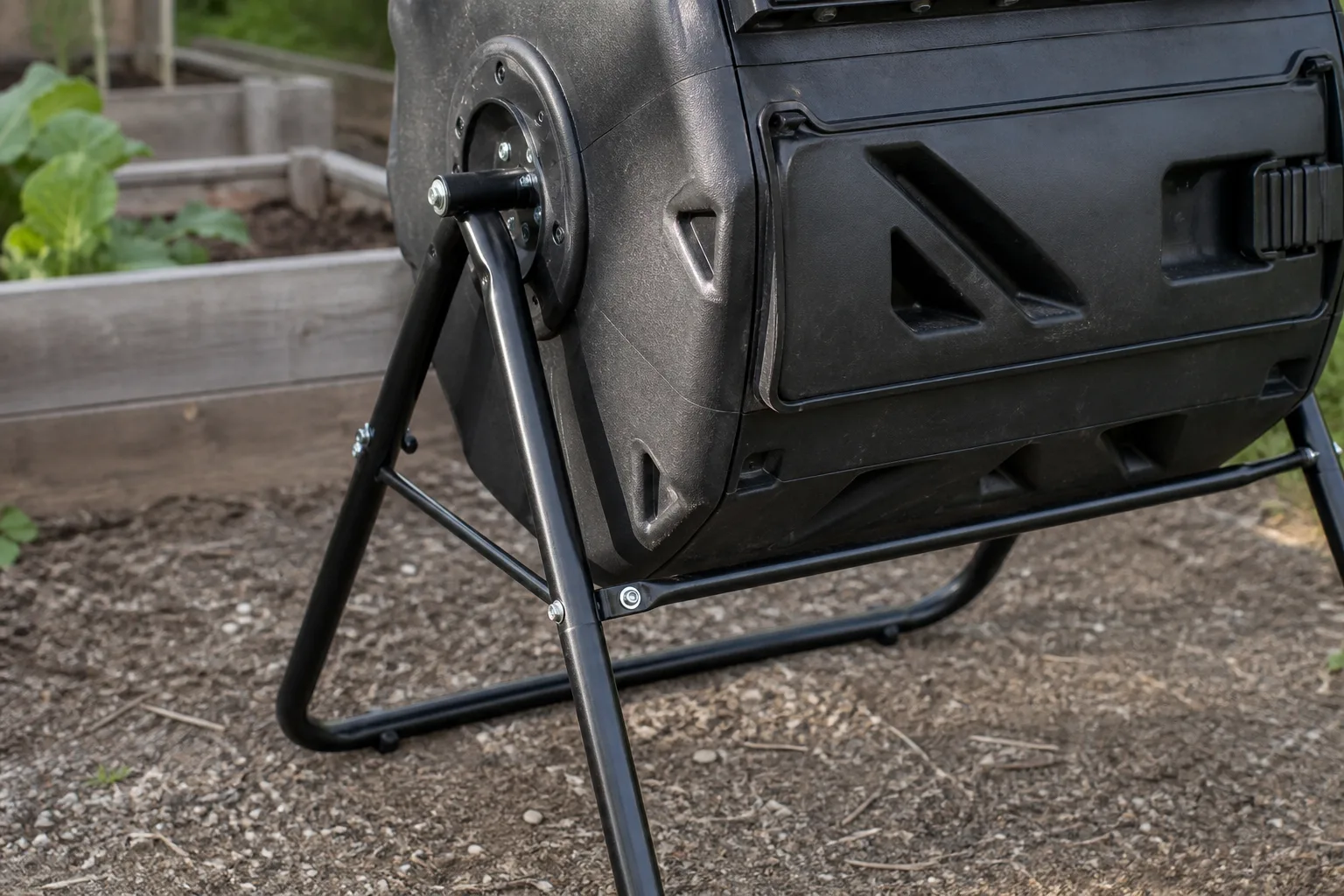
Wet compost is heavy. The frame should have broad feet, diagonal bracing, and joints that do not rely on a few small screws biting into thin plastic. Powder coated steel can last well if the coating remains intact. Galvanized hardware resists corrosion, but mixed metals and trapped moisture can still create rust at fasteners.
Inspect how the barrel panels join. Many tumblers arrive as curved sections that bolt together. More seams mean more assembly and more potential leak paths. Seam leakage is messy, but the bigger concern is whether a panel can bow under load and make the door or axle bind.
Dark plastic absorbs heat in sun, yet ultraviolet exposure also ages poor resin. Look for a stated UV resistance claim, a meaningful warranty, and replacement availability for doors, vents, cranks, and hardware. A sturdy frame is less useful if a proprietary latch cannot be replaced.
Ventilation and drainage need balance
Air holes help, but more holes do not guarantee aerobic compost. Water can fill the small spaces between particles and slow oxygen movement. Cornell’s compost research puts the useful moisture range around 40 to 60 percent by weight and warns that wetter material can turn anaerobic. Its compost moisture guidance gives the familiar field check: the mixture should feel like a wrung-out sponge, not drip when squeezed.
Kitchen scraps and fresh grass already carry a great deal of water. Keep dry leaves, shredded plain cardboard, or another approved brown nearby. A tray under the tumbler may keep a patio clean, but standing liquid should not block the lower vents. Place the unit on a washable, well drained surface rather than directly against wood siding or a fence.
The Illinois Extension comparison of compost bins explains why turning units tend to work faster than unaerated holding units. It also points out the price and complexity tradeoff. A rotating shell is a convenience mechanism, not a substitute for managing the pile.
Winter, summer, and placement
Small batches cool quickly in winter. Insulated double walls may slow heat loss, but they also add cost and can hide water between layers if the assembly leaks. In a cold climate, plan for slower processing and keep a separate covered store of browns. Do not promise yourself a two-week batch in January because a listing uses the word “fast.”
Full sun can warm a barrel, then dry the outside layer and overheat the handle or dark plastic. Light shade often gives a more stable working area. Put the tumbler near the kitchen route and a water source, but not where leaks run across a deck or path. Accessibility in wet weather matters more than a perfect view from the house.
When an open bin is the better buy
An open or enclosed stationary bin accepts more bulky leaves per dollar and can keep a larger thermal mass. A three-bin setup makes turning and curing easy when there is room. Cornell’s outdoor composting overview describes holding, turning, and enclosed systems, each with a different labor pattern.
A tumbler earns its space when easy mixing, a raised loading height, and a closed shell solve real problems. It is a weak fit when the yard produces bags of leaves, long vines, thick stalks, or enough material to overwhelm the door every weekend. Some gardens work best with both: a tumbler for regular kitchen scraps and a larger bin for leaves and curing.
Finished compost can amend a raised bed, but it does not remove the need to calculate fill volume. Use the raised bed soil calculator before ordering bulk soil, and compare the compost contribution with the full volume. The raised garden bed kit guide covers material and depth choices.
A practical pre-purchase checklist
- Estimate one normal batch of greens and stored browns.
- Compare usable chamber size rather than total shell volume.
- Decide where fresh scraps will go while a batch cures.
- Measure door width, loading height, emptying clearance, and assembled footprint.
- Inspect frame bracing, axle support, panel seams, latches, vents, and drainage.
- Check replacement parts, UV resistance, warranty terms, and winter limitations.
- Confirm the manual’s material exclusions and assembly requirements.
Compare compost tumblers on Amazon (paid link). Before ordering, download the exact manual and confirm chamber dimensions, assembled size, frame material, clearance below the door, replacement parts, and whether the model can be secured on the surface you plan to use.