Disclosure: This page contains affiliate links. As an Amazon Associate, Yard Foundry earns from qualifying purchases.
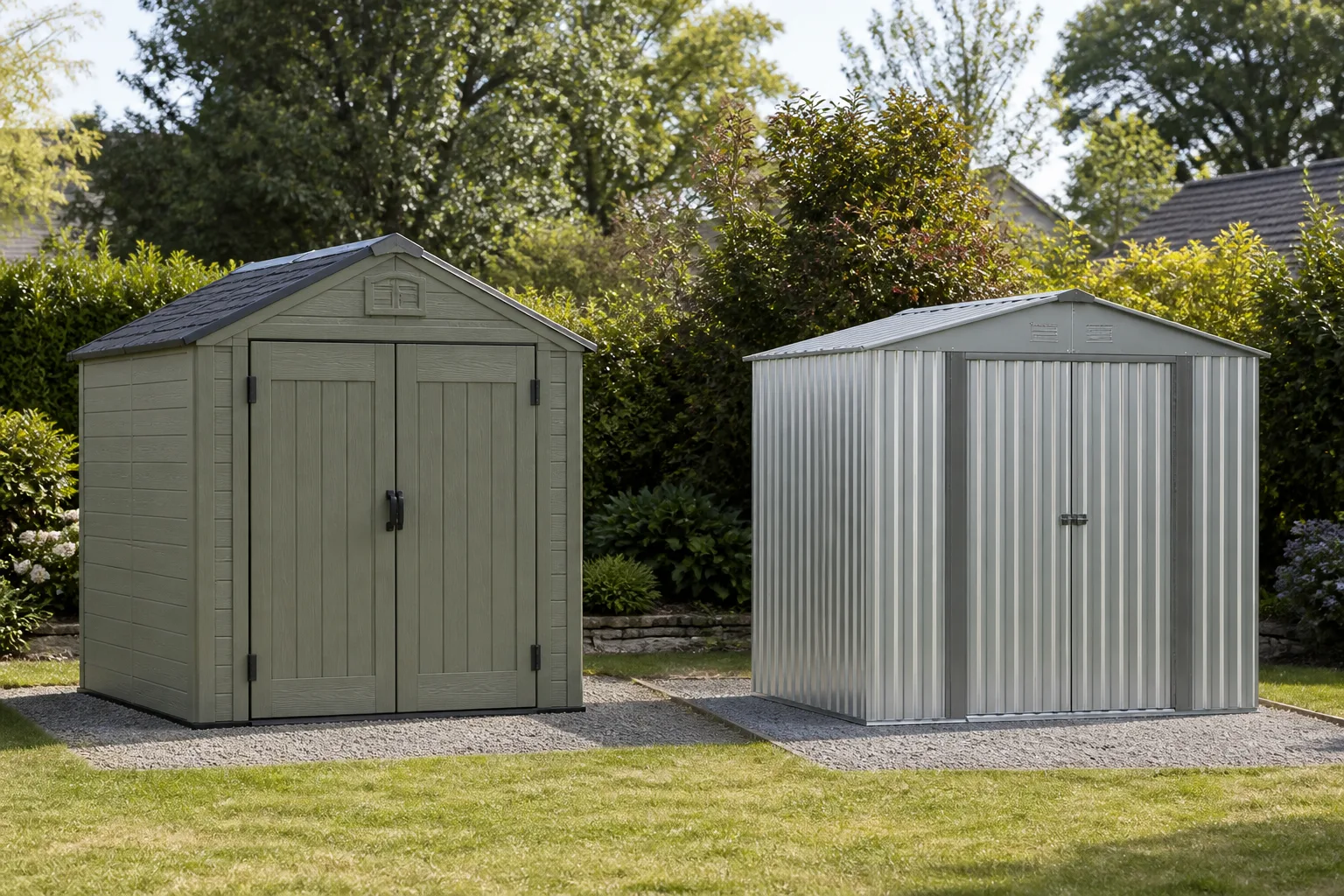
A resin vs metal shed decision usually comes down to weather exposure, foundation quality, and what you plan to hang on the walls. Resin is often the easier low maintenance choice for a homeowner who wants an included floor and a finished interior. Metal usually offers more storage volume for the money, but thin panels demand careful assembly, anchoring, and moisture control. The better material is the one whose complete system fits your site, not the one with the strongest marketing claim.
This is a research based comparison of shed construction and ownership. Yard Foundry did not conduct physical product testing for this guide, so model specific wind, snow, floor, and anchoring claims should be checked in the current manual before purchase.
Resin vs metal shed at a glance
| Decision point | Resin shed | Metal shed |
|---|---|---|
| Routine upkeep | Washable panels with no rust and usually no painting | Inspect coating, cut edges, fasteners, and scratches for corrosion |
| Floor | Often included, though a level base is still required | Frequently sold without a finished floor |
| Wall storage | Limited to approved attachment points or accessory systems | Possible with a separate frame or manufacturer approved system |
| Assembly tolerance | Molded panels need a square, level base so doors and roof joints align | Numerous thin panels and fasteners make squareness and sequencing important |
| Moisture risk | Does not rust, but humid air can still damage stored tools | Cold sheet metal can collect visible condensation when moist air reaches it |
| Best fit | Finished storage with modest upkeep | Budget conscious storage where the owner can manage assembly and corrosion checks |
The table describes common kit patterns, not a guarantee. A steel reinforced resin shed may be stronger than a basic metal kit, while a heavier steel building may outperform both. Compare the specifications for the exact size and configuration you intend to buy.
Start with the stored equipment
List the largest item first. A riding mower needs a clear door opening, enough turning room, a floor rated for the load, and a ramp that does not create a sharp breakover angle. Long handled tools need usable wall height. Bicycles need aisle space even when their nominal footprint fits on paper.
Interior dimensions matter more than the advertised footprint. Wall thickness, door tracks, roof supports, and shelves all consume space. Sketch the mower, bins, and walking path on graph paper. Leave room to remove the item at the back without unloading the whole shed.
Also decide whether the building is storage or a future workshop. Neither a basic resin kit nor a light sheet metal kit should be assumed suitable for electrical work, insulation, occupancy, or heavy wall mounted cabinets. Those changes can affect structural performance, condensation behavior, code compliance, and warranty coverage.
The labels hide important construction differences
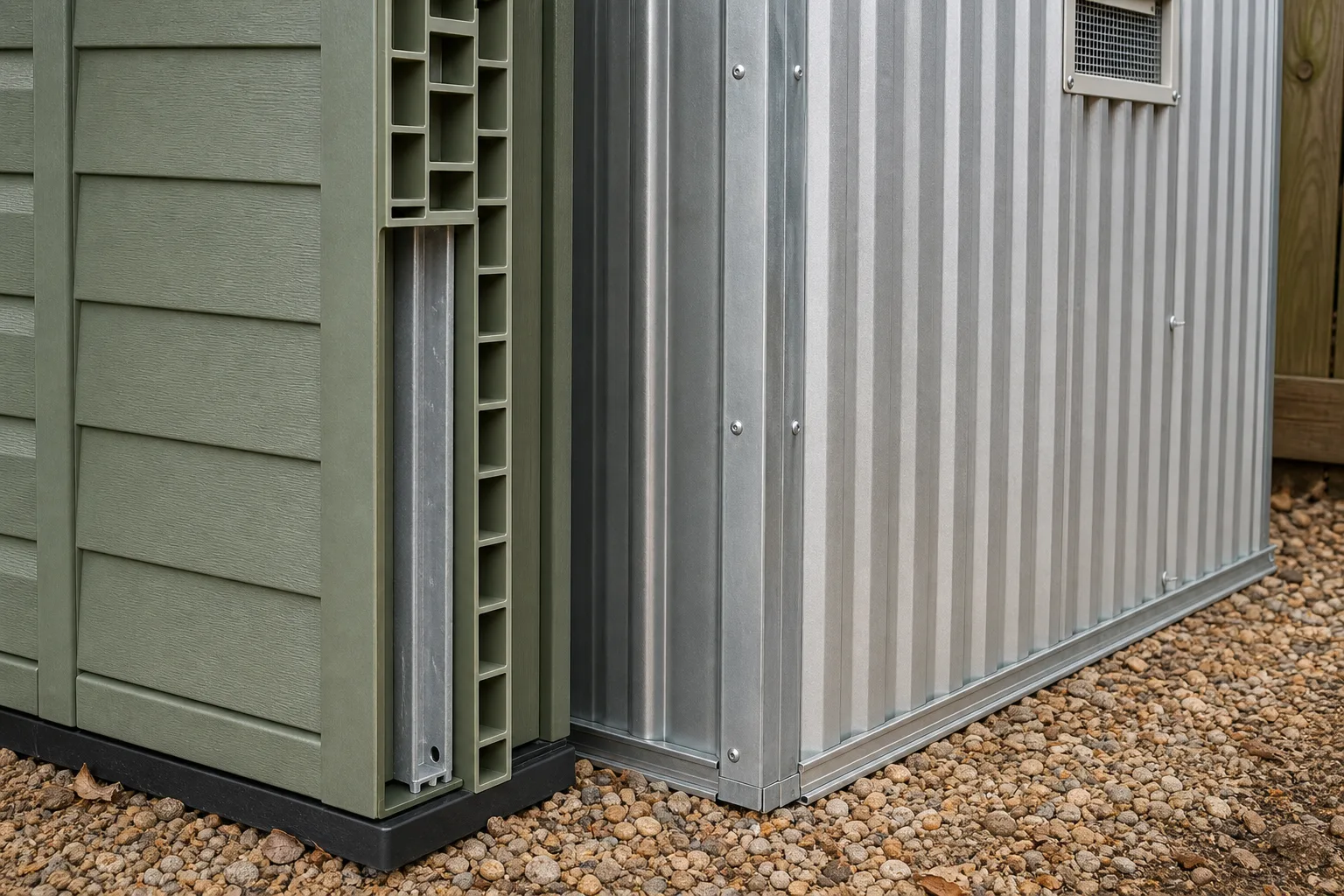
Resin is not one uniform material. Many current sheds use high density polyethylene panels, and some use steel wall supports or roof trusses. For example, Lifetime lists dual wall HDPE, steel reinforcement, UV protection, and screened vents on one of its 8 by 10 foot shed specifications. Those features describe that model, not every plastic shed.
Metal sheds vary just as widely. Panel thickness, corrugation, frame design, protective coating, fastener quality, roof geometry, and bracing all affect the finished building. ShelterLogic describes its Arrow Classic shed as galvanized steel treated for corrosion resistance. That still leaves the owner responsible for protecting damaged coating and following the assembly and anchoring instructions.
A useful comparison therefore goes beyond resin versus steel. Look for an actual materials list, assembled weight, floor details, vent locations, compatible anchors, wall load instructions, snow rating, wind rating, and replacement part availability. If the listing substitutes words such as durable or weatherproof for those details, keep looking.
Foundation and anchoring affect both materials
Lightweight does not mean foundation free. A resin floor can flex when the base has high spots or settles unevenly. That movement may show up as doors that rub, roof panels that resist alignment, or seams that open. Thin metal framing can rack out of square on the same poor base.
Use the foundation type allowed by the manual and suited to your drainage, soil, frost conditions, and local rules. A compacted gravel base may work for some floor systems. Other sheds call for a wood platform or concrete slab. Lifetime specifies a flat, level platform for a current 10 by 8 foot resin model, which is a good reminder that an included floor is not a foundation.
Estimate gravel, lumber, or concrete with the Yard Foundry shed foundation material calculator. Treat the result as a planning quantity, then match the final dimensions and anchor layout to the shed manual. Local frost depth, wind exposure, and permit requirements may change the design.
Anchoring is a separate job. Connect the building to the approved foundation points with the specified hardware. Do not assume that stored weight will hold a shed in place, and do not drill extra holes through molded resin or thin steel unless the manufacturer permits it.
Weather resistance is model specific
Wind and snow
Wind performance depends on the entire load path: roof panels, wall connections, frame, anchors, and foundation. Snow performance depends on roof shape, support spacing, material strength, and the exact rated load. A generic claim that metal is stronger, or that resin flexes safely, is not enough for an exposed site.
Ask for the tested or engineered rating for the exact model and size. An extension kit, different door, or optional roof accessory may change the configuration. If the seller cannot provide a manual or rating, do not rely on a marketplace bullet point for a high wind or heavy snow location.
Sun, heat, and impact
UV stabilized resin avoids rust and usually tolerates minor bumps without a permanent dent. Long sun exposure can still change color or age a lower quality panel, so check whether UV protection is stated in the technical documentation. Metal will not become brittle in cold weather, but a thin wall can dent from a mower handle, falling branch, or careless assembly.
Both materials heat in direct sun. Interior temperature depends on color, roof exposure, ventilation, air leakage, insulation, and thermal mass. A light exterior and shaded location can matter more than the material label. Do not store products outside the temperature range on their labels.
Rain and corrosion
Resin panels do not corrode, but water can enter through a poorly seated roof joint, unlevel door opening, damaged gasket, or incorrect fastener. Steel coatings protect the underlying metal until scratches, cut edges, or dissimilar hardware create a weak point. Inspect those areas after assembly and after branches or tools strike the wall.
Keep soil, mulch, and wet leaves away from the siding. Maintain drainage around the base. A shed that sits in splashback or standing water will have moisture problems regardless of wall material.
Condensation deserves its own comparison
A metal roof makes condensation easy to see because the interior surface cools quickly. Water vapor turns to liquid when it reaches a surface below its dew point. Resin can hide the same damp interior until a steel tool rusts, cardboard softens, or mildew appears on fabric.
Ventilation helps when replacement air is drier, but vents cannot repair a roof leak or dry a mower parked wet. The US Environmental Protection Agency explains in its moisture control guidance that condensation control requires managing water entry, indoor moisture, and cold surfaces as a system.
Compare built in vents and their positions. Check that stored bins will not block them. For a metal shed in a damp or cold climate, ask whether the manufacturer offers an approved condensation control layer or insulation detail. Randomly gluing absorbent material under the roof can trap water against steel and complicate repairs.
Security and organization are not the same thing
A padlock loop is only one part of security. Check hinge exposure, door overlap, frame stiffness, latch engagement, and whether the doors can be lifted off a track. Large resin doors often have internal steel reinforcement. Thin metal doors may need precise alignment to close without binding.
Plan shelving before purchase. A resin wall may accept only a proprietary rail, limited screw locations, or a freestanding shelf. A light steel panel is not a structural stud. Heavy cabinets and tool racks may need an independent interior frame that transfers load to the floor.
Freestanding shelves are often the cleanest option in either shed, provided the floor supports the load and the shelf is restrained from tipping. Keep air paths open around bins and leave the wall perimeter visible enough to spot leaks or corrosion.
Assembly and repair change the ownership experience
Resin kits tend to use fewer large molded pieces. Those pieces can be awkward to handle, and alignment becomes difficult when the base is not flat. Cold panels may be less forgiving during assembly, so follow the temperature and handling limits in the manual.
Metal kits often arrive as many panels, channels, and bags of fasteners. Sorting parts before the build saves time. Gloves help protect hands from edges, but personal protective equipment does not replace the sequence in the manual. Leave final tightening until the instructed stage so the frame can be squared.
Repair options are uneven. A scratched steel coating can often be cleaned and touched up with an approved product. A bent panel may be replaceable if parts remain available. Cracked resin generally needs a model specific replacement or a repair approved by the manufacturer. Check the parts catalog before buying a shed expected to stay for many years.
Which shed should you choose?
Choose resin when you want a clean finished interior, an included floor, low corrosion concern, and minimal surface maintenance. It is especially appealing for ordinary garden tools, bicycles, and bins when the model has documented weather ratings for the site.
Choose metal when price per square foot and compact packaging matter, and you are comfortable building a precise foundation, assembling many fasteners, and checking the coating over time. It can be a sensible tool shed in a dry, well drained location with a model appropriate for local wind and snow.
Neither material is the automatic answer for a conditioned office, a welding space, or storage of temperature sensitive chemicals. Those uses need a building designed around occupancy, fire safety, ventilation, electrical work, and local code.
A short buying checklist
- Confirm internal dimensions and the clear door opening.
- Read the foundation and anchoring pages in the manual.
- Find model specific wind and snow information.
- Check whether a floor, anchors, vents, and shelves are included.
- Verify approved wall loads and accessory attachment points.
- Look for replacement panels, hinges, handles, and roof parts.
- Review permit, setback, and homeowners association rules.
- Budget for the base, delivery, ramp, anchoring, and organization.
The Yard Foundry garden calculators can help with the foundation and project quantities before you order. For current product configurations, compare resin garden sheds on Amazon (paid link) and galvanized metal garden sheds on Amazon (paid link). Open the manual for any finalist and make the decision from its actual structure, ratings, and included parts.