Disclosure: This page contains affiliate links. As an Amazon Associate, Yard Foundry earns from qualifying purchases.
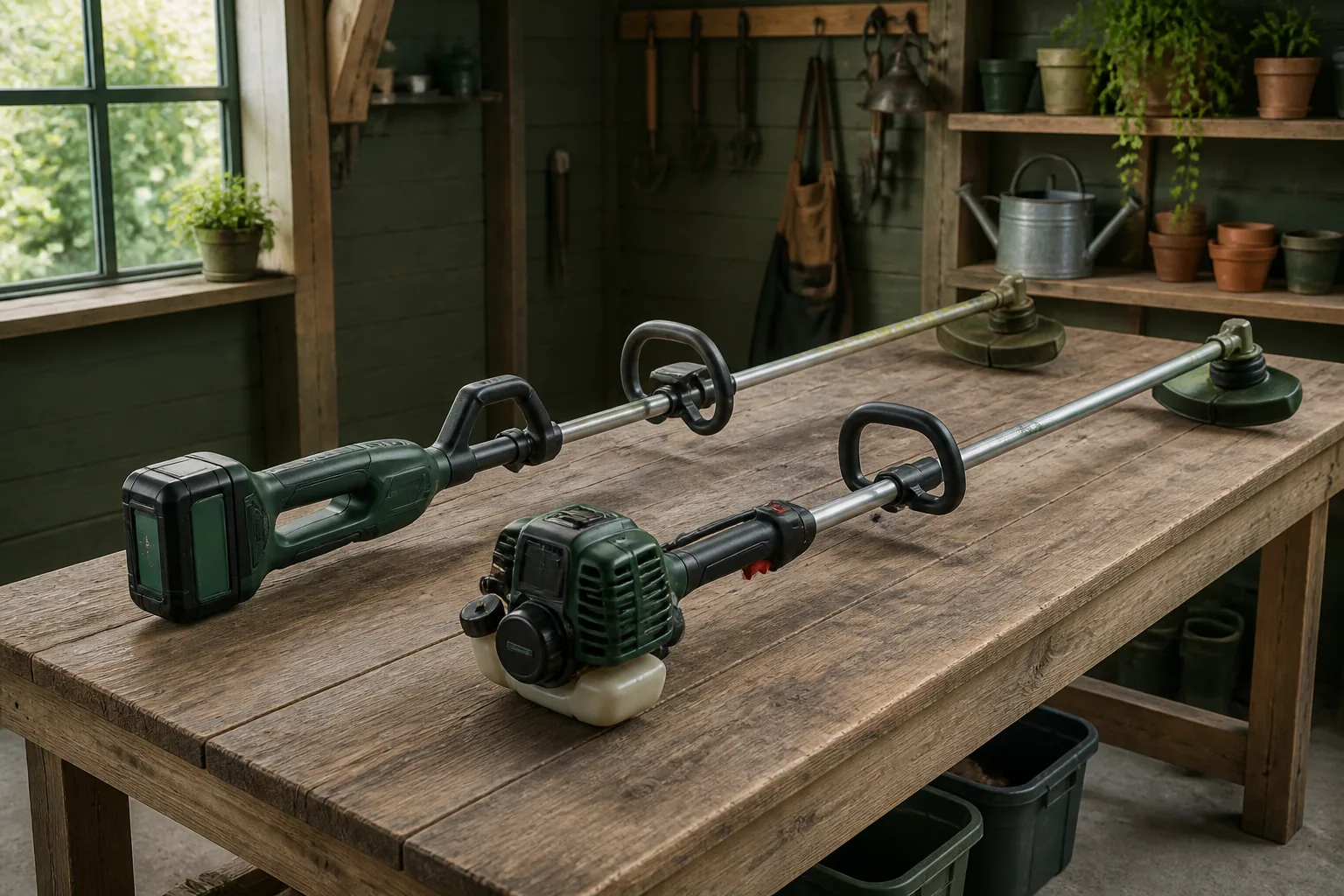
A battery vs gas brush cutter decision comes down to the work cycle, not a simple contest between voltage and engine size. Battery power is usually easier to start, quieter at the operator’s ear, and simpler to store. Gas still makes sense for long clearing sessions, remote acreage, and crews that can refuel faster than batteries can recharge. Compare the complete working system, including cutting attachment, harness, fuel or batteries, charger, service access, and the weight you will actually carry.
This is a research based comparison. Yard Foundry has not field tested the machines discussed here. Specifications and approved attachments must be confirmed in the current manual for the exact model.
Start with the vegetation and the approved cutting system
Power source matters only after the machine is suitable for the material. A brush cutter designed for a grass blade is not automatically approved for a circular saw blade. The gearbox, shaft, guard, handlebar, harness, blade hardware, and stopping behavior all belong to the cutting system. Never add a metal blade to a string trimmer unless the manufacturer lists that exact combination.
Map the property before comparing machines. Separate soft grass and annual weeds from dense stems, bramble, and woody saplings. Record the largest stem diameter, the slope, the distance from the house, and how many uninterrupted minutes the job normally takes. Our wood chipper versus chipper shredder guide uses the same principle: define the material stream first, then choose the equipment class.
| Work pattern | Battery tends to fit | Gas tends to fit |
|---|---|---|
| Short trimming and periodic rough-edge cleanup | Quick starts, low routine service, easy stop and restart | Works, but fuel handling and warm starts add little value |
| Several separated work zones near the house | Spare batteries can move with the operator and charge between sessions | One tank may cover the route, subject to the model’s run time |
| Long continuous clearing far from power | Possible with enough charged packs, but battery cost and transport grow | Fast refueling may be more practical when fuel can be stored and carried safely |
| Noise-sensitive residential work | No engine exhaust at the tool and generally lower sound pressure | May conflict with local hours or nearby neighbors |
| Seasonal storage with little mechanical upkeep | No carburetor or mixed fuel; battery storage rules still matter | Fuel system preparation and periodic engine service are required |
Compare usable output, not unlike specifications
Gas models often publish engine displacement and output shaft power. Battery models may lead with nominal voltage, battery capacity, or an equivalence claim. Those numbers are not directly interchangeable. A high voltage does not describe torque at the blade, while engine displacement alone does not reveal gearbox ratio, blade speed, or how the machine responds in heavy vegetation.
Use manufacturer support pages to compare machines within the same duty class. For example, Husqvarna lists the current 535iFR battery brush cutter with its compatible blade, harness, cutting width, tool-only weight, output-shaft speed, sound, and vibration values. A gas model should provide the same families of information. This does not make one model the recommendation; it shows the level of documentation worth demanding.
Pay particular attention to tool-only weight. A battery machine still needs a battery, and a gas machine still needs fuel. Add the approved blade, guard, harness, and any backpack battery or adapter. The ready-to-work figure is the weight your shoulders and hands experience.
Battery vs gas brush cutter run time is a workflow question
Battery run time changes with pack capacity, vegetation density, cutting attachment, motor mode, temperature, and how often the tool is allowed to spin at full speed. A single marketing run-time number cannot describe every property. Ask for a manufacturer run-time table if one exists, then treat it as a planning estimate rather than a promise.
Build a simple energy plan:
- Time a normal clearing session, including walking and debris removal.
- Find the approved battery options and charger times for the exact tool.
- Decide whether one pack can work while another charges.
- Check whether the available circuit can support the planned chargers without sharing a heavy load.
- Include storage temperature and state-of-charge instructions from the battery manual.
A second battery is useful only if it is charged when needed and belongs to a platform you expect to keep. Shared batteries can improve the economics when the same packs run a mower, blower, or hedge trimmer. They can also lock the next purchase into one ecosystem, so compare replacement availability and warranty terms before counting that benefit.
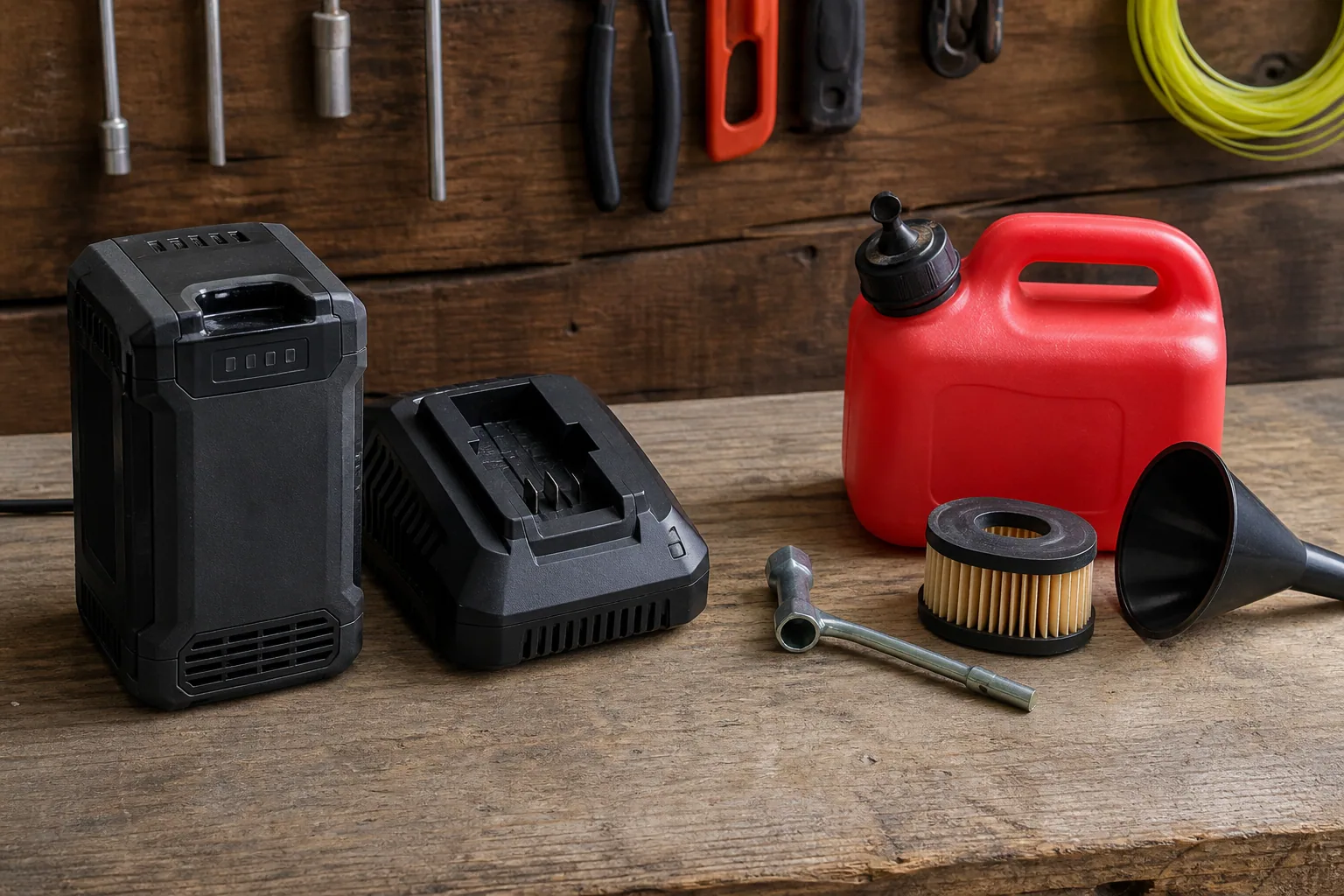
Gas equipment shifts the planning burden. Fuel must be bought, transported, mixed when required, and stored in an approved container. The engine needs the correct fuel, oil, air-filter care, spark-plug service, and seasonal preparation. Fast refueling is a real advantage during long work, but it is not maintenance-free continuity.
Noise, exhaust, and neighborhood fit
Battery equipment has no tailpipe at the tool. The US Environmental Protection Agency advises shoppers to consider electric or battery lawn and garden equipment because it is quieter and produces less local pollution than gas-powered alternatives. Electricity generation still has an upstream footprint, so the accurate claim is about operation at the tool, not zero impact everywhere.
Sound values need context. Compare sound pressure at the operator’s ear and guaranteed sound power under the same test framework when manufacturers publish both. Cutting a metal blade through woody material can still be loud. Hearing protection may remain appropriate even when the motor is quieter.
Local rules can limit outdoor power-equipment hours. Battery power may extend the practical window without removing the obligation to follow those rules or consider neighbors. If the property borders a school, shared garden, or close housing, lower noise and no fuel exhaust at the work area may outweigh a small difference in purchase price.
Weight, balance, vibration, and the harness
A well-balanced machine can feel easier than a lighter machine that pulls forward or twists in the hands. Bicycle handles suit broad sweeping movements and help keep a blade at a consistent distance. Loop handles may fit tighter spaces, but approved handle and blade combinations vary. Follow the manual rather than mixing parts to chase a preferred feel.
Check whether the battery or engine mass sits close to the operator, how the suspension point adjusts, and whether the harness transfers load to both shoulders and the hips. The release mechanism should be reachable and should work with the exact harness supplied or approved by the manufacturer. Try the complete setup before purchase when a dealer allows it.
Published vibration numbers can help compare models, but test methods and operating conditions must match. Actual exposure changes with the blade, balance, maintenance, grip pressure, and vegetation. Stop if numbness, unusual vibration, a bent blade, or damaged guard appears. Those are reasons to inspect the system, not to push through the remaining patch.
Starting and restarting during real work
Battery machines usually start with a lockout and trigger sequence. That makes frequent stops for moving branches, opening gates, or checking the cutting area less disruptive. The tradeoff is electronic controls that must stay dry and a battery connection that must remain clean.
Gas starting depends on engine temperature, choke procedure, fuel condition, and maintenance. A healthy warm engine may restart easily; a neglected carburetor or stale fuel can consume the time saved by quick refueling. Read the starting sequence before buying, especially if repeated pull starting is difficult for the intended operator.
Neither power source removes blade hazards. Clear people, animals, glass, wire, rocks, and loose objects from the work zone. Wear the protection listed in the manual. Use the correct guard, stop the machine before crossing gravel or inspecting the head, and disconnect the battery or spark-plug lead as directed before service.
Storage and ownership costs
Price the complete kit over the period you expect to own it. A bare battery tool may look inexpensive until suitable packs and a charger are added. A gas tool needs fuel containers, oils, filters, spark plugs, and periodic service. Both need cutting attachments, sharpening or replacement, protective equipment, and a dry secure storage space.
Battery packs age with time, temperature, and use. Gas engines also deteriorate when fuel and maintenance are neglected. Avoid a made-up universal lifespan for either. Instead, check replacement prices today, confirm parts support, and ask how long the manufacturer keeps manuals and service components available.
Storage can decide the purchase. A battery can often be removed and stored under the temperature conditions in its manual. Gas equipment should not share cramped space with ignition sources or incompatible chemicals. The shed sizing guide helps plan a clear equipment route, and the shed condensation guide covers moisture before tools fill the walls.
Compare battery and gas brush cutter listings on Amazon (paid link). Use listings to build a shortlist, then confirm every blade, guard, harness, battery, and fuel requirement in the manufacturer’s current manual.

A practical choice by property type
- Choose battery when jobs are short or segmented, the work is near charging, noise matters, and the battery platform fits other tools you will use.
- Choose gas when clearing sessions are long, the site is remote, fast refueling matters, and you are prepared for fuel storage and engine service.
- Price spare energy for both. That means enough charged battery capacity for the route or enough correctly stored fuel for the session.
- Reject either machine if the manual does not approve the cutting attachment needed for the vegetation.
If you are still deciding whether the site needs a blade-equipped machine at all, compare the vegetation against the limits in our electric versus gas wood chipper guide. It shows why material and duty cycle matter more than a single power number across outdoor equipment.
Frequently asked questions
Is a battery brush cutter as powerful as a gas model?
Some current battery models occupy the same professional duty class as gas machines, but power cannot be inferred from voltage or an equivalence slogan. Compare approved blades, output data, cutting width, ready-to-work weight, and performance documentation for the exact models.
How many batteries do I need for a brush cutter?
Start with the length and density of a normal work session, then compare that demand with the manufacturer’s run-time guidance and charger time. A rotate-and-charge plan works only when the charger can restore a pack before the next one is empty.
Can I put a saw blade on a battery brush cutter?
Only when the manufacturer approves that blade, guard, hardware, handle, harness, and operating method for the exact model. Battery power by itself does not establish blade compatibility.
Write down the vegetation, session length, distance from charging, and full ready-to-work weight before opening product pages. The better machine is the one that completes that defined route with an approved cutting system and a support plan you can maintain.