Disclosure: This page contains affiliate links. As an Amazon Associate, Yard Foundry earns from qualifying purchases.
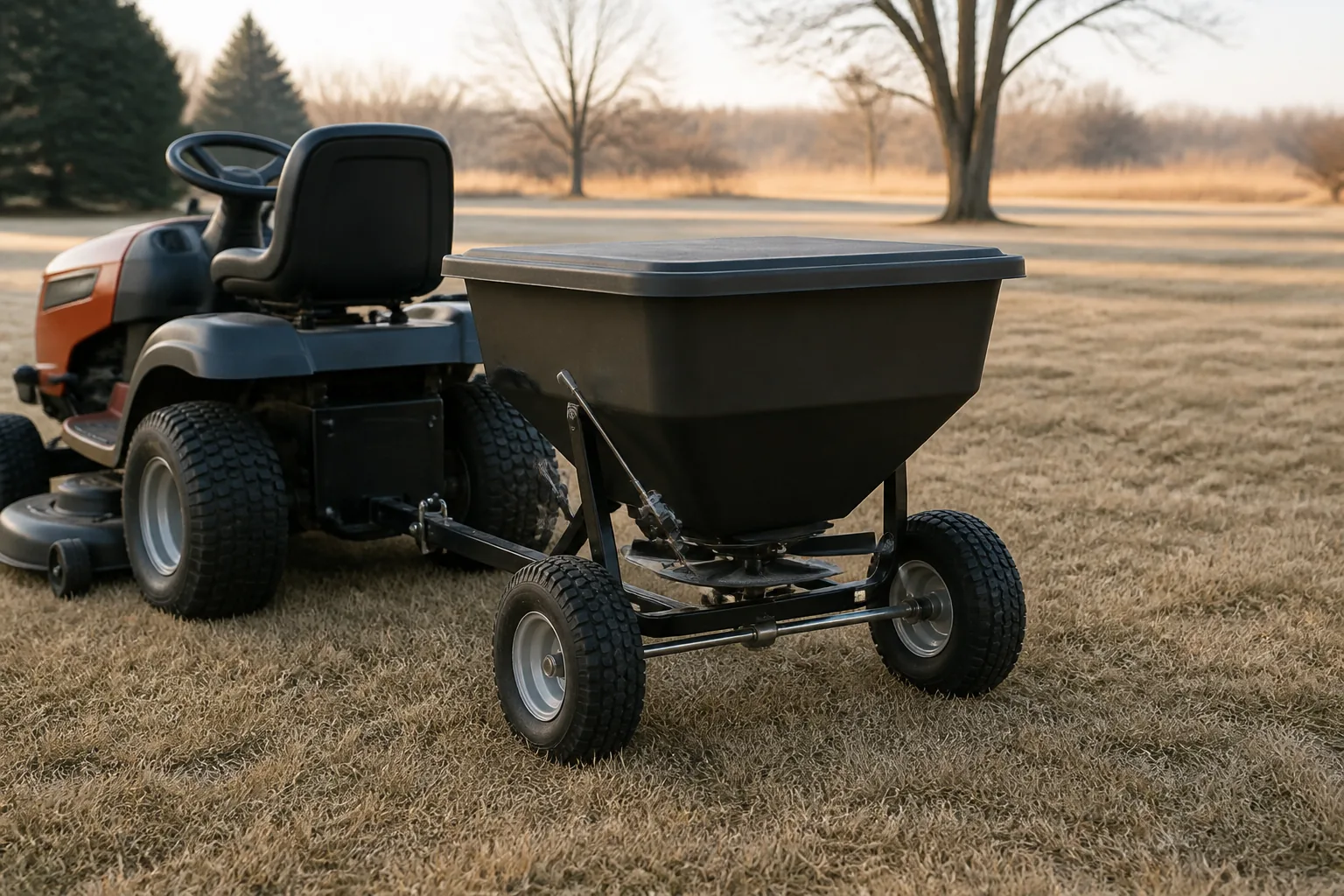
A tow behind spreader is a good fit for a lawn large and open enough to justify towing, provided the tractor can safely pull and stop the loaded attachment. Choose by material compatibility, useful hopper load, ground-drive quality, flow-control access, calibration repeatability, edge control, corrosion resistance, and storage. A large capacity saves refills only when the tow vehicle, terrain, and operator can handle the weight.
This is a research-based buying guide, not a hands-on product test. Yard Foundry has not operated the spreaders discussed here. Application rates, settings, speeds, loads, slope limits, and material restrictions must be confirmed in the product label and exact spreader manual.
Choose a tow behind spreader by distribution pattern
Most tow-behind consumer models are rotary broadcast spreaders. A ground-driven spinner throws granules beyond the wheel track, covering a broad swath. They suit open turf where efficient coverage matters. The pattern naturally tapers at the edges, so passes overlap.
A tow-behind drop spreader releases material straight down through openings across the hopper width. It offers a sharper edge and better control beside beds or pavement, but it requires more passes and careful alignment. A missed strip remains untreated; an overlapping strip can receive twice the intended amount.
Penn State’s current spreader calibration guide describes pull-behind rotary units as practical for large open areas. That does not make rotary the right answer beside ponds, vegetable beds, ornamental borders, or tight lawn fingers. Map the property first. Edge control can matter more than capacity.
Start with the material label
A spreader is only one part of an application. The product label controls where, when, and how the material may be used. Read it before filling the hopper. Check the target area, application rate, protective equipment, wind restrictions, cleanup, watering instructions, and limitations near water, pavement, gardens, pets, or children.
Granule size, shape, density, coating, and moisture all affect flow. Powdered products may bridge or produce an uneven pattern in a rotary spreader. Agri-Fab’s current 130-pound tow spreader manual says powdered lawn chemicals are not recommended for a consistent broadcast pattern. That warning applies to the cited model, but the broader lesson is sound: confirm material form, do not assume every dry product flows alike.
Break up lumps before loading only when the label permits handling. Never reach into a hopper while the tractor can move the drive system. Fill on a flat, clean surface with the gate fully closed, away from drains and hardscape where a spill is difficult to recover.
Capacity is a weight and terrain question
Hopper ratings are often listed in pounds, but that number may be a structural capacity rather than the load your tractor should tow across a slope. Compare the loaded spreader weight with the tow vehicle’s attachment guidance and its ability to brake. Include the spreader’s empty weight, the material, and any accessories.
A 130-pound hopper can be useful on broad level turf where a full bag or two covers a planned area. On a small or sloped lawn, the same load adds rearward force during stopping and a wider turning radius. Partial filling is not a flaw. It can make the combination safer and keeps material fresher during a careful calibration run.
Brinly’s tow-behind spreader manual covers specific 125-pound and 175-pound models, yet still centers correct tow-vehicle choice, slow travel, careful turns, and avoidance of holes and roots. Use those values only for the named machines. Capacity classes across brands are not directly interchangeable.
Inspect the ground-drive system
The wheels usually power the gearbox, agitator, and spinner. That makes tire contact and gear quality central to application consistency. A wheel that slips on wet turf stops driving the spinner even while the tractor continues forward. A narrow hard tire may bounce over roots and ruts. Pneumatic tires can smooth the ride but need pressure checks.
Look beneath the hopper in the manual’s parts diagram. Find the axle, gearbox, spinner shaft, bushings or bearings, agitator, and gate linkage. Check whether the gearbox is enclosed, which parts require lubrication, and whether a replacement gear, axle, spinner, cable, gate plate, or agitator is available.
Corrosive granules turn cleaning access into a buying feature. A complicated frame that traps product around an unsealed gearbox can demand more attention than a simple model with a clear rinse path.
Flow control must be reachable and repeatable
The operator should be able to close the gate while seated and moving forward. Penn State recommends starting travel before opening the gate and closing it while still moving before turns or stops. That prevents a concentrated pile at the beginning or end of a pass.
A long rigid lever is simple, but its reach changes with tractor seat position and hitch length. A cable can bring the control closer, though cables can stretch or corrode. Electric actuators add convenience and more parts. Whatever the design, the fully closed position must shut off cleanly, and a chosen opening should return consistently.
Do not treat the number on a gate plate as a universal application rate. Settings are starting references at best. One product’s size and density differ from another’s. Speed, humidity, residue, and manufacturing tolerance change output.
Calibration belongs in the plan
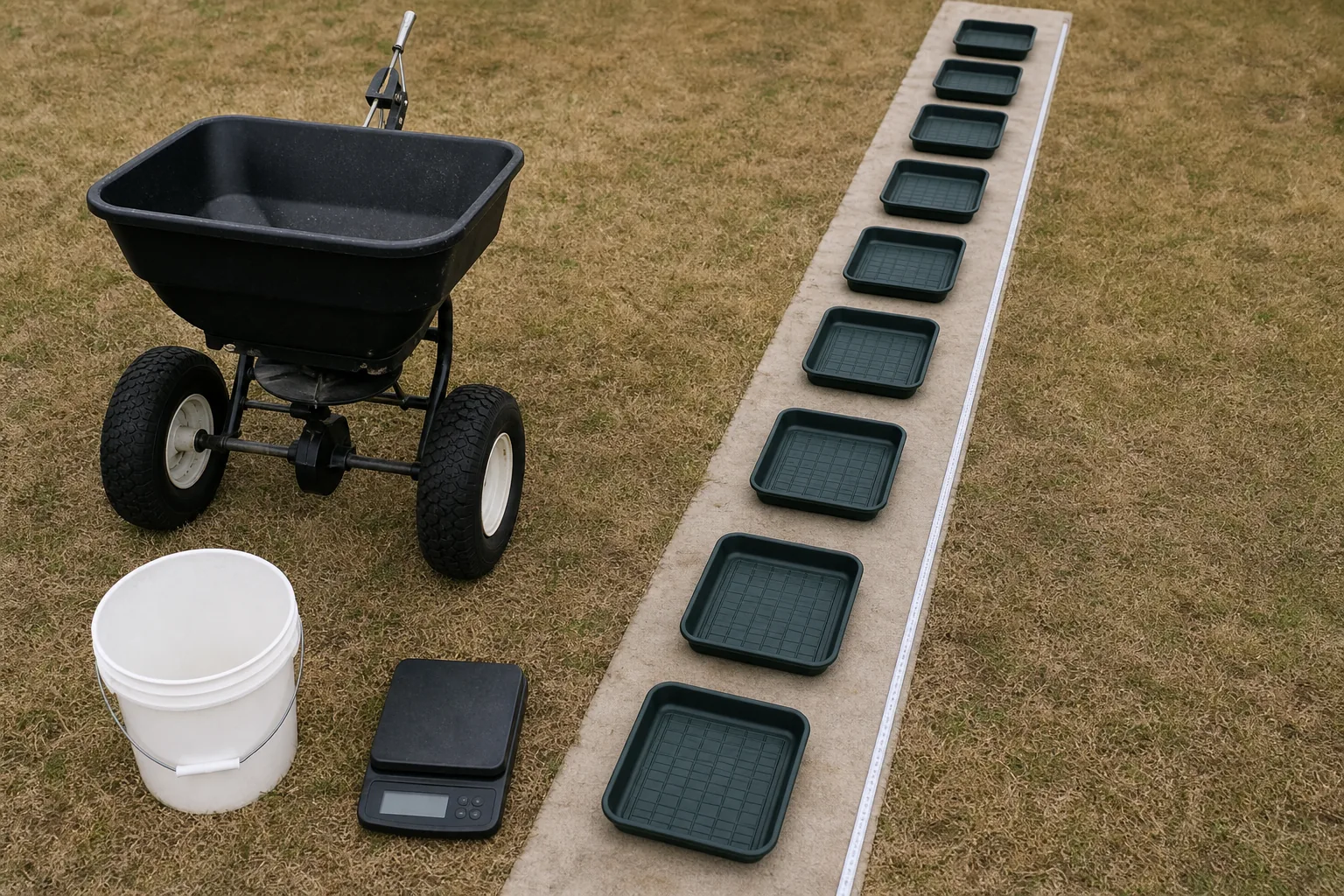
Calibration answers a simple question: how much of this exact material does this spreader apply over a known area at this speed and opening? It is not the same as copying a chart setting.
- Read the product label and calculate the intended amount for a measured test area.
- Choose a steady, realistic tractor speed and keep it constant.
- Weigh a known quantity of material before the test.
- Make the measured pass with a conservative gate setting.
- Close the gate while moving, then weigh the material that remains.
- Calculate the amount applied and adjust the opening or speed.
- Repeat until output matches the label rate without striping or heavy edges.
For rotary spreaders, effective swath is part of calibration. Penn State explains that swath changes with the spreader, product, and operating conditions and shows a catch-pan method for evaluating distribution. If using two perpendicular passes to reduce striping, calibrate each pass to half the intended total. Two full-rate passes would double the application.
Keep a small record for each product: date, spreader, gate setting, speed, effective swath, test area, starting weight, ending weight, and conditions. Recalibrate when the product changes, parts wear, tires change, or the spreader is cleaned and adjusted.
Edge control can prevent the most expensive mistakes
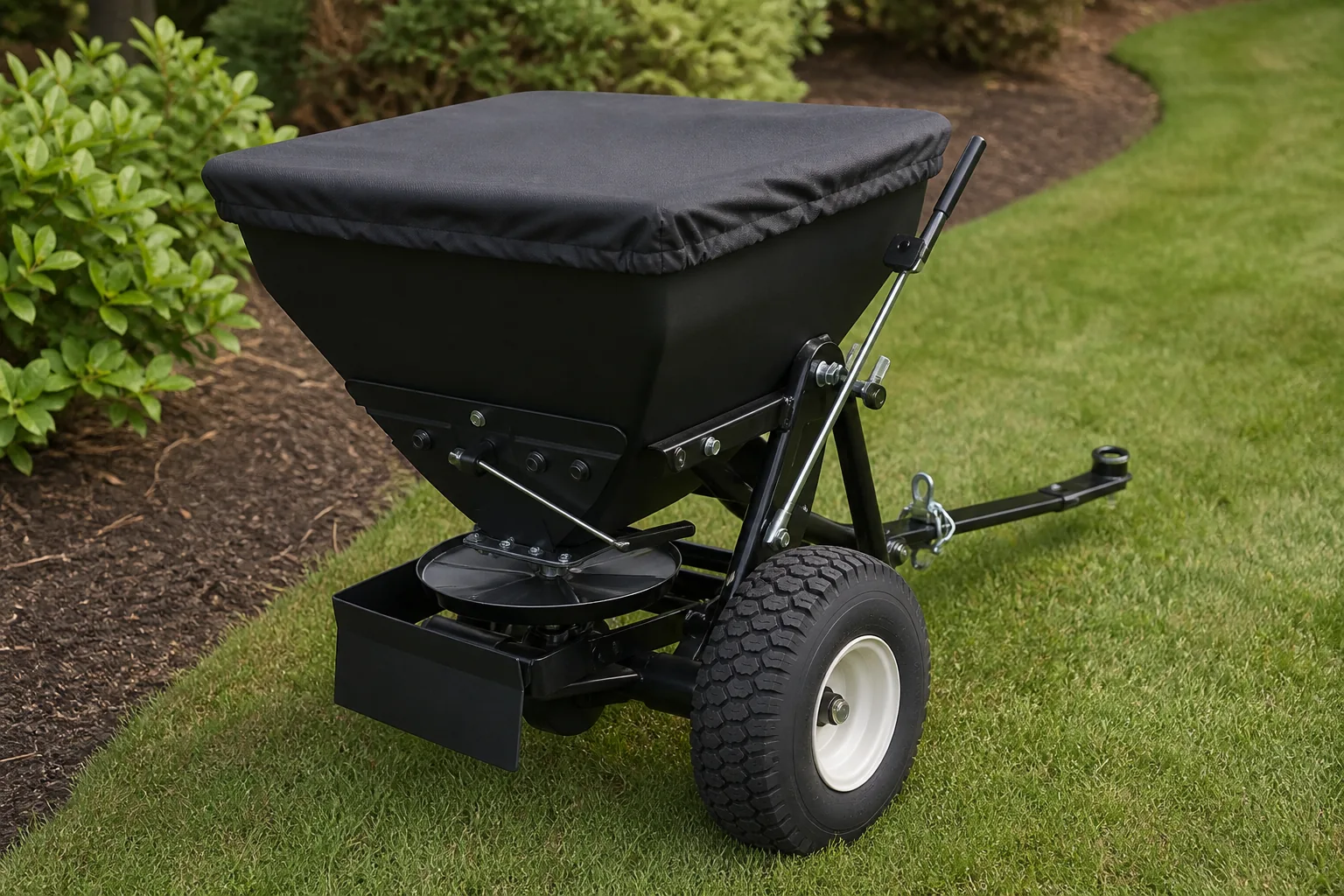
A broadcast pattern can throw material onto driveways, sidewalks, beds, and water. An edge deflector or side shield reduces one side of the pattern, but it also changes distribution. Calibrate or verify the swath with the deflector in the position that will be used.
Penn State’s turfgrass fertilization guide stresses keeping granules off impervious surfaces and cleaning spills. That protects water quality and avoids wasting product. A handheld blower is not permission to overspread first; careful edge passes remain better.
For herbicide or weed-and-feed products, off-target granules can harm ornamentals. Follow the label’s wind and buffer instructions. A calm day and low tractor speed make control easier. The Agri-Fab manual also warns against allowing weed-control material to reach ornamental plants.
Covers solve only part of the weather problem
A fitted hopper cover can reduce wind disturbance and protect the load from a brief sprinkle. It is not a license to spread in rain. Agri-Fab describes its cover as a wind and moisture shield rather than a rain cover. Damp granules can clump, alter flow, and remain in the hopper where they promote corrosion.
Store product according to its label, not in the spreader. Load only what the planned area needs. If weather changes, stop, close the gate, and deal with the remaining product by the label’s directions. Never wash residue toward a storm drain.
Cleaning and corrosion resistance
Fertilizer residue pulls moisture from the air and attacks steel. After the application, empty the hopper as allowed, rinse or clean it according to the manual, dry every part, and lubricate the points the manufacturer identifies. Pay attention under the gate, around the spinner shaft, along frame seams, and inside wheels.
Stainless hardware helps but does not make a spreader maintenance-free. A plastic hopper can outlast the frame beneath it. Compare paint or powder coating, exposed fasteners, sealed gearbox construction, replaceable bushings, and whether the hopper can be removed for service.
Handling, route, and storage
Measure gates, narrow turns, and the storage path using full tire-to-tire width. A spreader may be narrower than a sweeper, but the hopper and control lever can still catch a doorway. Check whether the hitch stand supports the unit when detached and whether a partial load can tip it.
Do not allow riders. Reduce speed over roots and holes, and avoid sudden turns. The cited manuals give model-specific speed limits, including 6 mph for one Agri-Fab model and 3 mph for the cited Brinly models. Use the exact manual’s lower requirement, not the fastest number found in another product guide.
A spreader sits within a wider lawn-care system. If the goal is relieving soil compaction rather than applying material, the tow-behind aerator buying guide covers that attachment. The plug versus spike comparison and aeration timing guide keep those operations separate from fertilization.
Buying checklist
- Choose rotary or drop distribution for the property’s edges and open area.
- Confirm the exact materials and granule forms the spreader permits.
- Match loaded weight, hitch, speed, and slope rules to the tow vehicle.
- Inspect ground-drive gears, tires, agitator, gate, and replacement parts.
- Make sure the gate closes fully and the control is reachable from the seat.
- Look for a usable edge deflector, not only a large hopper.
- Plan calibration equipment and a clean test area.
- Favor a frame and gearbox that can be cleaned and dried thoroughly.
- Measure storage dimensions with the lever, tires, and hitch included.
Compare tow-behind broadcast spreaders on Amazon (paid link). Download the manual for each candidate before ordering and verify its tow vehicle, material, speed, calibration, cleaning, and parts requirements.
The best spreader is the one that applies a known amount evenly and stops cleanly at the property edge. Capacity helps after compatibility, control, and calibration are solved. If the site’s broader tool plan is still taking shape, the Yard Foundry tools and calculators hub keeps equipment decisions and project arithmetic in one place.