Disclosure: This page contains affiliate links. As an Amazon Associate, Yard Foundry earns from qualifying purchases.
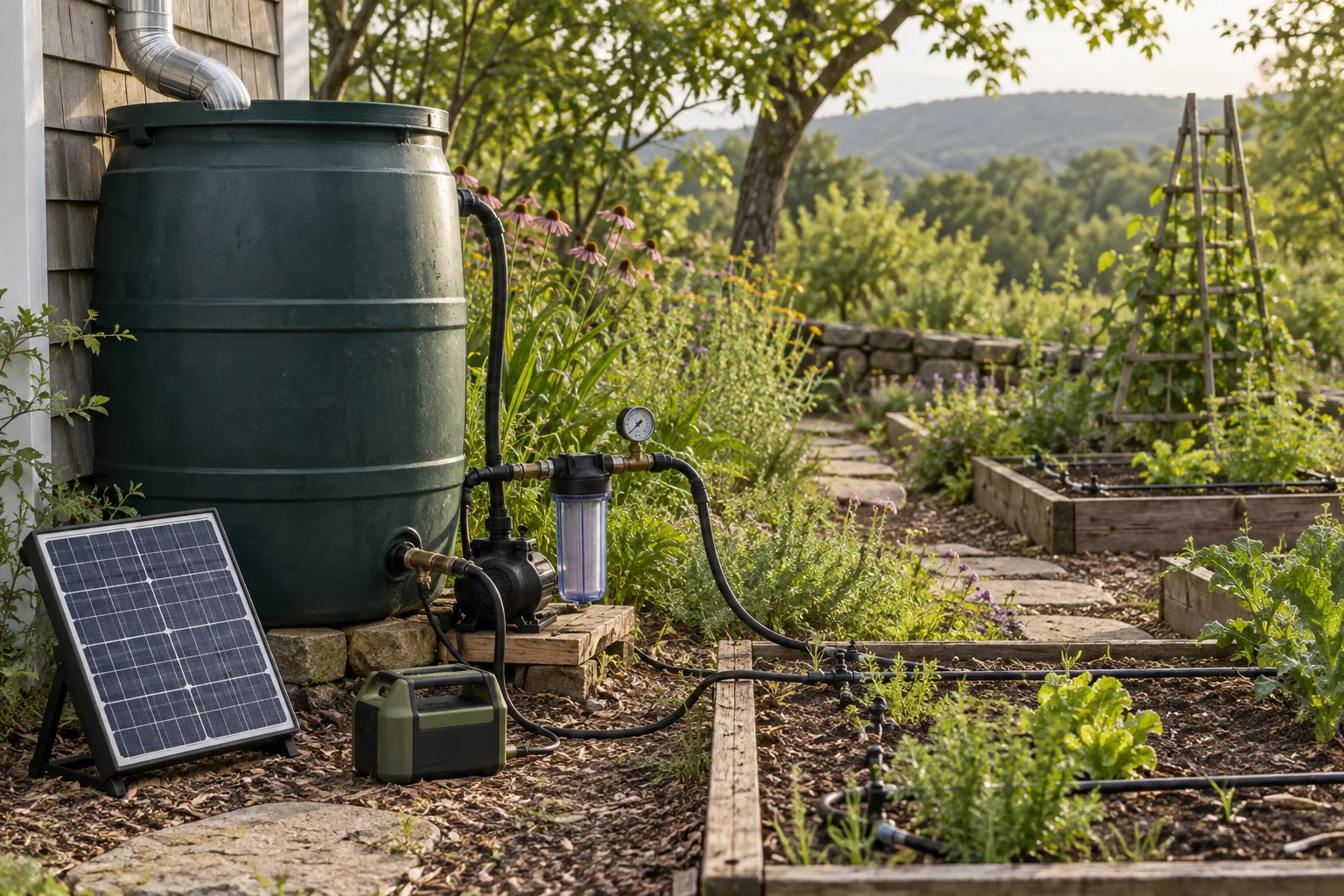
A solar vs battery rain barrel pump choice is really a question about when irrigation runs, how much pressure it needs, and how reliably energy can be replenished. A solar panel does not guarantee direct daytime pumping, and a rechargeable pump does not guarantee enough runtime for a large zone.
This guide is based on extension guidance, installation manuals, and published specifications. Yard Foundry has not physically tested the equipment discussed here. Confirm every load, clearance, electrical detail, and compatibility requirement with the current manual for the exact product you buy.
Solar or battery: the practical choice
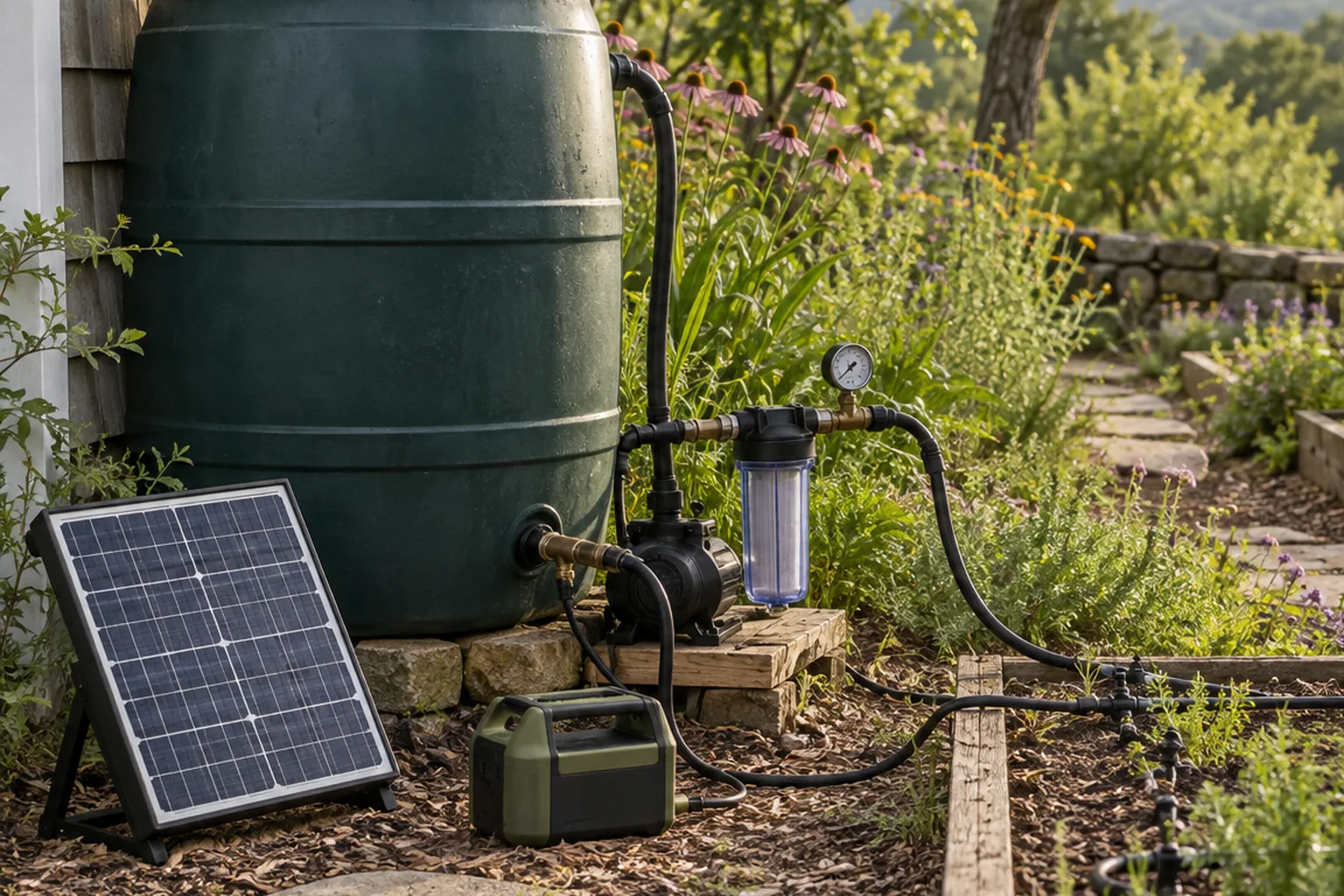
Use a solar charging system when the panel has reliable sun, irrigation demand is modest, and the battery, controller, and pump are specified as a matched set. Use a removable rechargeable battery pump when watering sessions are short and indoor charging is convenient. For automatic irrigation, prioritize documented pump curves, dry-run protection, low-voltage cutoff, and replaceable energy storage over the marketing label.
The pump still has to overcome elevation, filters, tubing, and emitter pressure. The broader solar irrigation pump kit guide explains the surrounding decision. This page stays with one narrower job: comparing how compact rain-barrel pumps store and receive energy.
Define the irrigation load first
List the number of emitters, required pressure, total flow, vertical lift, hose length, and desired runtime. A pump that fills a watering can may not hold pressure across a drip zone.
Decide whether irrigation must run at a specific time. Direct solar output changes with clouds and panel angle. A battery buffers that variation, but its usable capacity and cycle life become part of the ownership cost.
The National Renewable Energy Laboratory provides a plain explanation of photovoltaic system output and storage in How Does Solar Work?. The energy principles are useful, but the exact pump, controller, and battery limits come from their manuals.
Compare water performance and energy logistics
| Decision point | What to check | Why it matters |
|---|---|---|
| Pump curve | Flow at required head | Free-flow ratings overstate irrigation performance |
| Energy storage | Built-in, removable, or separate battery | Sets runtime and replacement path |
| Solar input | Panel watts, connector, and controller | Controls recharge speed and compatibility |
| Protection | Dry-run and low-voltage cutoff | Protects pump and battery |
| Automation | Timer, pressure switch, or controller input | Determines unattended operation |
A complete solar kit can be convenient, but proprietary batteries and connectors may make a simple pump harder to service later.
Pump curve
Start with flow at required head. Free-flow ratings overstate irrigation performance. A specification may describe a ceiling rather than a comfortable working point, so read the footnotes before relying on it. Write the confirmed figure beside the measurement from your yard.
Energy storage
Built-in, removable, or separate battery. Sets runtime and replacement path. Give this item its own line on the comparison sheet. If the product page and current manual disagree, use the manual or ask the manufacturer to explain the difference.
Solar input
Then look at panel watts, connector, and controller. Controls recharge speed and compatibility. Note the conditions attached to the number, including the selected accessory, surface, weather, load, or operating mode. Those details often explain why two similar listings behave differently.
Protection
Dry-run and low-voltage cutoff. is easy to skim past. Protects pump and battery. Confirm whether the figure applies to the standard setup or an optional configuration, then compare it with the tightest condition on your site.
Automation
Finish with timer, pressure switch, or controller input. Determines unattended operation. A blank or vague answer is a reason to pause, especially when it affects safety, fit, or a costly accessory. Get the answer in writing before ordering.
Count the cost after delivery
The box price leaves out plenty: mounting hardware, utility connections, delivery, disposal, routine service, wear parts, and storage. With solar vs battery rain barrel pump, the cheaper choice can become expensive when a proprietary part is hard to find or ordinary maintenance needs awkward access.
Read the warranty exclusions, not just the term printed in large type. Look for conditions tied to installation, weather, maintenance, registration, and nonstandard parts. Save the manual, parts diagram, receipt, and product page while they are still easy to find.
A parts diagram tells you almost as much as a feature list. Identify the pieces likely to wear or take damage, then check whether you can replace them individually. Equipment that can be cleaned, adjusted, and repaired in place is usually easier to live with for several seasons.
Estimate runtime honestly
Multiply pump electrical power by intended runtime to estimate energy use, then account for conversion and battery losses. Manufacturer runtime data at the required operating point is better than a calculation from nominal capacity alone.
Compare daily energy use with realistic panel production at the actual location. Shade from the greenhouse, fence, or trees can be more important than the panel’s nameplate rating.
Check usable water volume and pump inlet height. A floating intake or raised outlet can leave sediment behind, while a bottom intake needs good filtration. If the numbers lead to a larger system than expected, revisit the assumptions before downsizing the equipment. Our irrigation pump sizing guide can help with that adjacent calculation.
Protect the pump and water path
Use a screened inlet, serviceable filter, and dry-run protection. Keep electrical connections above overflow level and within their weather rating.
Mount the panel where it receives sun without shading greenhouse glazing or creating a wind sail. Provide cable support and a drip loop.
Route overflow independently from the pump system. Automation cannot control a blocked downspout or a tank that fills during a storm. This is also where the irrigation water tank sizing guide becomes useful.
Common mistakes that make a good product disappoint
- Choosing by free-flow GPH instead of flow at head
- Assuming a small panel powers the pump directly in all weather
- Ignoring battery replacement availability
- Running the pump without filtration or dry-run protection
- Expecting a compact barrel pump to supply several sprinklers
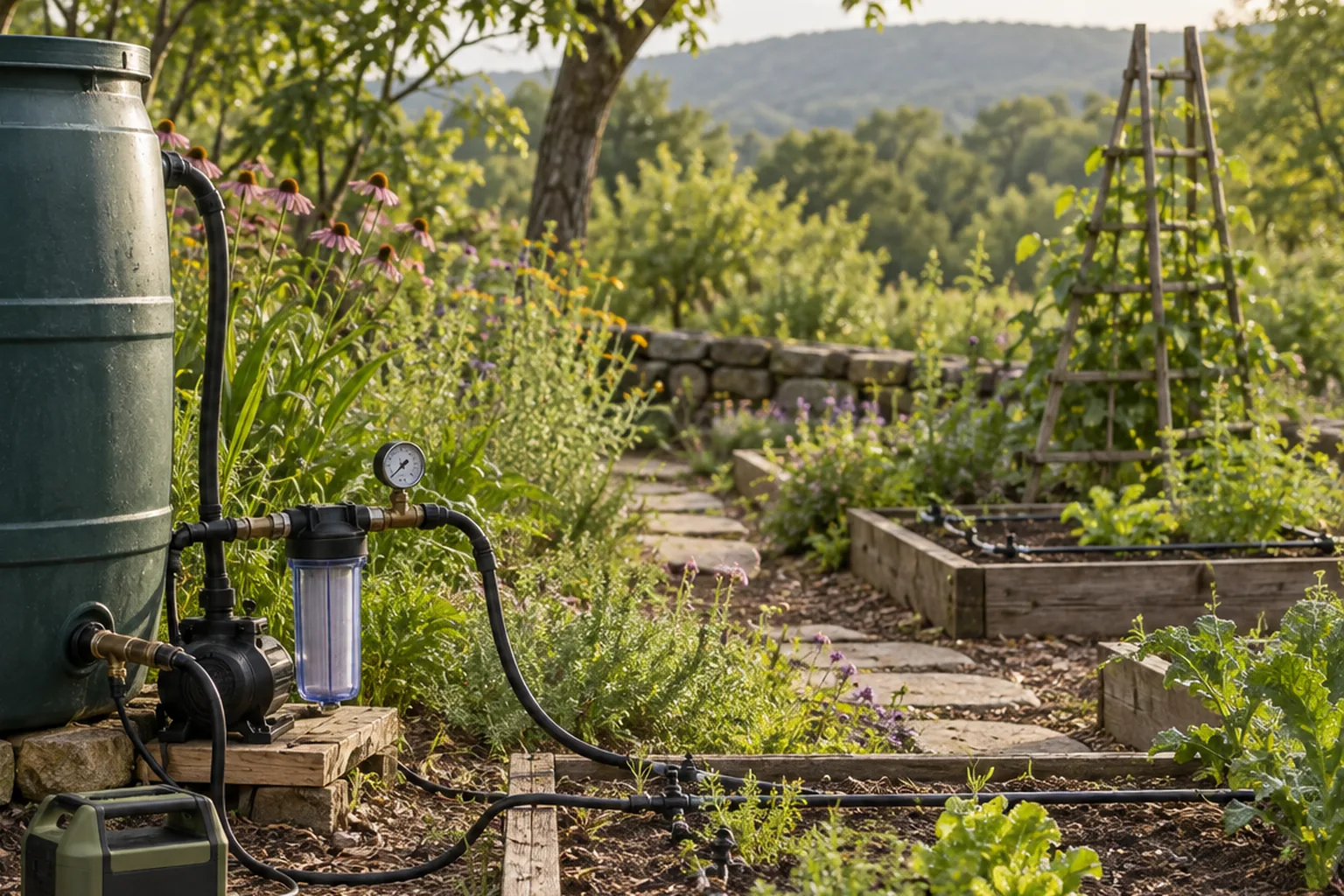
Test one complete irrigation cycle while watching pressure, runtime, and the final emitter. Repeat with a partly discharged battery and a lower tank level.
Make a one page fit check
Put your site measurements in one column and the documented limits in the other. Mark each line pass, uncertain, or fail. Treat uncertain as unfinished, not acceptable. Ask the manufacturer a narrow question that names the exact model and site condition.
A sensible buying and setup order
- Calculate flow, pressure, lift, and runtime
- Read the pump curve
- Confirm battery chemistry and replacement path
- Check solar input and connector compatibility
- Verify dry-run and low-voltage protection
- Size filtration and inlet
- Run a worst-case cycle before automating
Compare solar and battery rain barrel pumps on Amazon (paid link). Use the results to build a shortlist, then leave Amazon and verify the current manual, dimensions, warranty conditions, and replacement-part path on the manufacturer’s site.
Treat bundled panel wattage and battery capacity as claims to verify. The deciding data are flow at head, runtime at load, protection features, and service parts.
Questions homeowners ask before committing
Can a solar panel run a rain-barrel pump without a battery?
Some systems can, but flow will follow available sunlight unless electronics regulate it. Many automatic setups use storage to separate charging from watering time.
How much pressure does drip irrigation need?
It depends on the tubing and emitters. Use their specified operating range and include filter and elevation losses.
Can I use a cordless-tool battery?
Only if a purpose-built compatible interface, voltage range, enclosure, and protections are documented. Improvised connections can damage equipment or create a safety hazard.
The Yard Foundry take
Solar charging suits regular off-grid use when panel exposure and system documentation are good. Removable battery pumps suit shorter sessions when charging is easy. In both cases, buy the water performance and protection features before the power-source label. Before placing an order, compare that plan with the drip irrigation filter guide so the new purchase fits the rest of the yard rather than solving one problem and creating another.