Disclosure: This page contains affiliate links. As an Amazon Associate, Yard Foundry earns from qualifying purchases.
This guide compares common resin-shed designs and ownership requirements. Yard Foundry did not assemble or weather-test every model on the market.
Resin sheds are popular for a good reason. They don’t need painting, they won’t rust, and most arrive as panels that two careful people can assemble over a weekend. The catch is that a resin shed depends heavily on its floor base and internal reinforcement. Set a decent shed on a twisted base and the doors may never close properly.
See large resin garden sheds on Amazon
Resin is a broad label
Manufacturers may describe panels as resin, plastic, or a proprietary composite. Panel thickness tells only part of the story. Molded ribs, steel reinforcement, double-wall construction, and the way panels lock together have a large effect on stiffness.
Press gently on display panels if you can see a shed locally. Some flex is normal. What you don’t want is a wall system that relies on shelves to feel stable.
A level foundation is a model-specific requirement, not a generic box to check. Suncast, for example, tells buyers to use the dimensions in the assembly manual and warns that overtightened anchors can damage a molded floor. Read the selected shed manual before building the base; the manufacturer’s foundation FAQ shows why.
The foundation decides how the doors behave
A shed base must be flat, square, and strong enough to support stored equipment without sagging. A compacted gravel pad with a framed perimeter drains well. Concrete is durable and easy to anchor. A raised timber platform works on a sloped yard if it is properly supported and built for moisture exposure.
Many kits include a molded floor but still require a full foundation beneath it. The plastic floor is not a substitute for a level base. Check the manual before pouring concrete because the real footprint may differ from the advertised size.
Measure equipment, not empty floor space
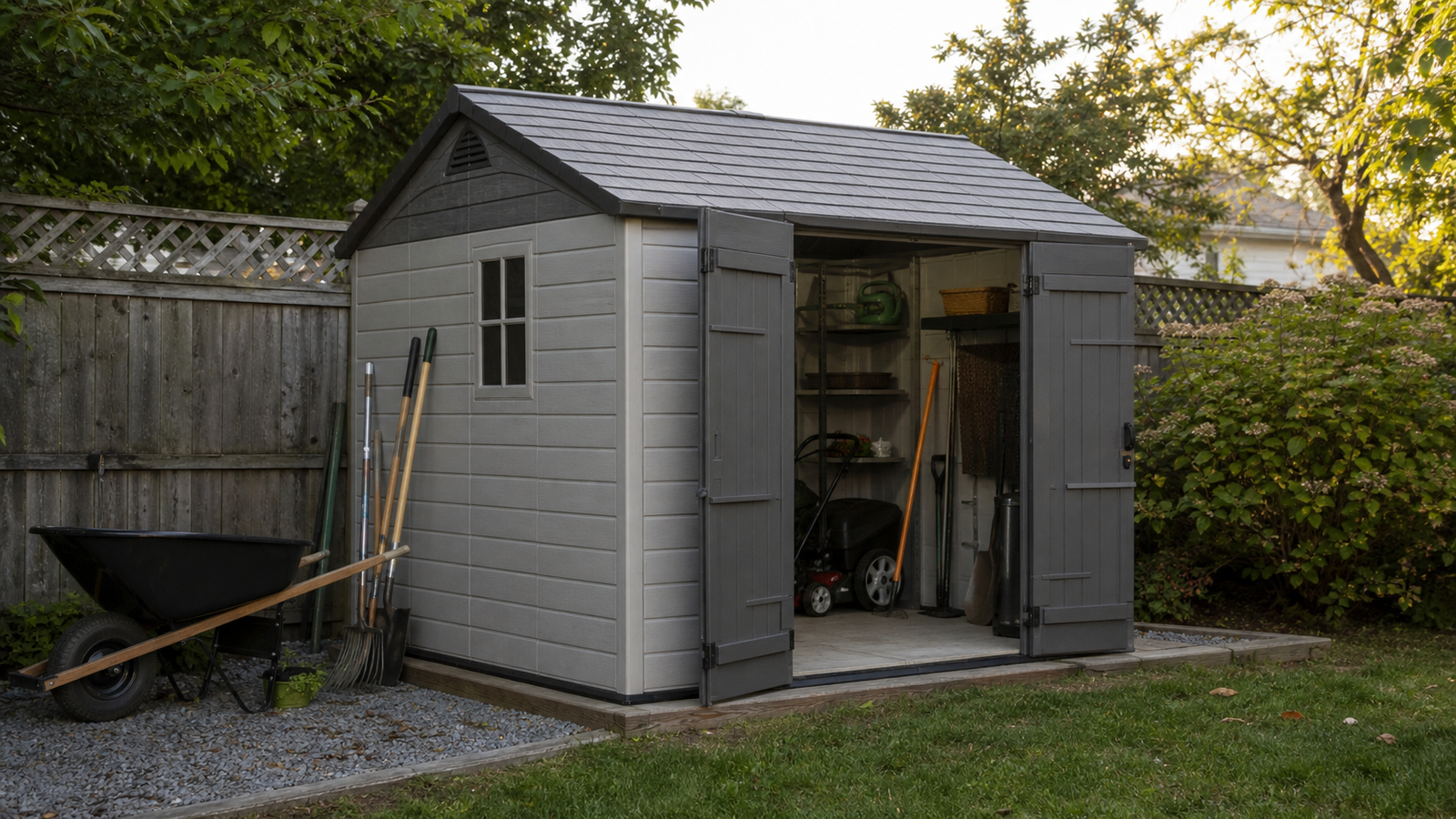
A riding mower, snow blower, wheelbarrow, and long-handled tools consume space awkwardly. Door width and threshold height may matter more than total square footage. Measure the widest machine and include mirrors, handles, mower decks, or attachments.
Then plan a route through the shed. If the mower blocks every shelf, the nominal storage capacity means little. Tall wall space is valuable, but confirm where the manufacturer allows hooks or shelves. Thin wall panels aren’t meant to carry arbitrary loads.
Roof design and local weather
Look for a stated snow-load or roof-load rating if winters are serious in your area. A steep roof sheds water and debris, while a low roof may fit below a fence line. Gutters are uncommon on basic models, so note where roof runoff will land.
Wind deserves equal attention. A closed shed still presents a broad surface to gusts. Use the specified anchor locations and hardware suitable for your slab, timber base, or ground system. Keep doors latched when the shed isn’t in use.
Doors, hinges, and security
Double doors make equipment access easier, but they reveal any error in the foundation. Check whether hinges are metal or molded plastic, whether the latch accepts a real padlock, and whether the doors have reinforcement around the lock area.
A padlock protects only as well as the surrounding door. Expensive power tools may be better stored in a garage or secured inside a locked cabinet bolted to the base.
Ventilation and condensation
Resin doesn’t absorb moisture, so wet equipment can raise humidity quickly. Built-in vents help, but they shouldn’t admit wind-driven rain. Leave space around stored items and avoid pushing cardboard boxes against an exterior wall.
Gasoline, propane cylinders, pesticides, and pool chemicals have separate storage requirements. A garden shed isn’t automatically suitable for every substance just because it is outdoors.
Assembly reality
- Build the foundation first and verify both diagonals.
- Open boxes in order and protect panels from wind.
- Don’t overtighten screws in molded plastic.
- Install roof pieces on a calm day.
- Recheck door alignment before anchoring permanently.
Large sheds may arrive by freight. Confirm curbside delivery details and the weight of each carton. A narrow side gate can turn delivery day into a long carry.
Resin, metal, or wood?
Resin asks for little routine maintenance and is friendly to DIY assembly. Metal sheds can be economical and compact, though thin panels dent and condensation may be noticeable. Wood is easiest to customize and repair, but it needs paint or stain and careful moisture detailing.
For a mower and ordinary garden tools, a reinforced resin shed on a proper base is often the least demanding option. For a workshop, heavy wall storage, or a custom interior, wood may justify the extra work.
How to compare resin garden sheds
- Download the manual and confirm the exact base dimensions.
- Check door opening width and threshold height.
- Look for internal steel reinforcement and approved shelf locations.
- Find the roof and wind ratings.
- Confirm anchor points, ventilation, warranty, and replacement parts.
- Add the foundation and delivery costs to the comparison.