Disclosure: This page contains affiliate links. As an Amazon Associate, Yard Foundry earns from qualifying purchases.
This guide compares aerator mechanisms and operating conditions. It does not diagnose turf disease or replace a local soil evaluation.
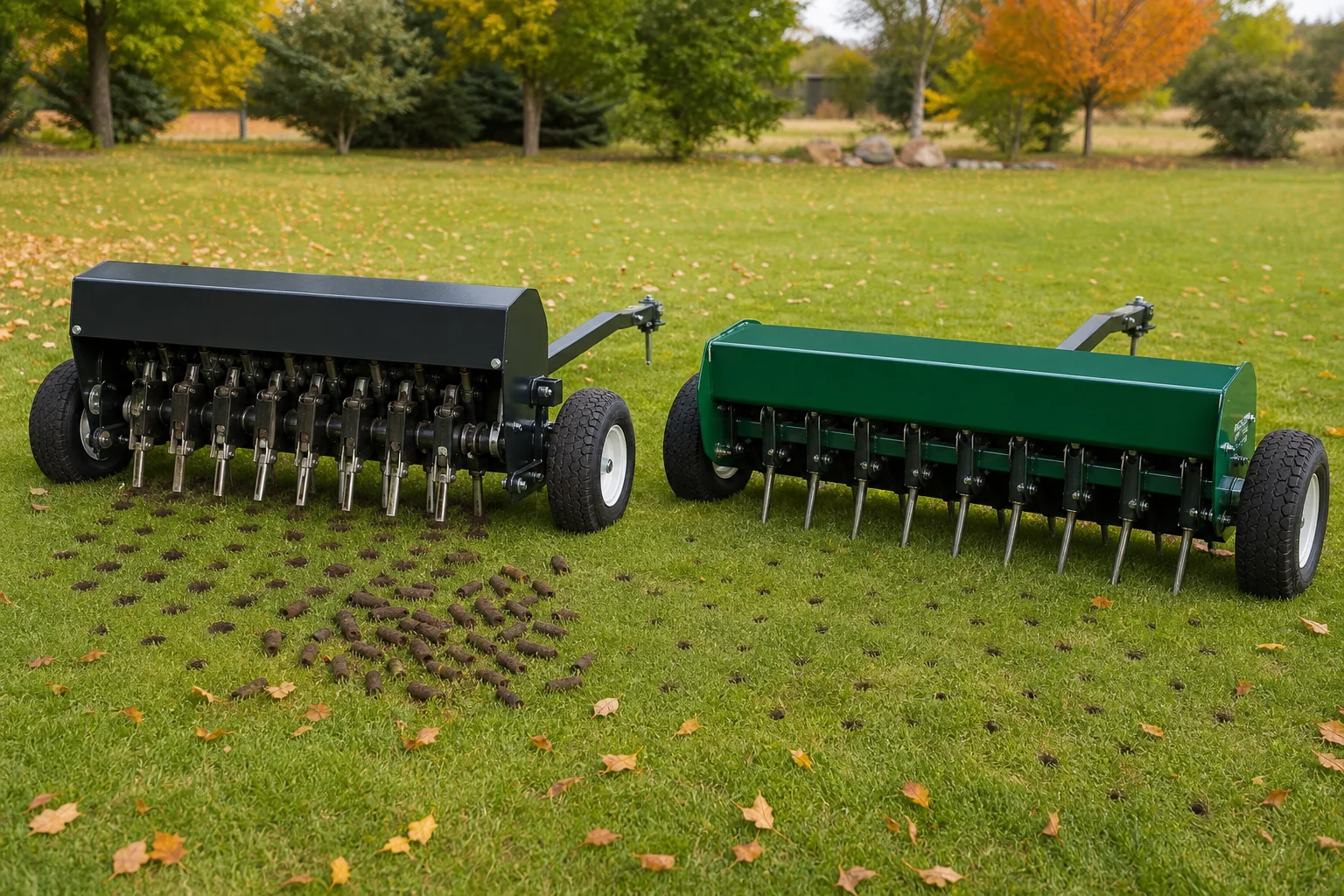
For a compacted lawn, a plug aerator is usually the better tool because hollow tines remove cores and create space in the soil. A spike aerator pushes solid tines into the ground, which can provide temporary holes but also compresses soil beside each hole. Spike models still have uses for light surface opening, but they are not equivalent to core aeration.
How a plug aerator works
Hollow tines enter the lawn and pull small cylinders of soil to the surface. The open holes improve short-term movement of air and water while the surrounding turf grows into the relieved space. The cores can dry and break apart naturally.
Penn State Extension defines aeration as removing soil plugs and notes that solid tines should not be mistaken for core-aerating equipment in its seasonal lawn guidance.
How a spike aerator works
Solid spikes make holes by displacing soil. A rolling spike attachment is simple, relatively light, and may help break a crusted surface before overseeding. Penetration often drops in hard ground unless ballast is added, and excess ballast can strain the attachment or towing machine.
Shoe-style spikes concentrate body weight over a tiny area and produce an uneven pattern. They may be harmless on a small lightly compacted patch, but they are not a practical treatment for a large compacted lawn.
Soil moisture decides whether either tool works
Aerate when soil is moist enough for the tines to enter but not saturated. Dry clay may refuse the tines. Wet soil can smear, rut, and compact under tractor tires. Water the lawn ahead of time if needed, then test a small area.
Mark shallow irrigation, invisible-fence wire, lighting cable, and sprinkler heads before starting. Call the utility locating service for buried public utilities, but remember that private landscape lines may require separate locating.
Pass pattern and coverage
One fast pass leaves wide untouched spaces. Multiple passes in different directions improve hole density, especially in traffic lanes. Do not turn sharply with tines engaged; lift the attachment first if its design permits.
The University of Minnesota Extension recommends core aerification and several passes in different directions in its lawn aeration guidance.
When to aerate
Work when the grass can recover. Cool-season lawns are commonly aerated during active growth in early fall or spring. Warm-season grasses are generally treated during their active late-spring or summer growth period. Local Extension timing is more useful than a national calendar.
Tow-behind, walk-behind, or rental
A tow-behind core aerator suits a property that already has a compatible lawn tractor and enough open turning room. Check hitch height, attachment weight, ballast limits, transport lock, and storage position.
A walk-behind rental may produce better cores on a smaller or obstacle-filled lawn. It is heavy, so plan loading and unloading before pickup. Hiring a lawn service can make sense when the site is steep or transport is difficult.
Choose a plug aerator when
- The lawn has traffic-related compaction.
- You want meaningful soil removal rather than shallow punctures.
- Soil moisture permits clean core extraction.
- You can make overlapping passes safely.
Choose a spike aerator when
- The problem is a light surface crust rather than deep compaction.
- You need a simple attachment for a limited task.
- You understand that the spikes displace rather than remove soil.