Disclosure: This page contains affiliate links. As an Amazon Associate, Yard Foundry earns from qualifying purchases.
This is a technology comparison based on current manufacturer documentation. Features and positioning requirements vary by model and can change with firmware or accessory choices.
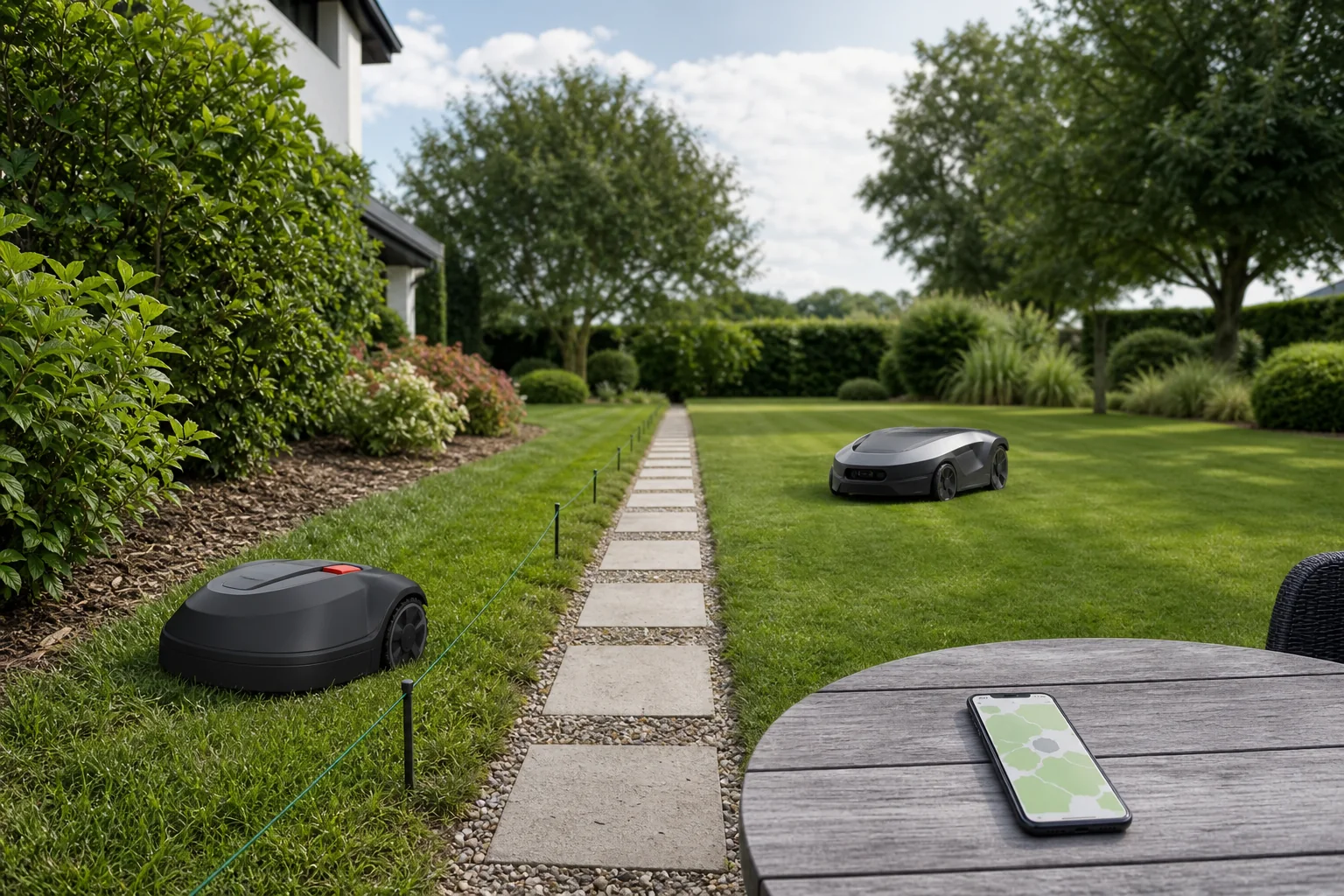
Choose a physical boundary-wire robot mower when you want a mature, fixed installation and the property has heavy tree cover or other areas where satellite positioning may struggle. Choose a wire-free mower when the lawn has a good sky view and you value editable work zones, temporary exclusions, and easier landscape changes.
How a physical boundary wire works
A low-voltage loop around the lawn creates the boundary signal. The installation may also include guide wires that help the mower reach remote areas and return to the charging station. Once the wire is buried or covered by turf, the lawn looks unchanged.
The work is front-loaded. Borders, islands, passages, and the charging-station approach must be planned carefully. Later edging projects and aeration can damage a shallow wire. A break is repairable, but locating it may take time.
How wire-free positioning works
Wire-free systems create virtual boundaries in an app and use satellite positioning, sometimes with a reference station, cloud corrections, cameras, or other sensors. You can move a boundary without digging and create temporary stay-out zones around a play area or new planting.
The tradeoff is signal dependence. Buildings, dense tree canopies, narrow side yards, and steep terrain may interfere with a particular system. Check the site requirements for the exact model rather than assuming every product advertised as GPS works the same way.
Installation comparison
Wire installation takes more physical work but produces a boundary independent of editable map data. A virtual installation is faster on a suitable open lawn, though the charging station and any reference equipment still need precise placement and power.
Husqvarna describes both approaches in its current robotic mower installation guide. Its wire-free system allows virtual work areas and stay-out zones, while the physical system uses perimeter loops and islands. Other manufacturers use different positioning stacks, so treat this as one documented example.
Trees, passages, and separate lawn areas
Physical guide wires can be useful through narrow passages. Husqvarna’s US guide-wire documentation notes that the guide helps the mower find remote zones and the dock. Wire-free products may handle the same path well, but only when positioning and obstacle sensing remain reliable there.
Walk the property at mower height. A clear sky from the patio does not prove good reception beside a tall hedge. Check every corridor, tree cluster, and wall edge.
Landscape changes
Virtual boundaries win when garden beds and play zones move often. With wire, permanent changes require lifting, cutting, rerouting, and reconnecting the loop. Temporary physical fences can still keep either type out of a short-term project.
Repair and long-term ownership
Wire systems may need break repairs, connector replacement, and careful marking before digging. Wire-free systems remove that buried component but add reliance on compatible corrections, software, connectivity, and sometimes subscription or accessory costs. Confirm what continues to work if Wi-Fi or cellular service is unavailable.
Decision checklist
- Map tree canopy and building shadows.
- Measure narrow passages and slopes.
- List areas that change during the season.
- Price installation materials, reference equipment, and subscriptions.
- Check service support and replacement battery availability.
- Confirm the return window allows a realistic property test.
Compare wire-free and boundary-wire robotic mowers on Amazon