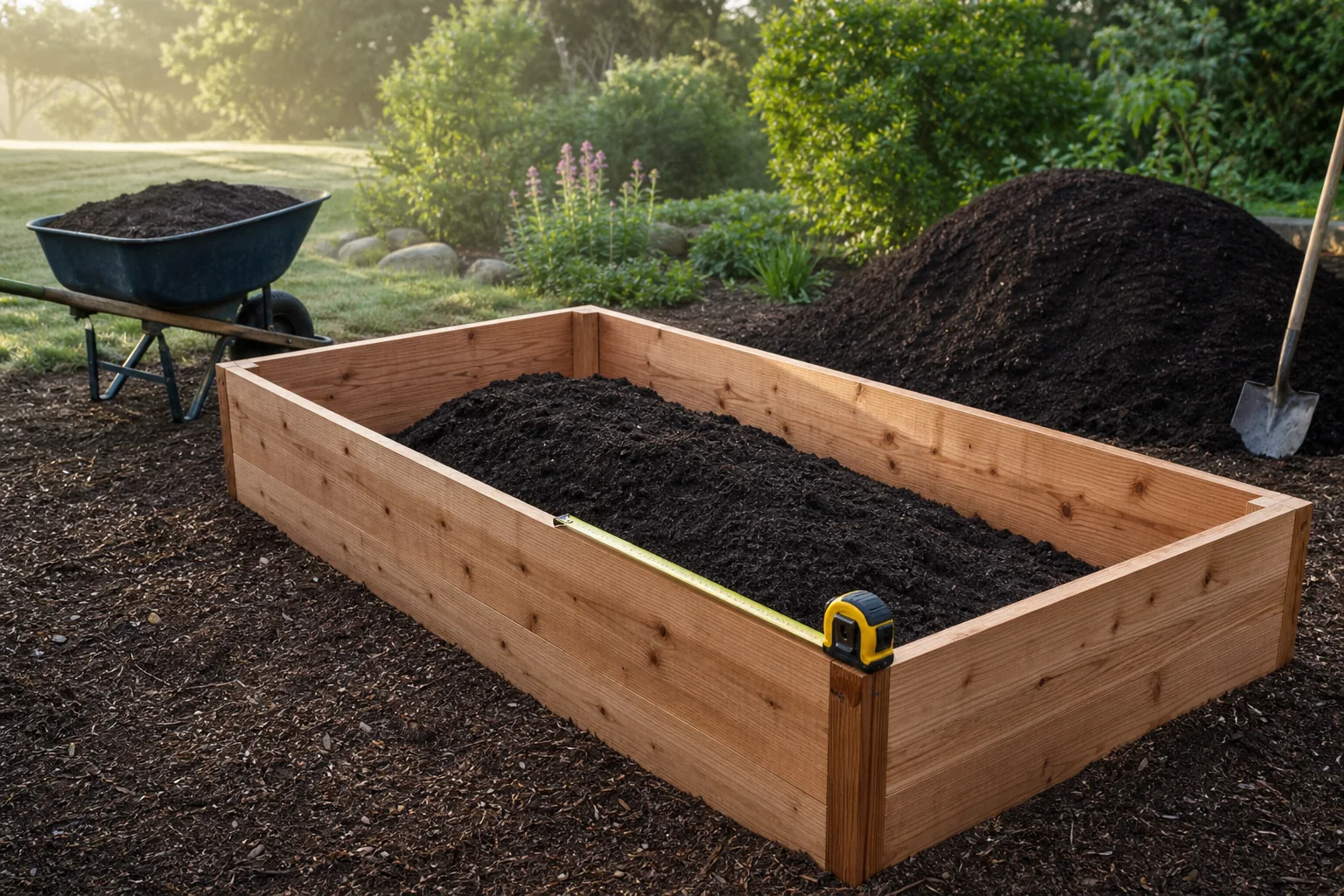
This raised bed soil calculator method uses the bed’s inside length, inside width, and actual fill depth. Multiply those three measurements in feet to get cubic feet. Divide by 27 for cubic yards. Add a modest allowance for settling, but do not order from the advertised outside dimensions of the frame.
Raised bed soil calculator
Use the finished inside dimensions. The allowance covers settling and small measuring differences.
The basic raised bed soil formula
Length in feet x width in feet x fill depth in feet = cubic feet of soil.
For a 4-foot by 8-foot bed filled 12 inches deep:
4 x 8 x 1 = 32 cubic feet.
To convert that amount to cubic yards:
32 / 27 = 1.19 cubic yards.
A landscape supplier may sell by half-yard increments, so the practical order could be 1.25 or 1.5 yards depending on delivery rules and whether the bed will be filled to the top.
Common raised bed soil volumes
| Inside dimensions | Fill depth | Cubic feet | Cubic yards |
|---|---|---|---|
| 2 x 4 ft | 12 in | 8 | 0.30 |
| 3 x 6 ft | 12 in | 18 | 0.67 |
| 4 x 8 ft | 12 in | 32 | 1.19 |
| 4 x 8 ft | 18 in | 48 | 1.78 |
| 4 x 12 ft | 12 in | 48 | 1.78 |
Measure the inside, not the product name
Thick boards, corner posts, and curved metal panels reduce the soil cavity. Measure the finished inside length and width. If the bed has rounded ends, split the shape into simple rectangles and semicircles or use the manufacturer’s stated soil capacity when it is documented.
Fill depth is not always the same as wall height. Leave room below the top edge for mulch and irrigation water. A 17-inch-tall bed filled to 15 inches should be calculated at 1.25 feet deep.
How many bags?
Bag labels usually list volume in cubic feet. Divide the total cubic feet by the volume of one bag. A 32-cubic-foot bed needs sixteen 2-cubic-foot bags before any settling allowance.
For more than a small bed, bulk delivery is often easier and produces less packaging. Compare the delivered price, minimum load, and whether the supplier can place the pile where a wheelbarrow can reach it.
Allow for settling without overbuying
Fresh mixes with abundant compost and coarse organic material settle as particles rearrange and decompose. Adding roughly 5 to 10 percent is a reasonable planning allowance for many mixes, but the supplier may have a better figure for its product. Deep beds filled with fluffy material may settle more.
Do not fill the lower half with fresh logs or uncomposted waste just to reduce the soil bill unless you deliberately want a mound-culture system and understand how decomposition changes volume, nitrogen availability, and moisture.
Choose a mix made for vegetables
Oregon State Extension advises choosing a raised-bed mix with good nutrient and water-holding capacity rather than generic fill soil. Its raised bed guide also recommends loosening native soil beneath an open-bottom bed when deeper rooting is useful.
Ask what the delivered mix contains. A useful blend may include screened mineral soil, finished compost, and a material that preserves pore space. A laboratory soil test gives better fertilizer guidance than adding amendments by habit.
Remember the weight
Wet soil is heavy. Elevated beds, rooftop installations, decks, and tall beds with legs need a verified structural capacity. Long or tall freestanding beds also need enough bracing to resist the outward pressure of wet soil.
Quick ordering checklist
- Measure the internal length and width.
- Choose the actual fill depth.
- Convert inches to feet before multiplying.
- Convert cubic feet to yards or bags.
- Add a small, product-appropriate settling allowance.
- Confirm delivery access and storage space.