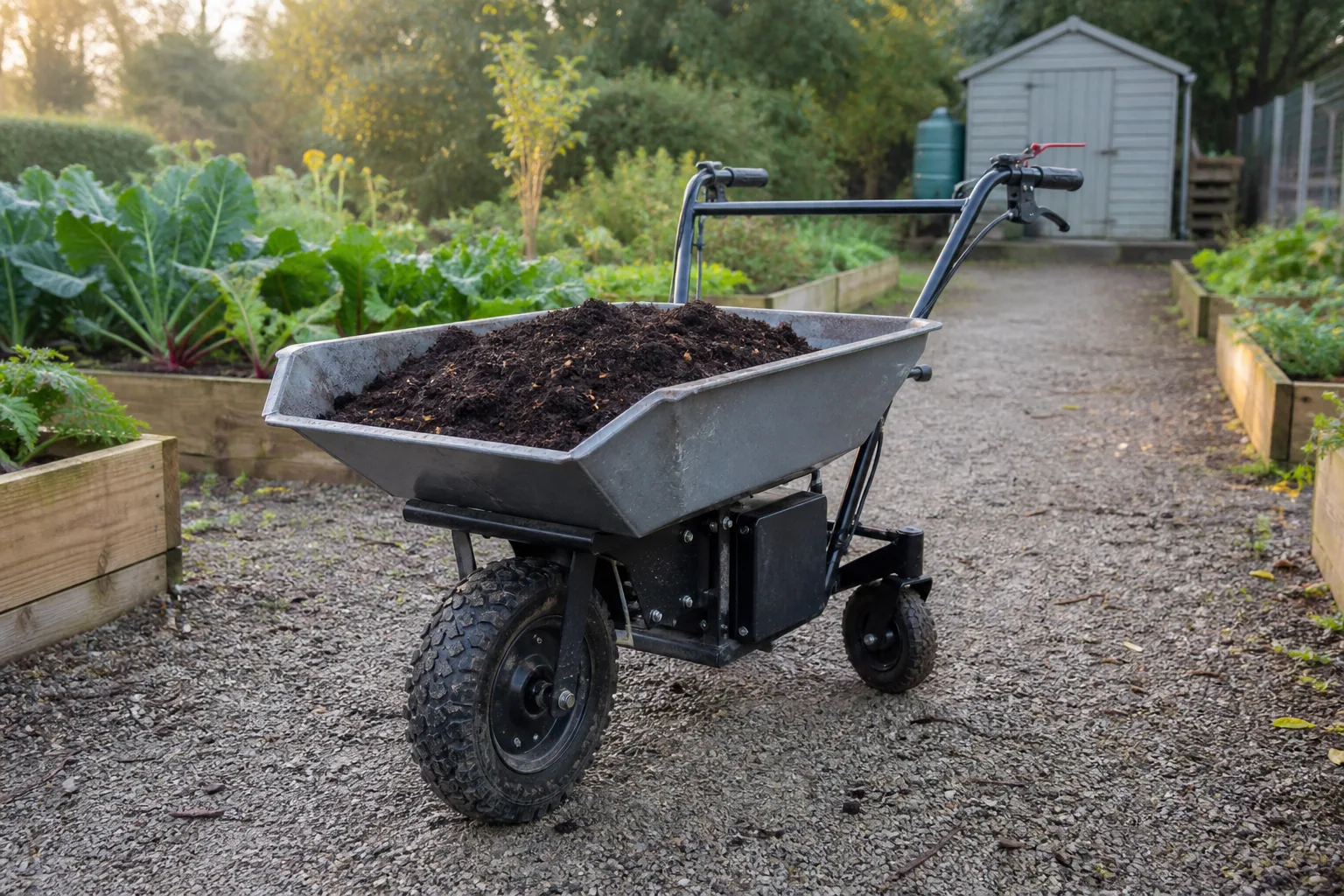
Disclosure: This page contains affiliate links. As an Amazon Associate, Yard Foundry earns from qualifying purchases.
A power wheelbarrow buying guide should begin with the route, not the biggest payload printed on a product page. Measure the narrowest gate, steepest grade, sharpest turn, softest patch, and storage doorway first. Then choose a machine that can carry a useful load through that route with predictable speed, braking, and dumping. A high capacity barrow that cannot turn beside the raised beds is simply the wrong machine.
This is a research based buying guide. Yard Foundry has not loaded or driven the machines discussed here. Confirm payload, grade, controls, battery, fuel, and transport limits in the current manual for the exact model.
Power wheelbarrow buying guide: map the whole route
Walk from the material pile to every likely unloading point. Bring a tape measure and note more than path width. Handles swing wide in a turn, a tray can overhang the wheels, and the operator needs room to walk without stepping into a bed or backing toward a drop.
Record these route details:
- Clear width at gates, shed doors, fence corners, and between beds
- Surface changes such as pavement to gravel, gravel to lawn, or lawn to loose soil
- Longitudinal grades, side slopes, steps, curbs, drainage channels, and exposed roots
- Turning space at both ends of a narrow passage
- Overhead branches, low shelves, and anything that can catch a tall load
- A safe place to park, load, and dump on firm ground
Do the same check when empty and when carrying a bulky load in your imagination. A bag of soil stays inside the tray. Brush, rolls of fencing, and long timber can change the working width or shift the center of mass. The Makita XUC01 instruction manual, for example, tells users to keep loads inside the carrier, secure them, lower load height, and reduce the load on slopes. Those are model-specific instructions, but they show the questions every useful manual should answer.
Compare the specifications that affect real work
| Specification | Why it matters | What to verify |
|---|---|---|
| Rated payload | Maximum permitted mass in the maker’s stated conditions | Whether accessories, tray, slope, and uneven ground reduce the limit |
| Tray or deck volume | How much loose mulch, compost, or debris fits before it spills | Usable volume and side height, not only overall dimensions |
| Machine width and length | Gate clearance, turning radius, storage, and trailer fit | Width at the tray, wheels, and handles in working position |
| Forward and reverse speeds | Control on grades and how comfortably the operator can walk | Low speed behavior, reverse control, and neutral |
| Maximum grade | A screening limit for climbing and controlled descent | Surface, load, direction, and test conditions stated in the manual |
| Brake system | Stopping, parking, and holding the machine while loading | Service brake, parking brake, release procedure, and adjustment |
| Drive layout | Traction, steering effort, turf disturbance, and stability | Driven wheel or tracks, support wheels, differential, and tire type |
| Dump mechanism | Operator effort and where material leaves the tray | Manual, assisted, or powered tip; latch; hinge; discharge height |
An older official Makita outdoor equipment catalog illustrates the difference between payload and volume. Its XUC01 entry listed a 290-pound maximum load and a 3-cubic-foot bucket, along with separate forward speed, reverse speed, and maximum grade fields. This is not a current model recommendation. It is a good example of why one large capacity number does not describe the machine.
Payload and volume solve different problems
Payload limits mass. Tray volume limits bulk. Wet soil may reach the weight limit while the tray still looks half empty. Dry leaves may fill the tray without approaching the same mass. Never convert cubic feet to pounds using a generic number and assume it covers every material or moisture condition.
Estimate the job in volume before comparing trips. The raised bed soil calculator gives the cubic feet or cubic yards needed for a rectangular bed. Divide that volume by the barrow’s usable tray volume to estimate an ideal trip count, then allow for material that cannot be heaped safely and for the manufacturer’s payload limit.
Look at tray shape as closely as volume. A shallow wide bucket is easy to load with mulch but may catch a narrow gate. A deep tub keeps loose compost contained and raises the center of mass. A flat deck carries bags, stones, and crates, but loose material needs a compatible bucket or secure container.
If the main project is a new bed, plan machine access before assembling the structure. Our raised garden bed kit guide covers bed dimensions and site planning. Leave a route wide enough for the machine, operator, and future repairs rather than squeezing a powered cart through a decorative gap.
Wheels, tracks, and the surface under them
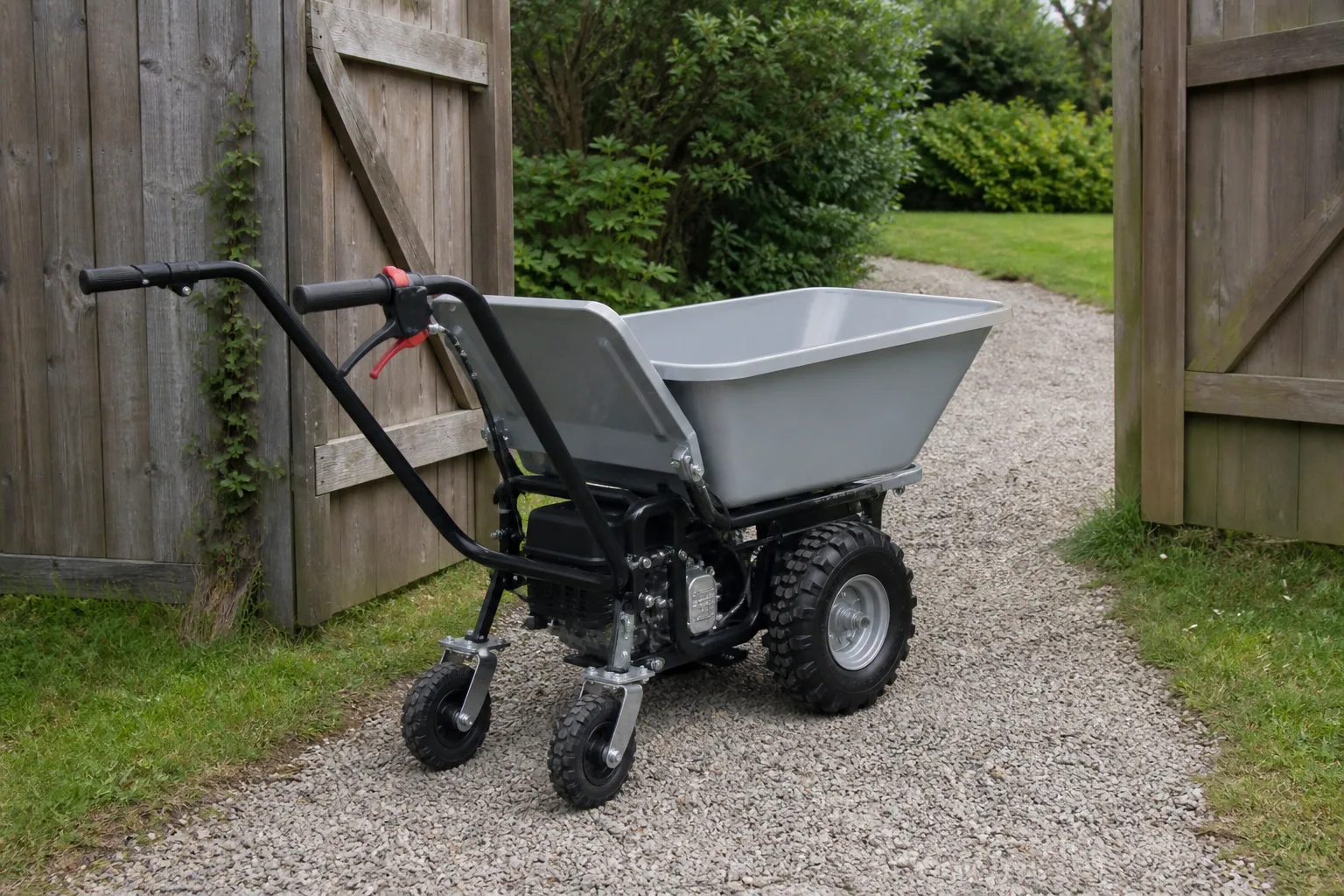
A large driven pneumatic tire can roll over coarse gravel and small roots while keeping the machine relatively simple. Small hard support wheels may still sink or chatter. Four-wheel power wagons spread the load across more contact points and can feel stable on firm ground, although steering geometry and tire scrub vary. Tracks offer a long contact patch on loose or uneven ground, but tracked machines tend to be heavier, need more room for turns, and can disturb turf when pivoting.
Do not choose tracks merely because the yard becomes muddy. Fix drainage and route construction where possible. A machine that repeatedly ruts saturated soil damages the path and may become difficult to recover even if the drive system keeps moving.
Cross-slope stability deserves special attention. A grade number usually describes travel up or down a slope, not sideways across it. Tray height, load placement, tire pressure, wheel spacing, and hidden holes all change the tipping margin. Treat the manual’s grade limit as a boundary, not a target, and reduce the load well before traction or braking feels uncertain.
Controls should make slow work easy
Material handling around beds is mostly low-speed work. The machine should start gently, hold a predictable walking pace, and stop without a long reach or a complicated sequence. Check control layout while wearing the gloves used for garden work.
Useful controls include a spring-return drive lever or other deliberate operator-presence control, a separate direction selector, a true low range, and a parking brake that can hold during loading. Reverse should be slow enough to manage without pulling the operator off balance. The handles need a natural wrist angle and enough adjustment for the people who will use the machine.
NIOSH identifies forceful pushing, awkward posture, lifting, vibration, and task duration as physical risk factors in material handling. Its ergonomics risk-factor guidance is written for workplaces, not backyard purchasing, so it cannot assign a safe garden payload. It does explain why handle position, repeated loading, control effort, and trip count belong in the decision.
Braking matters as much as climbing
Buyers often ask whether a machine can climb a hill. The harder question is whether it can descend the same hill with a load, pause without rolling, and remain parked while the tray is filled. Find the braking section in the manual before ordering.
Check whether releasing the drive lever actively slows the machine or merely stops power. Look for a service brake, parking brake, and a clear adjustment or inspection procedure. If the machine has a freewheel or transport release, learn what happens when it is engaged on a grade. A brake that depends on battery power or drive-system resistance may behave differently with power off, so use the exact manual rather than assuming.
A machine should never be trusted to hold itself on a slope while unattended. Load and unload on stable ground whenever the manual requires it. Chocks, improvised ropes, and a helper standing downhill are not substitutes for the specified parking method.
Manual, assisted, and powered dumping
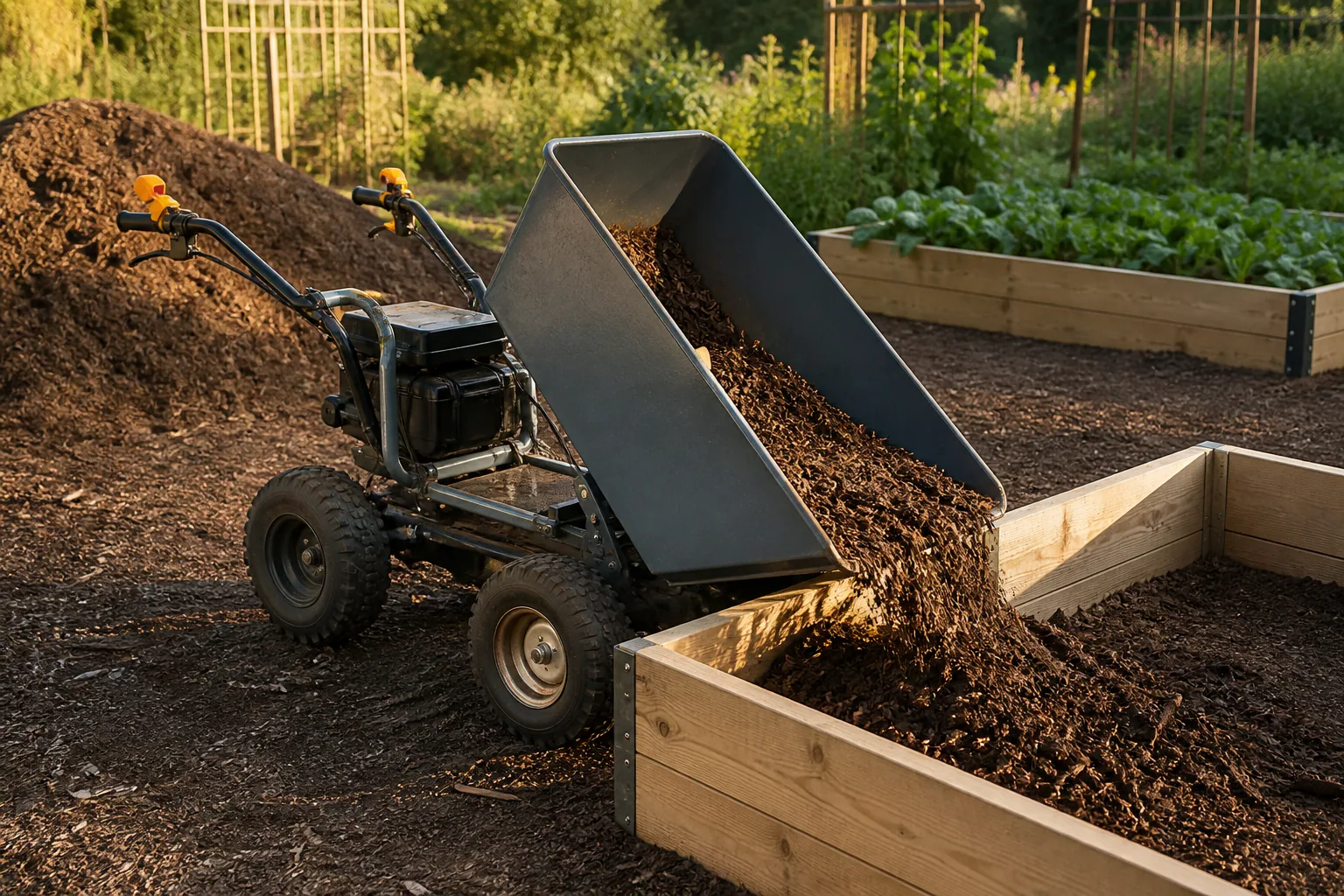
A manual tip tray is simple, but the operator still raises part of the load around the hinge. Gas struts or springs can reduce effort. Hydraulic or electric dumping adds convenience and can place the tray higher, though it also adds weight, controls, and service points.
Inspect the latch and hinge in product diagrams. The latch should be reachable without stepping in front of the machine or placing a hand near a pinch point. The tray should clear its frame through the full tip. Check whether the load slides out at the desired height or piles against the bed wall.
Dumping into a raised bed can tempt the operator to put a wheel on soft soil or rest the machine against the bed. Keep the chassis on the route the manufacturer allows. If the bed is too high or access too narrow, unload onto a tarp and finish with a shovel rather than forcing the tip geometry.
Battery, gas, and service support
Battery machines avoid fuel storage and can be convenient for short trips near a shed. Compare watt-hours, number of battery bays, charger time, weather restrictions, replacement-battery availability, and whether the advertised runtime was measured with a representative load and grade. A bare runtime number is weak evidence without test conditions.
Gas machines can work away from charging power and may suit long sessions, but they bring fuel, oil, exhaust, noise, warm-up, and seasonal engine service. Never run an engine in a closed shed or greenhouse. Check how easily the machine can be rolled if the engine stops far from storage.
Parts support matters for either power source. Tires, tubes, brake cables, drive belts, control switches, trays, and battery packs are ownership items. A clear illustrated parts list is more useful than a long accessory gallery. Similar logic applies to branch-processing equipment, as explained in our wood chipper versus chipper shredder guide.
Storage and transport can rule out a model
Measure the machine with its tray, handles, and support wheels in the actual storage configuration. Folding handles save length only if the fold is quick enough to use every time and does not trap control cables. Allow room to charge or refuel, inspect tires, and release the parking brake without moving other tools first.
The shed sizing guide explains why door width and turning path matter more than floor area alone. A powered barrow parked behind a mower and bags of soil will not simplify garden work.
If the machine travels in a truck or trailer, verify loading-ramp limits, tie-down points, weight, and whether batteries or fuel require separate handling. Do not assume the garden-grade limit also approves a transport ramp. The Makita manual cited earlier, for example, gives a specific ramp inclination and loading procedure for that machine. Other models may differ.
Compare power wheelbarrow listings on Amazon (paid link). Use listings to build a shortlist, then verify every route, load, grade, brake, dump, power, and storage claim in the current manufacturer manual.
A practical shortlist process
- Measure the complete route, including gates, turns, grades, side slopes, and storage access.
- Estimate material volume and identify the heaviest routine load.
- Reject machines whose working width or turning space does not fit.
- Compare payload, tray volume, drive layout, low-speed control, reverse, and brakes.
- Read the slope, loading, dumping, and transport sections of each manual.
- Price the correct tray, batteries or engine supplies, charger, spare tire items, and delivery.
- Choose a lower trip load whenever the route or material makes the full rating unrealistic.
Frequently asked questions
Is a tracked power wheelbarrow better than wheels?
Tracks can help on loose or uneven ground and spread contact over a longer area. They also add weight, need more turning room, and may scuff turf during tight turns. Choose from the actual route rather than treating tracks as an automatic upgrade.
How much can a power wheelbarrow carry?
The answer is the lower of the machine’s permitted payload, tray volume, accessory limit, and the safe load for the route. Wet soil can reach a mass limit long before a tray is full. The current manual should explain reductions for slopes or difficult surfaces.
Can I use a power wheelbarrow on a hill?
Only within the exact model’s grade, surface, direction, braking, and load rules. Measure both the uphill route and the descent. Avoid cross-slope travel where possible, and never use a published maximum grade as a routine working target.
Take the final two candidates back to the measured route. The better purchase is the one that fits every gate, moves slowly under control, stops on demand, and unloads where the material is needed. Capacity matters only after those checks pass.