Disclosure: This page contains affiliate links. As an Amazon Associate, Yard Foundry earns from qualifying purchases.
The best greenhouse flooring options depend on where water should go and what needs to roll across the aisle. Compacted crushed stone is forgiving and drains well. Pavers make a cleaner walking surface while keeping repairs manageable. Concrete is easiest to sweep and roll over, but it needs planned slope and drainage. Rubber mats add traction or cushioning over a stable base; they do not fix mud, settlement, or trapped water underneath.
This is a research based planning guide. Yard Foundry has not installed or slip tested the materials described here. Floor thickness, drainage, accessibility, frost preparation, and structural work should follow local requirements and the greenhouse manufacturer’s plans.
Separate the greenhouse floor from the foundation
The foundation carries the greenhouse frame and transfers wind, snow, and dead loads into the ground. The interior floor gives people, benches, pots, and carts a usable surface. They may meet at the perimeter, but they do different jobs.
A gravel aisle inside a greenhouse does not turn a loose perimeter into a structural base. A concrete floor is not automatically a code-compliant foundation either. Review the frame requirements and our greenhouse foundation options before choosing the finish underfoot.
Start below the finish. Strip organic topsoil from traffic areas, correct soft spots, and establish drainage away from the greenhouse. Water should not sit against a timber base or run from outside beds into the doorway. Plan sleeves, drains, and utility routes before placing pavers or concrete. Cutting them in later is noisy, dusty, and usually less tidy.
Greenhouse flooring options compared
| Floor | Drainage | Carts and access | Cleaning | Best use |
|---|---|---|---|---|
| Crushed stone or coarse gravel | Good when the base and site drain | Fair to poor unless tightly compacted and well graded | Spilled mix and leaves work into the stone | Budget greenhouse, under benches, flexible layouts |
| Concrete pavers | Through joints and the prepared base; depends on installation | Good when flat, tight, and restrained | Easier than loose stone; joints collect debris | Main aisles and small hobby greenhouses |
| Conventional concrete | Poor through the slab; requires deliberate slope and drains | Very good on a smooth, textured surface | Easy to sweep and wash if runoff has an outlet | Frequent cart use, potting, permanent layouts |
| Permeable concrete | Water passes through when pores stay open | Good for light traffic if properly designed | Fine media can clog the surface | Specialized installations with a designed drainage base |
| Rubber mats | None through solid mats; edges and seams can trap water | Good if mats lie flat and cannot shift | Can be lifted; soil collects at joints | Standing zones or slippery spots over a sound floor |
University of Georgia Extension lists gravel, crushed stone, concrete, and brick among practical hobby-greenhouse floors. Its hobby greenhouse guide points out the basic tradeoff: hard surfaces are easier to walk on and clean, while loose material handles moisture differently. Modern greenhouse sanitation adds another concern. A floor that stays wet can support algae and weeds.
Crushed stone: inexpensive and easy to revise
Crushed angular stone locks together better than rounded pea gravel. For an aisle, a graded crushed aggregate that compacts into a firm surface is usually easier for narrow wheels. Coarser clean stone can drain well under benches, but it is unpleasant for small casters and dropped hardware disappears into it.
Use a stable, compacted base and keep the finished stone below the frame’s weep paths and door threshold. A woven separation fabric can reduce mixing between soil and aggregate. It is not a cure for a wet site. If groundwater or roof runoff has nowhere to go, water can stand within the stone even when the surface looks dry.
Gravel needs maintenance. Potting mix fills the voids, weeds root in the organic layer, and algae grows where irrigation leaks. The University of Florida’s greenhouse weed-control guidance recommends reducing standing water through drainage, coarse gravel, and correct concrete slope. It also notes that weeds can establish in gravel once organic matter accumulates.
Gravel makes sense when the budget is tight, the greenhouse layout may change, and most traffic is on foot. Use a firmer central path if you regularly move a loaded wheelbarrow or cart.
Pavers: a useful middle ground
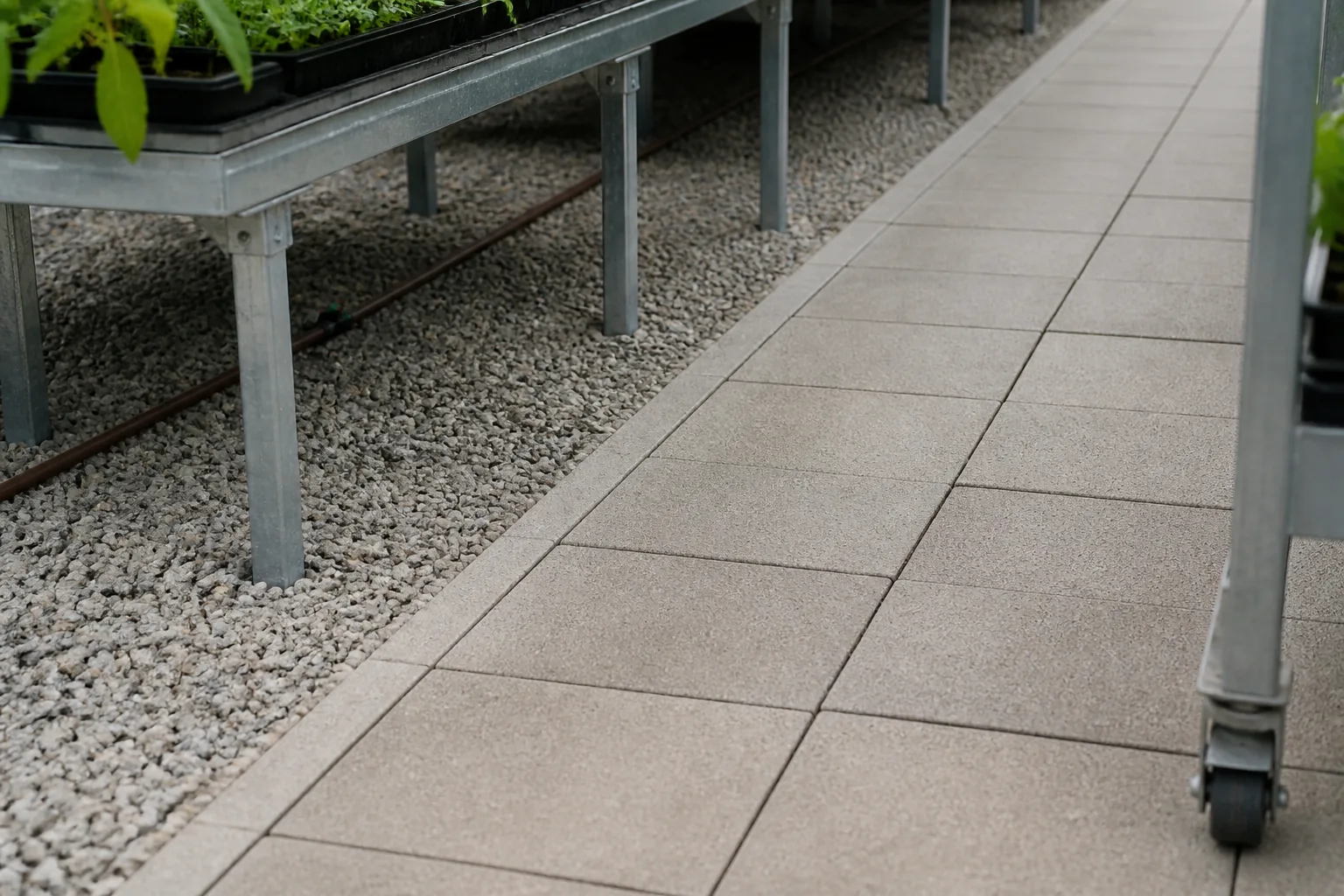
Concrete or clay pavers give a small greenhouse a flat aisle without committing to one monolithic slab. Individual units can be lifted to reach a pipe or correct settlement. Joints let some water into the base, although pavers are not automatically a permeable drainage system.
Preparation decides how the path feels after two winters. Excavate to a stable layer, compact the aggregate base in lifts, use an even bedding course, and restrain the edges. Keep the surface pitch consistent so irrigation water does not collect in a low joint. Doorways need especially careful compaction because carts and foot traffic load the same narrow strip.
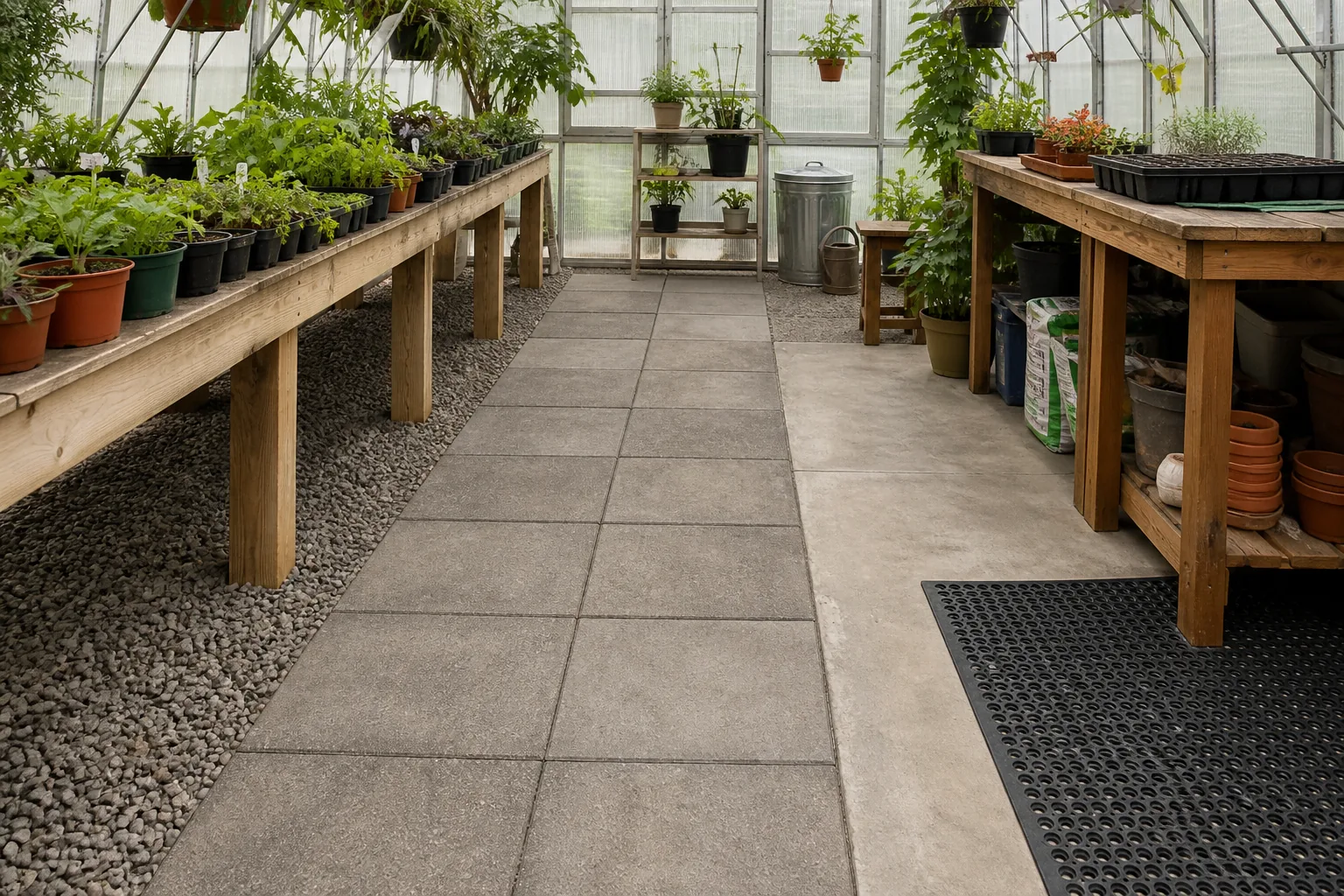
A paver aisle with gravel under the benches suits many hobby greenhouses. The aisle stays rollable and the side zones accept drips. It also keeps a permanent hard surface only where it earns its cost. Uneven, wide, or sinking joints are a trip problem, so inspect and reset them rather than covering them with a loose mat.
Concrete: clean movement, unforgiving drainage
Concrete handles carts, narrow wheels, and repeated sweeping better than loose aggregate. It can also support fixed benches and a defined potting area when the slab was designed for those loads. The drawback is simple: water does not pass through ordinary concrete.
Put the drainage route on the plan. A gentle, consistent slope can send water to a trench drain, floor drain, or permitted exterior discharge point. Local rules may restrict where nutrient-rich wash water goes. The slope must be enough to prevent puddles without making carts roll or benches sit awkwardly.
Surface finish matters. Mirror-smooth concrete gets slippery when algae, soil, or water covers it. A coarse broom finish offers more traction but takes more effort to sweep. Sealers can change slip behavior, so choose a product for wet pedestrian areas and follow its cure and recoat instructions.
The Cornell-hosted Greenhouse Engineering manual describes a hybrid of gravel floors and concrete traffic aisles. It also discusses porous concrete, which can drain through the surface but may clog where fine potting material falls. For a backyard greenhouse, ordinary concrete with planned drainage is often easier to maintain than a specialty porous slab.
Rubber mats: an overlay, not a base
Rubber mats can make a standing zone less tiring and add texture at an entrance or potting bench. Choose mats made for wet work areas, with beveled edges and a pattern that can be cleaned. A mat that curls, creeps, or leaves a tall edge creates its own trip hazard.
Solid rubber holds water underneath if the floor is not dry and sloped. Interlocking seams trap potting mix. Perforated mats drain through holes, but the water still needs a route across or through the base below. Lift the mat on a cleaning schedule and inspect for algae.
Do not lay rubber over loose pea gravel and expect a firm accessible aisle. The mat will follow ruts and may separate at the joints. It works best over concrete, well-set pavers, or another smooth surface that already handles loads and drainage.
Compare wet-area rubber mat listings for greenhouse work zones on Amazon (paid link). Check drainage pattern, edge profile, material limits, and cleaning instructions before purchase.
Design the aisle around real movement
Measure the widest cart, wheelbarrow, tray, and door swing. Then add hand clearance rather than making the path exactly as wide as the equipment. University of Georgia’s guide notes that a simple standing path may be narrow, while a wheelbarrow or visitor route needs more room. Your own equipment gives the better number.
- Roll the loaded cart across a taped outline before building fixed benches.
- Leave room to turn at the end of a center aisle.
- Keep hose connections and electrical cords out of the walking route.
- Make door thresholds low, supported, and easy to see.
- Provide a firm work pad where heavy bags are opened and mixed.
Bench width and ventilation change the layout too. A wide hard aisle is wasted if benches block airflow or force you to reach too far. Our greenhouse ventilation guide covers the air path, while the Greenhouse Fan CFM Calculator gives a starting airflow estimate.
Drainage and sanitation need a routine
No floor stays clean by itself. Fix irrigation leaks promptly, collect spilled potting mix, remove plant debris, and keep drains open. The University of Florida guidance warns that algae-like growth on wet greenhouse floors can become slippery. UC Integrated Pest Management also recommends good drainage and level gravel or soil beneath benches to reduce wet pockets.
Watering technique affects the floor as much as material choice. If every irrigation cycle leaves the aisle wet, revisit emitter placement and run time. Condensation can add water from above, so use the greenhouse condensation troubleshooting guide when drips continue after irrigation is corrected.
A cleaning plan should suit the surface. Sweep pavers and concrete before washing so organic matter does not enter joints or drains. Rake and top up compacted stone when ruts form. Lift mats, clean both sides, and let the base dry. Avoid pressure washing that drives dirty water into electrical equipment or onto plants.
Choose by use, not appearance
- Choose compacted crushed stone when drainage, low initial cost, and easy changes matter more than smooth cart travel.
- Choose pavers for a repairable, rollable main aisle in a small or medium hobby greenhouse.
- Choose concrete when carts, cleaning, and a permanent layout justify the cost of a properly drained slab.
- Add rubber mats only where a stable floor already exists and a specific work zone needs more traction or comfort.
If two needs conflict, combine surfaces. A concrete or paver center aisle with coarse gravel under benches often costs less than a full slab and works better than loose stone everywhere. Keep the transitions flat and make sure both surfaces drain.
Frequently asked questions
Can I put a greenhouse directly on soil?
You can grow in ground beds, but bare soil is a poor traffic surface once it becomes muddy or compacted. The structural base still needs to meet the greenhouse plan, and a defined aisle usually makes drainage and cleaning easier.
Should greenhouse gravel be covered with landscape fabric?
A robust woven separation fabric below aggregate can slow mixing with native soil. Weed fabric on top of gravel is easier to sweep at first, but tears and accumulated potting mix can still support weeds. Use the fabric as one maintenance aid, not a permanent sanitation solution.
Do I need a floor drain in a greenhouse?
That depends on floor type, water volume, grade, discharge rules, and winter conditions. A solid slab needs a deliberate drainage route. Ask the local authority where wash water may go before pouring concrete.
Sketch water flow before choosing the surface. Then push your heaviest cart across a mock aisle. Those two small checks usually reveal whether gravel, pavers, concrete, or a mixed floor will be pleasant to live with after the greenhouse is full.