Disclosure: This page contains affiliate links. As an Amazon Associate, Yard Foundry earns from qualifying purchases.
Accurate irrigation pump sizing needs one operating point: the gallons per minute the active zone requires and the total dynamic head the pump must overcome at that flow. Do not choose a pump from its maximum GPM or maximum head printed on the box. Those ratings occur at different ends of the pump curve. The useful question is whether the curve reaches your required GPM and head at the same time.
This is a research based sizing guide, not a substitute for a pump manufacturer’s curve, local plumbing rules, or a qualified installer. Yard Foundry has not physically tested the pumps discussed here.
Irrigation pump sizing starts with one design point
A pump supplies less flow as the head it works against increases. This relationship appears on the manufacturer’s head and flow curve. Your design point is the intersection of required flow on the horizontal axis and required head on the vertical axis.
North Dakota State University Extension explains that pump selection is based largely on the efficiency and total dynamic head available at a specific flow. The same pump may deliver a large volume with little resistance and far less water when it must lift water, build sprinkler pressure, and push through a long small pipe.
Write down two numbers before shopping:
- Design flow in gallons per minute, or GPM
- Total dynamic head in feet at that design flow
Horsepower, outlet diameter, and marketing labels come later. They do not replace those two numbers.
Step 1: calculate the flow the active zone needs
Use the manufacturer’s rated flow for every sprinkler nozzle, dripline section, emitter, or appliance that will run at the same time. Add only simultaneous demand. If the controller runs one irrigation zone at a time, the pump usually needs to serve the highest-flow zone, not the sum of every zone on the property.
For a sprinkler zone, add the nozzle GPM at the intended operating pressure. A nozzle listed at 3 GPM at 30 psi may deliver something different at another pressure, so use the correct row in its performance chart. For drip emitters rated in gallons per hour, convert the zone total to GPM:
Zone GPM = number of emitters x emitter GPH / 60
Two hundred 0.5 GPH emitters have a nominal combined flow of 100 GPH, or about 1.67 GPM. Inline drip tubing may publish flow per 100 feet instead. Multiply that figure by installed length and convert the result to GPM.
The Drip Irrigation Flow and Runtime Calculator can total a drip zone, while the Garden Water Demand Calculator estimates daily volume. These answer different questions. Daily gallons help size storage and runtime. GPM determines the instantaneous flow the pump must deliver.
Add other fixtures only when they can operate with irrigation. A hose bib opened during a sprinkler cycle changes peak demand. A second zone scheduled at a different time does not.
Step 2: calculate total dynamic head
NC State Extension expresses total dynamic head for a rainwater pumping system as required operating pressure head plus elevation head plus friction head:
TDH = pressure head + elevation head + friction head
The same framework works for a garden system when every component is measured along the active path from the water level or pump intake to the most demanding outlet. The details change for wells and specialized systems, so use the pump and well designer’s method when those apply.
Convert outlet pressure to feet of head
Sprinklers and drip regulators specify pressure in pounds per square inch. Convert required pressure with the relationship used by NC State Extension:
Feet of head = psi x 2.31
A sprinkler needing 30 psi therefore needs about 69.3 feet of pressure head before elevation and friction are added. This is why a pump rated for 35 feet of head cannot operate that sprinkler properly even if its advertised maximum flow looks generous.
Measure vertical elevation, not pipe length
Elevation head is the vertical distance between the relevant water level and the discharge point. A 200-foot hose that stays level does not add 200 feet of elevation head. It adds friction. Water pumped eight feet uphill adds eight feet of elevation head.
For a tank with a changing water level, size from the lowest intended operating level. For a well, use the pumping water level rather than the static level before pumping. Well drawdown and pump setting need professional treatment if the information is unknown.
Add friction and component losses at design flow
Pipe walls, elbows, tees, valves, filters, check valves, and backflow devices all consume head. Friction rises quickly as flow increases through a small pipe. Use a chart for the actual pipe material and inside diameter, then add the published pressure loss for filters and other equipment at your design GPM.
Do not guess a flat percentage if the run is long or the pipe is narrow. A larger supply line can move the operating point more effectively than buying a much larger pump. Use the Garden Pump Total Dynamic Head Calculator to organize elevation, required pressure, pipe loss, and component loss before checking a curve.
A worked garden pump example
Suppose the largest sprinkler zone needs 12 GPM at 30 psi. The outlet is eight feet above the lowest water level. Pipe, fittings, filter, and check valve account for an estimated 11 feet of loss at 12 GPM.
| Input | Value | Head contribution |
|---|---|---|
| Required zone flow | 12 GPM | Sets the flow coordinate |
| Outlet pressure | 30 psi | 69.3 ft |
| Vertical rise | 8 ft | 8 ft |
| Friction and components | At 12 GPM | 11 ft |
| Total dynamic head | 69.3 + 8 + 11 | 88.3 ft |
The design point is 12 GPM at about 88 feet of head. Find that point on each candidate curve. A curve below and left of it cannot meet the requirement. A curve that barely reaches it at the far edge may leave little allowance for filter loading, water-level change, or ordinary wear.
Read the pump curve, not two maximum ratings
The maximum head is normally measured near zero flow. Maximum flow is measured at very low head. A listing that advertises both numbers side by side can make them look simultaneous when they are not. Only the curve reveals performance between those endpoints.
NC State Extension recommends placing the target discharge in the middle third of the curve for good overall efficiency. Also review efficiency, motor load, impeller size, and allowable operating range when the manufacturer supplies them. Variable-speed pumps have families of curves, one for each speed.
A small margin is sensible. Oversizing far beyond the system requirement is not. Excess pressure may require more regulation, increase velocity and leakage risk, and cause short cycling when demand is low. If the target sits awkwardly between models, revisit pipe diameter, zone size, and required outlet pressure before moving to a much larger motor.
Match the pump type to the water source
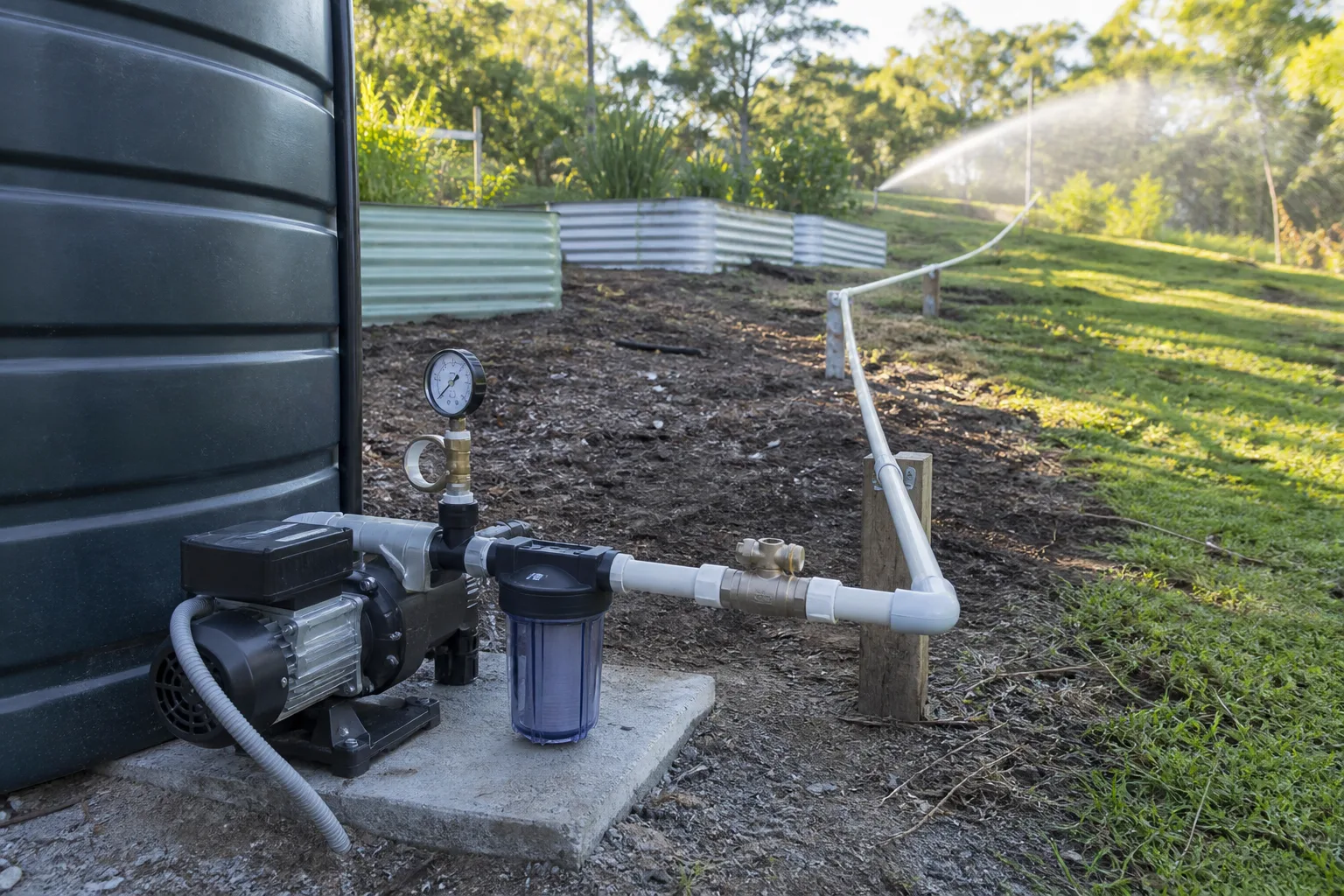
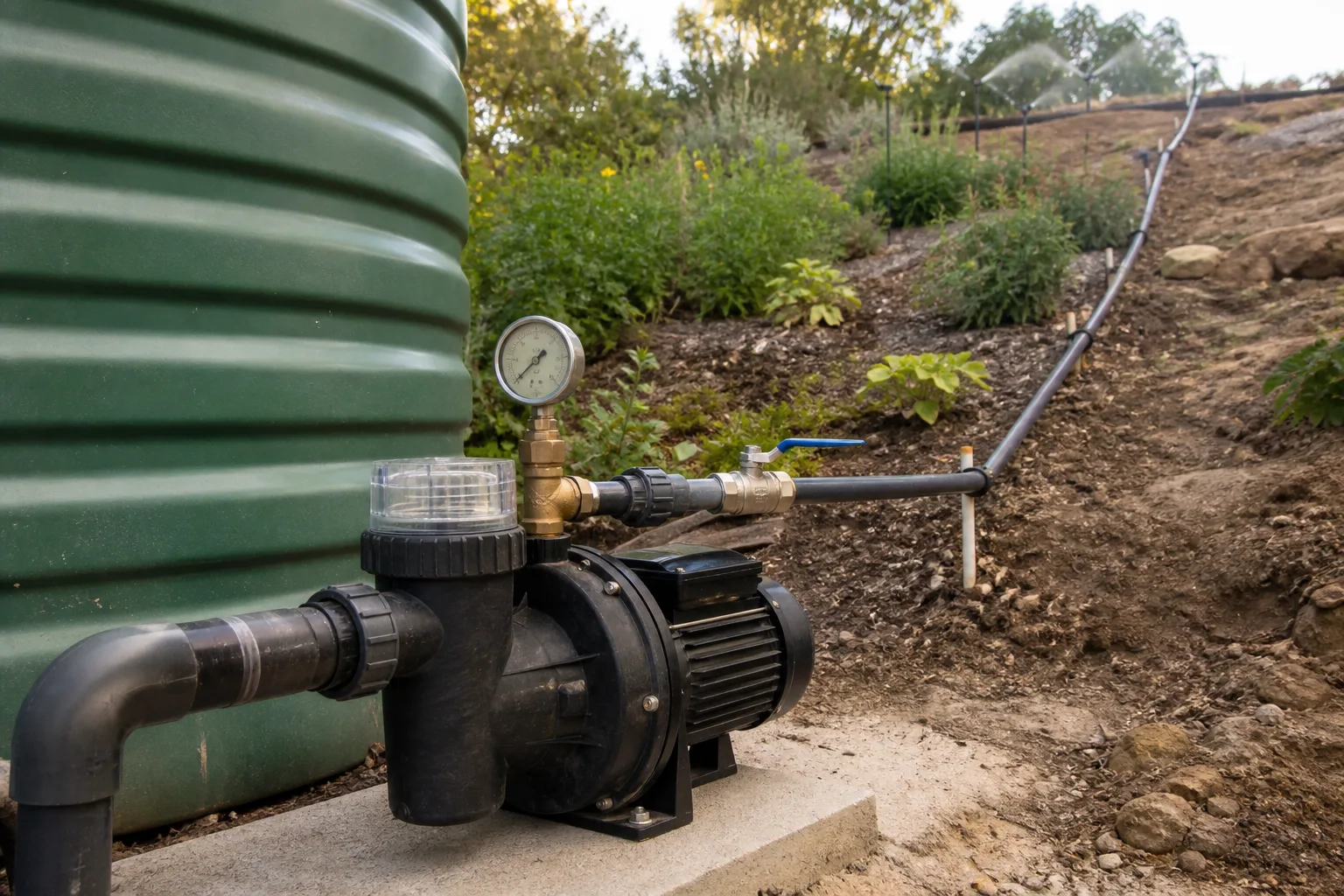
Centrifugal surface pumps work well for many ponds, shallow cisterns, and booster applications, but they must remain primed and have an airtight suction line. NC State Extension notes that an above-cistern pump can present priming problems and suggests considering a submersible pump or consulting a plumber for the specific installation.
Suction lift is not simply another generous number to use. NDSU explains that excessive suction head and insufficient net positive suction head can lead to cavitation, which damages an impeller. Water temperature, altitude, suction pipe diameter, fittings, and flow all affect the margin. Follow the manufacturer’s NPSH and maximum suction-lift guidance rather than relying on the theoretical atmospheric limit.
A submersible pump avoids suction-line priming because the pump is in the water. It still needs suitable intake clearance, dry-run protection, electrical protection, and a way to remove it for service. Pond and rainwater systems may need screening and filtration matched to the emitters. Include the dirty-filter pressure loss in the design rather than using the clean-filter figure alone.
Low-flow drip zones can make a pump cycle
A pump sized for a 12 GPM sprinkler zone may dislike a 1.7 GPM drip zone. If the pump starts, quickly reaches its shutoff pressure, stops, and repeats, the motor and controls see frequent cycles. A pressure tank, variable-speed control, bypass arrangement, or redesigned zone may solve the mismatch, but the correct choice depends on the pump’s minimum flow and control method.
Do not use a pressure regulator as the only fix for an unstable pump. The regulator protects the downstream zone after sufficient inlet pressure exists. It does not guarantee minimum pump flow or prevent the source from running dry. Ask the pump manufacturer or installer how the proposed system behaves at both the largest and smallest zone demands.
Final pump selection checklist
- Largest simultaneous demand in GPM, supported by nozzle or emitter data
- Required outlet pressure converted to feet of head
- Elevation measured from the correct low water level
- Pipe and fitting loss calculated at design GPM
- Filter, check valve, backflow device, and other component losses included
- Manufacturer curve that reaches the design point in a suitable operating range
- Acceptable suction conditions or a submersible arrangement
- Controls for dry run, small demand, and pressure stability
- Compatible voltage, motor protection, plumbing materials, and local code requirements
Compare garden irrigation water pumps on Amazon (paid link), but reject any listing that does not provide a readable pump curve for the required operating point.
Finish the calculation before choosing horsepower. Record the design GPM, TDH, source level, pipe assumptions, and curve revision with the installation paperwork. If storage is part of the system, use the Garden Water Tank Size Calculator to separate daily volume from pump flow.