Disclosure: This page contains affiliate links. As an Amazon Associate, Yard Foundry earns from qualifying purchases.
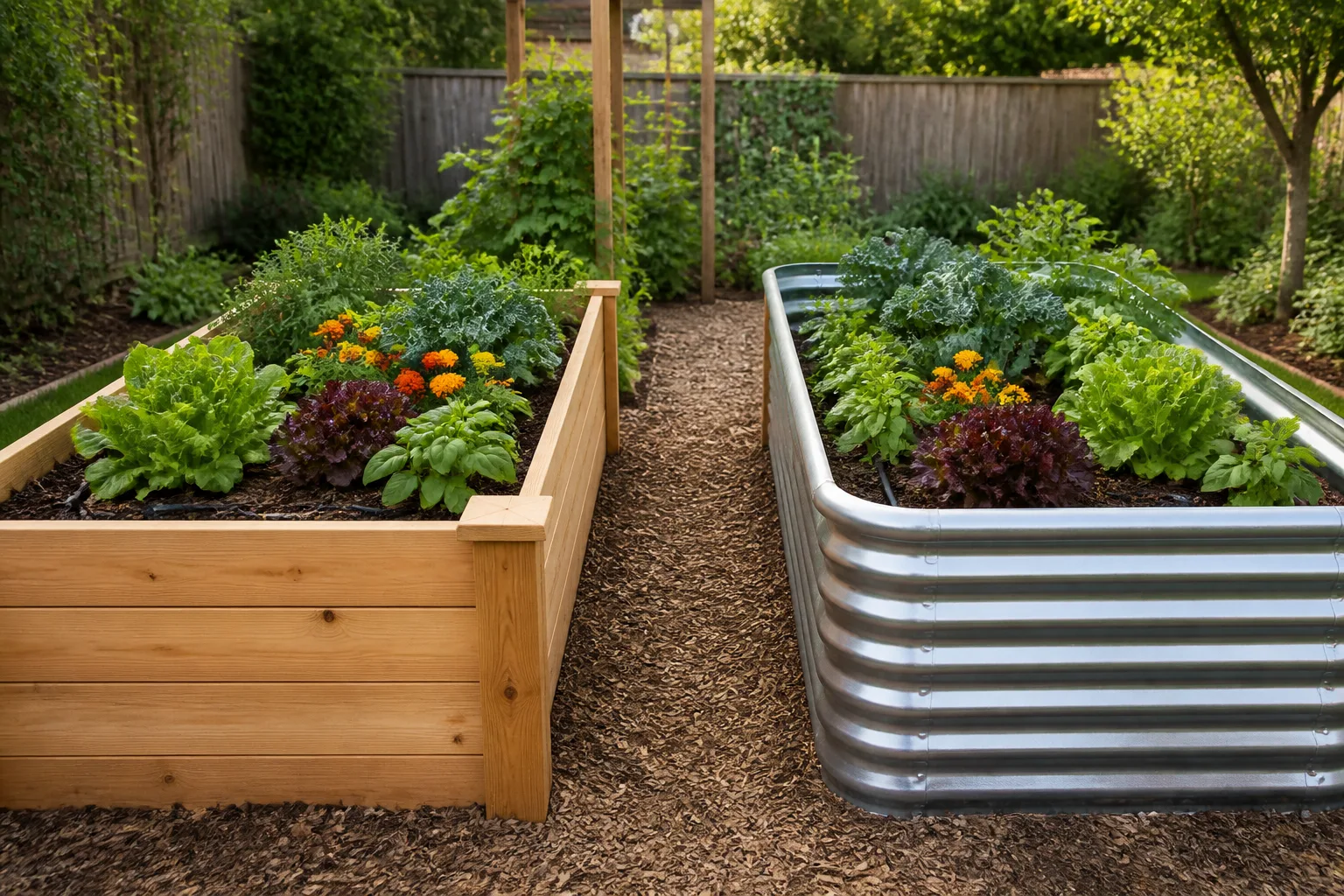
Wood vs metal raised beds is less about which material grows better vegetables and more about how you want to build, maintain, and use the bed. In this comparison, wood means cedar and metal means galvanized steel. Cedar is easy to cut, repair, and customize for trellises or benches. Galvanized steel kits are lighter before filling, resist decay, and offer tall shapes without thick walls. Soil volume, bracing, safe materials, and irrigation usually matter more to the plants than the look of the frame.
This is a research based material comparison, not a physical test of every bed kit. Coatings, lumber grade, panel thickness, hardware, and warranties vary, so verify the exact product before buying.
Wood vs metal raised beds at a glance
| Decision point | Cedar | Galvanized steel |
|---|---|---|
| Customization | Easy to cut, drill, reinforce, and attach accessories | Best when the kit shape already fits the plan |
| Decay or corrosion | Naturally decay resistant, but still biodegradable in wet soil contact | Zinc coating slows corrosion; damage, acidic soil, and constant moisture affect service life |
| Wall thickness | Boards take up some growing width | Thin panels preserve more interior width |
| Structural support | Long boards may bow and need stakes or cross ties | Corrugations and cross braces resist soil pressure; thin unbraced panels may flex |
| Repair | Individual boards and fasteners are usually straightforward to replace | Model specific panels and edge parts may be harder to match later |
| Appearance | Warm wood surface that weathers over time | Clean, uniform shape in coated or bare galvanized finishes |
Neither column is universal. Thick cedar heartwood and thin sapwood do not age alike. A properly coated, well braced steel kit differs from repurposed roofing with exposed cut edges. Compare the actual pieces rather than relying on the material name.
Choose the bed dimensions before the material
A bed should be narrow enough to reach the center without stepping into the soil. Oregon State University Extension suggests a maximum width around 4 feet for many adults and notes that access needs should guide the final size in its raised bed gardening guide. A bed reached from only one side should be narrower.
Height changes cost quickly because every extra inch adds soil volume and more pressure against the walls. It can improve access, but deeper is not automatically better for every crop. Before comparing kits, calculate the actual fill with the raised bed soil calculator. Include settling and leave a modest watering space below the rim.
Length also affects structure. Oregon State advises reinforcing beds longer than 6 feet or taller than about 18 inches so wet soil does not push the sides outward. Cedar beds may use internal stakes, corner posts, or cross ties. Metal kits often rely on corrugations and cross braces. If a long or tall kit has no visible reinforcement, ask how it handles full soil pressure.
How cedar behaves in a raised bed
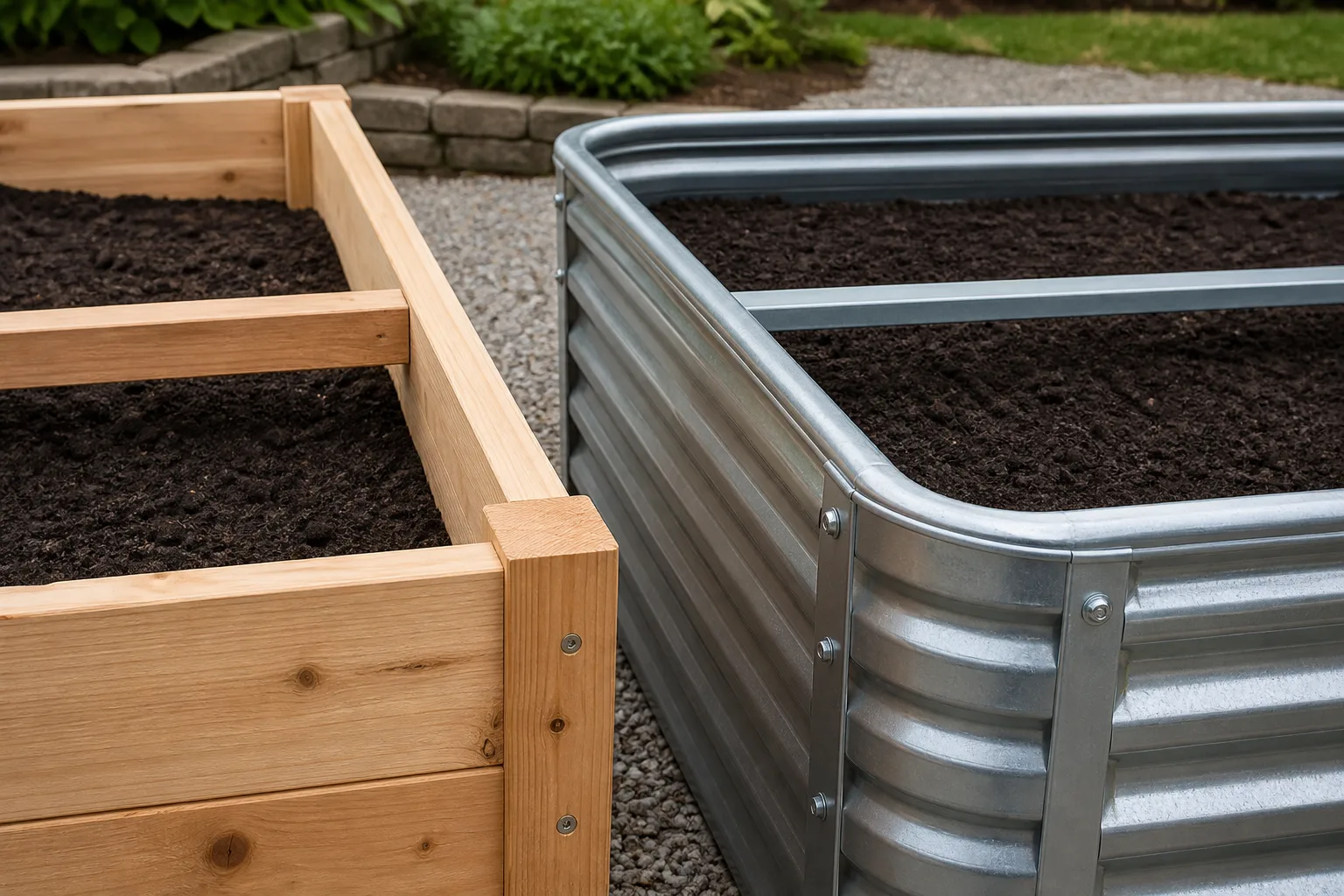
Cedar is popular because it is workable and more decay resistant than many common softwoods. It can be cut to a custom slope, repaired one board at a time, and fitted with a trellis, cap rail, irrigation clamp, or protective mesh without a proprietary accessory system.
The word cedar does not identify grade, species, or heartwood content. Boards with more sapwood may decay sooner. Thin boards can bow. Knots near a fastener can split, and end grain exposed to wet soil absorbs moisture readily. Inspect straightness, thickness, checks, knots, and board composition before treating a premium label as proof of long life.
Use corrosion resistant fasteners compatible with the wood and local exposure. Predrill near board ends where splitting is likely. A top cap can make the edge comfortable to lean on, but it should shed water rather than create a flat joint that stays wet.
Cedar weathers to gray outdoors unless a suitable finish is maintained. That color change is not the same as structural decay. Probe the lower inside edge and end grain during annual cleanup. Softness, crumbling fibers, loose fasteners, and a spreading split matter more than surface color.
How galvanized steel behaves in a raised bed
Galvanized steel has a zinc coating that protects the underlying steel from corrosion. The finished bed can use thin walls while retaining soil, which leaves more growing width inside the same exterior footprint. Prefabricated kits also pack compactly and need no cutting when the stock shape suits the site.
Panel gauge, corrugation depth, edge design, coating, bolts, and braces determine how the bed feels after filling. Virginia Cooperative Extension notes that metal bed durability depends on thickness, corrosion treatment, soil pH, and moisture in its comparison of raised bed materials. Its example also shows why ribs and cross members matter on thinner panels.
Look for a rolled or covered top edge. It makes planting and harvesting more comfortable and reduces exposure to a raw sheet edge. Check whether corner covers and braces are metal or plastic, whether replacement hardware is available, and whether all fastener holes line up before filling.
Scratches and cut edges deserve attention because they expose a different corrosion condition than an intact factory panel. Follow the maker’s repair instructions. Avoid adding copper hardware or an unknown coating without checking material compatibility.
Food garden safety needs documentation, not rumors
Untreated cedar and redwood are described by Oregon State Extension as long lasting choices for edible crop beds. That does not make old painted boards, railroad ties, or unidentified salvaged lumber suitable. Use new material with a known history.
Galvanized steel is widely used for raised beds, but product quality still matters. University of Minnesota Extension explains in its current raised bed materials guidance that zinc is more likely to leave the coating in highly acidic soil below pH 5. The same page cautions that some prefabricated metal beds sold online have contained lead.
The practical response is not to assume every metal bed is unsafe. Buy from a maker that identifies the base metal, galvanizing or coating system, and any painted finish. Ask for current material or compliance documentation when it is not published. Avoid mystery painted metal, badly corroded salvaged panels, and products whose seller cannot answer basic material questions.
Most vegetables grow in soil well above pH 5, but pH should be managed for the crop rather than adjusted to protect a bed. If soil is unusually acidic, test it and follow regional Extension guidance. A side liner may be an option when the manufacturer allows one, but it should not block drainage or trap water against the frame.
Will metal beds overheat the soil?
A steel rim in direct sun can feel much hotter than cedar. That observation does not prove that the full root zone reaches a harmful temperature. Bed color, soil volume, moisture, mulch, wind, exposure, and plant canopy all change the result.
Tall raised beds behave more like containers and can dry faster than in ground soil. University of Minnesota Extension advises that taller beds generally need more frequent watering. That applies to both cedar and metal. A narrow dark metal bed in reflected heat deserves closer monitoring, but so does a small cedar box on pavement.
Use two simple controls: keep the soil surface mulched where appropriate and check moisture below the top inch before watering. If heat is a concern, measure soil temperature at root depth in both the center and near the sunward wall instead of judging by the rim.
Cost is more than the frame
A cedar frame may cost more than a basic metal kit, though local lumber prices and kit shipping can reverse that relationship. The frame is only part of the installed cost. Soil, compost, delivery, irrigation, hardware, site preparation, paths, and pest barriers can exceed the difference between materials.
Use the raised bed cost calculator with current local quotes. Compare the same interior growing area and height. A nominal 4 by 8 foot cedar bed has slightly less interior area because the boards are thicker, while a tall steel kit may need far more soil than a shallow wood frame.
Replacement strategy belongs in the calculation. Cedar lets you replace a board, though disturbing a full bed is still inconvenient. A steel kit may last longer under suitable conditions, but a proprietary damaged panel could be hard to source years later. Save the model number, manual, and spare hardware.
Assembly and site preparation
Building with cedar
Cut the boards on a stable work surface, square the frame, and brace corners before filling. Place long side supports where soil pressure will be greatest. Keep raw end grain out of standing water and make sure irrigation fittings do not spray the same board joint every day.
Cedar is forgiving when the site has a custom shape, but the bed still needs level support. A twisted frame will invite bowing and uneven soil depth. Remove aggressive perennial weeds and loosen the native soil where roots will grow through the open bottom.
Assembling a steel kit
Wear gloves and follow the panel order in the manual. Start every bolt loosely, square the bed, install all braces, then tighten in the recommended sequence. Do not omit a cross brace because the empty frame seems rigid. Wet soil creates a much larger outward load.
Confirm that rolled edges, protective strips, and corner caps are fully seated. Position irrigation before the bed is full if tubing must cross a tall wall. Rubber or approved edge protection keeps tubing from rubbing on metal.
Irrigation is a tie breaker
Cedar makes it easy to fasten tubing clips and a header line. Metal kits may include dedicated ports, or they may require the line to pass over a protected edge. Either material works with drip irrigation when the layout avoids abrasion and delivers even flow.
Calculate the zone flow and a starting runtime with the drip irrigation flow and runtime calculator. Then check actual emitter output and soil moisture. The frame material cannot compensate for an oversized zone, clogged emitters, or a schedule that ignores weather.
Choose cedar when
- You want a custom size, slope, cap rail, bench, or attached trellis.
- Individual board replacement is more appealing than sourcing kit panels.
- The appearance of natural wood fits the garden.
- You can inspect lower edges and accept eventual biological decay.
Choose galvanized steel when
- A stock kit shape fits and quick assembly matters.
- You want thin walls and a tall bed without thick lumber.
- The maker documents the metal, coating, edge treatment, and bracing.
- You prefer corrosion checks over wood finishing and board repairs.
Final checks before ordering
- Compare interior dimensions rather than relying on the outside footprint.
- Calculate soil volume and delivered fill cost.
- Check braces for any bed longer than 6 feet or taller than about 18 inches.
- Confirm the material history and food garden suitability.
- Inspect the top edge, corners, fasteners, and replacement part policy.
- Plan irrigation and tubing protection before filling.
- Keep access width and local sun exposure in the decision.
For current configurations, compare cedar raised garden bed kits on Amazon (paid link) and galvanized steel raised garden beds on Amazon (paid link). Ignore the prettiest product photo until you have checked material thickness, bracing, usable dimensions, and the full installed cost.