Disclosure: This page contains affiliate links. As an Amazon Associate, Yard Foundry earns from qualifying purchases.
This guide compares installation and ownership constraints across product types. Yard Foundry did not test obstacle detection, slope performance, or battery life for every mower.
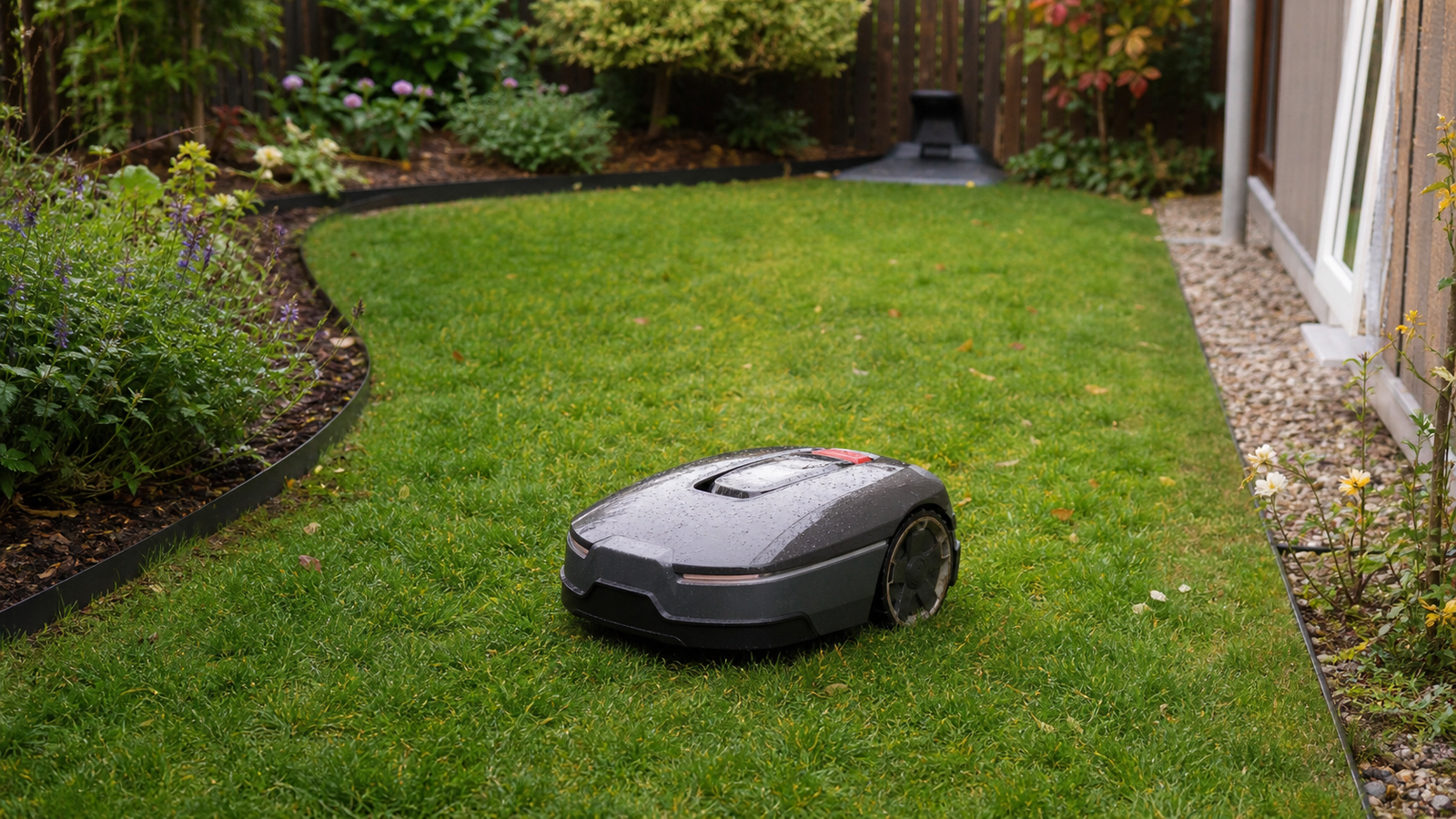
A robotic mower can quietly maintain a lawn several times a week and return to its charger without much attention. That is the ideal. On a difficult property, the same machine may stop at narrow passages, lose traction on damp slopes, or leave you trimming edges by hand.
Good results depend on matching the mower to the yard. Acreage ratings are a starting point, not the full answer.
See current robotic lawn mowers on Amazon
Map the lawn before comparing models
Sketch every mowing area, passage, island bed, tree root, slope, step, and driveway crossing. Measure the narrowest route between zones. A mower that covers enough square footage may still be unsuitable if it can’t pass behind the house.
Separate lawns create another question. Some systems manage multiple zones through a connected route. Others require moving the mower or installing another charging setup.
Boundary wire or wire-free navigation
Traditional robot mowers follow a buried or pegged boundary wire. The setup takes time, but the boundary is predictable and usually works beneath trees or beside tall buildings. Wire damage from edging, aeration, rodents, or construction can be frustrating to trace.
Newer wire-free machines may use satellite positioning, cameras, onboard sensors, local reference stations, or a combination. They are easier to re-map, yet performance depends on clear sky view, firmware, radio conditions, and the quality of obstacle detection.
Check what happens when positioning becomes uncertain. A cautious stop is preferable to wandering into a flower bed or driveway.
Coverage ratings need breathing room
Manufacturers state a maximum lawn area under certain conditions. Complex shapes, steep sections, dense grass, frequent rain, and long travel routes reduce practical capacity. Buying close to the maximum leaves little reserve.
A mower with comfortable capacity can finish its cycle sooner and recover after a few missed wet days. Battery replacement cost matters more than advertised runtime after several years.
Do not transfer a slope rating or boundary clearance from one mower to another. These limits vary by model and may differ between the middle of the lawn and its outer edge. Husqvarna’s slope-installation guidance is one manufacturer example; check the current manual for the exact mower being considered.
Slope performance
Slope ratings may be expressed as percent or degrees, which are not interchangeable. Measure the actual steepest section and check whether the rating applies to the middle of the lawn or the boundary edge. Turning across a slope is often harder than climbing straight up it.
Wet clay, exposed roots, and loose soil reduce traction. A machine that technically handles the angle may still mark the turf near repeated turning points.
Cut quality and edge work
Robot mowers trim small amounts frequently, leaving fine clippings behind. They are maintenance machines, not brush cutters. Overgrown grass should be cut conventionally before the robot starts its schedule.
Blade position affects edge cutting. Many mowers leave a strip beside walls and raised borders because the deck sits inside the wheel track. A level mowing strip around beds can reduce hand trimming.
Safety and pets
Look for lift, tilt, collision, and blade-stop systems, then read the manual’s rules for children and animals. Obstacle cameras don’t turn moving blades into a pet-safe toy. Schedule mowing when the lawn is clear, particularly at night when hedgehogs and other small wildlife may be active.
PIN protection, alarms, GPS tracking, and cellular connections may deter theft. Check whether any feature requires a paid subscription.
Connectivity without surprises
An app should make schedules and zones easier, but the mower still needs to function when home internet drops. Review which controls exist on the machine. Check Wi-Fi range at the charging station and whether cellular service is included or billed later.
Firmware support is part of ownership. A cheaper model with uncertain app support may age faster than the cutting hardware.
Charging station placement
The station needs power, drainage, and the clear approach specified by the manufacturer. Long outdoor extension cords are not a permanent electrical plan. Use a properly installed weather-protected outlet.
Place the station away from irrigation spray and low spots. Some owners build a small roof, but any cover must preserve ventilation, signal reception, and the required approach path.
Ongoing costs
- Replacement blades and screws
- Battery replacement after years of cycling
- Boundary wire repairs or positioning accessories
- Winter storage and cleaning
- Cellular or advanced software subscriptions
- Dealer service and shipping for repair
How to compare robotic lawn mowers
We would choose based on the hardest part of the property, not the average section. Confirm the narrowest passage, steepest slope, positioning conditions, edge layout, local repair route, and subscription terms. Then buy enough capacity to leave a margin.
A robotic mower is easiest to justify on a lawn that already has clean borders and predictable access. It won’t fix drainage, ruts, or a layout filled with temporary obstacles.